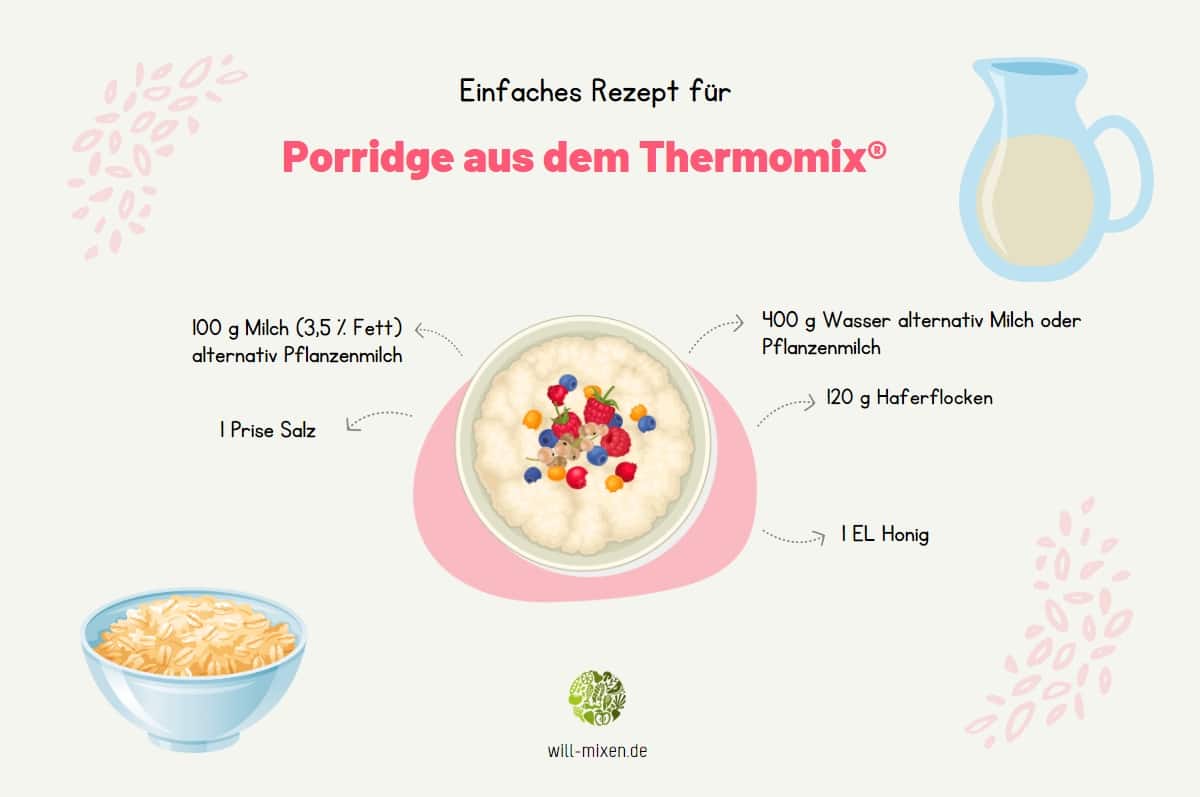
Porridge made in the Thermomix® is one of those breakfasts where we really cannot go wrong. 8 minutes in reverse direction at 100°C is no accident: it is the precise threshold for creamy porridge without scorching. Any less and the starch stays raw; any more and it turns to mush.
We have been making porridge several times a week for years. By now we know the difference between flat and full-flavoured, between thin and creamy, between burnt and perfect. The formula is simpler than most people think: 400 g water, 100 g milk, 120 g oats, a pinch of salt, 8 minutes at 100°C on speed 2 (reverse direction). Done.
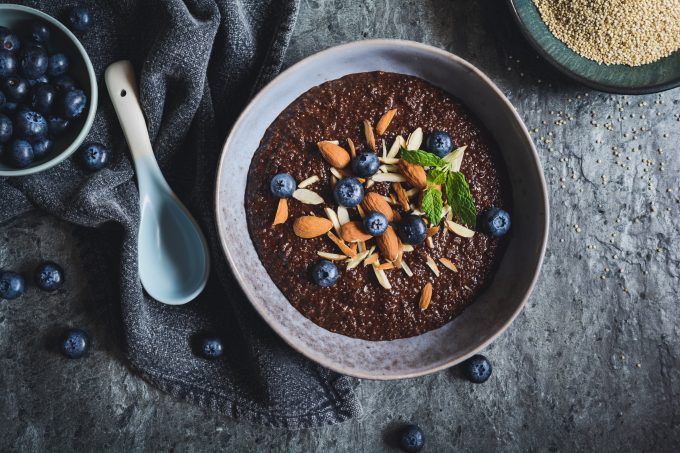
Millet Chocolate Porridge with the Thermomix®

Ingredients 0 / 6 ✓
- 80 g millet
- 1 pinch salt
- 450 g almond milk
- 2 tbsp honey
- 40 g dark chocolate
- 1 tbsp cocoa powder (unsweetened)
Instructions 0 / 3
-
1
Millet: place in a sieve and rinse thoroughly.
-
2
Add all ingredients except the chocolate and cocoa to the mixing bowl. Place the simmering basket on the mixing bowl lid as a splash guard and cook for 17 min / 90°C / reverse direction / speed 1.
-
3
Add the chocolate and cocoa and cook for a further 3 min / 90°C / gentle stir setting.
Nutrition per serving
8 minutes, 100°C, reverse direction
These three settings are not a suggestion; they are physics. Oat starch gelatinises above 80 to 85°C, and full gelatinisation happens at 95 to 100°C (McGee, “On Food and Cooking”, 2004). Below that threshold the porridge tastes floury; above it turns to mush. 100°C is the sweet spot.
Reverse direction is the reason porridge does not scorch in the Thermomix®. It rotates against the blade direction and stops thick mixtures from being chopped or sticking to the base (Vorwerk TM manual, all models: TM7, TM6, TM5, TM31). Without reverse direction you would have to stir constantly. With reverse direction the Thermomix® does it on its own.
The 8 minutes are the point at which the oats lose their structure and the starch binds. After 6 minutes the flakes are still grainy; after 10 minutes the porridge becomes too thick. 8 minutes is the balance between creaminess and bite. After cooking we leave the porridge to rest for 1 minute in the mixing bowl: the residual heat lets the starch swell a little more.
400 g water, 100 g milk
The 4:1 ratio of water to milk is the reason our porridge turns out creamy without sitting heavily in the stomach. Water alone makes porridge thin and flat in flavour. Milk alone makes it too heavy and rich. 400 g water provides the base liquid; 100 g milk (3.5% fat) gives the creaminess.
Instead of cow’s milk you can use almond milk, soya milk, or oat milk. The ratio stays the same: 400 g plant milk, 100 g water. Or 500 g plant milk without any water if you prefer it creamier. But the original recipe with 400 g water and 100 g milk is the balance we recommend after hundreds of portions.
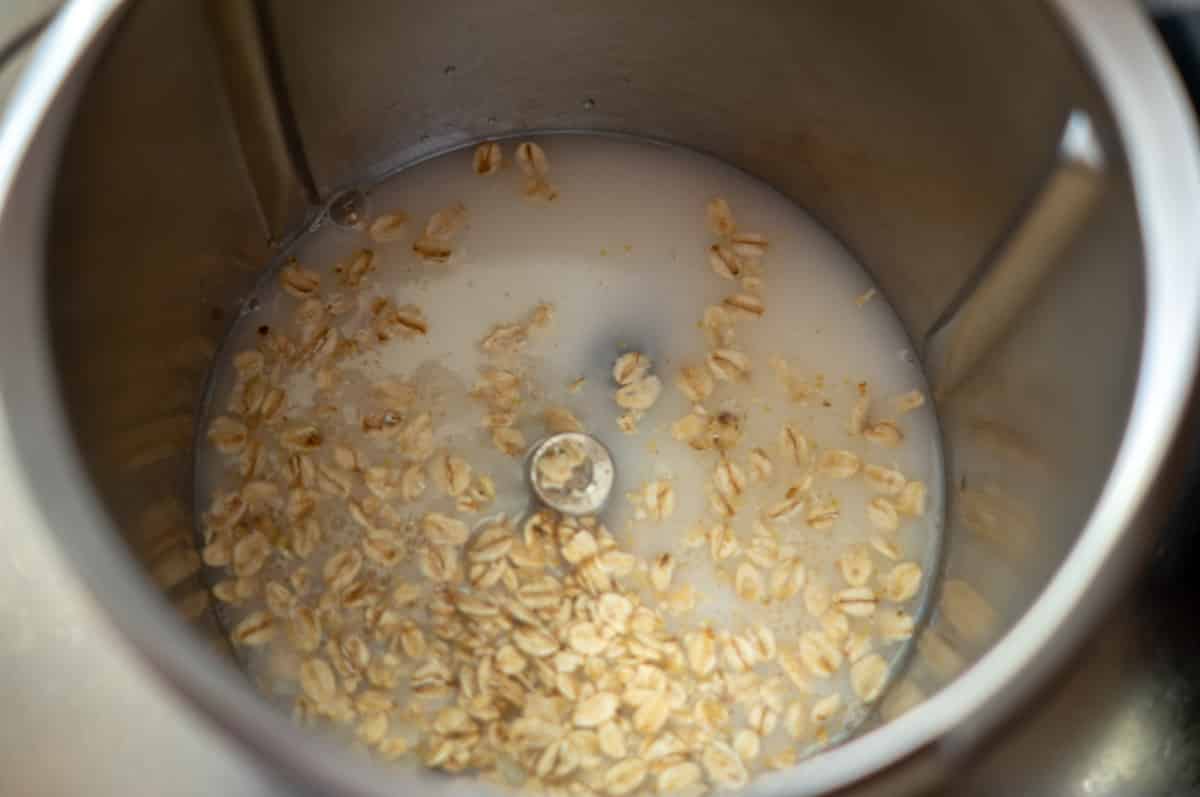
A pinch of salt lifts the sweetness
The pinch of salt in the recipe is not a mistake. Salt enhances sweetness because sodium ions suppress bitter receptors and bring out sweet aromas (Breslin & Beauchamp, “Salt enhances flavour”, Nature 1997). Without salt the porridge tastes flat; with salt the honey becomes rounder and the oats gain more depth.
It works exactly like with chocolate: a pinch of salt in dark chocolate lifts the sweetness without making the chocolate taste salty. With porridge it is the same. You do not taste the salt as salt; you simply notice that the sweetness becomes more intense.
Millet instead of oats: gluten-free and nutty
If you need gluten-free porridge or simply want a different texture, try our millet chocolate porridge. Millet contains no gluten (DZG Deutsche Zöliakie-Gesellschaft, 2023) and has a nuttier flavour than oats. The preparation is different: 80 g millet, 450 g almond milk, 17 minutes at 90°C on reverse direction speed 1, then 3 minutes on the gentle stir setting with 40 g dark chocolate and 1 tbsp cocoa powder.
The difference from oats: millet only needs 90°C because the grains are more delicate and absorb liquid faster. At 100°C millet would become too soft. Oats need the full 100°C to break down the starch fully. That is why the two recipes call for different temperatures.
For the millet version we place the simmering basket on the mixing bowl lid as a splash guard. Millet foams more than oats and will splatter out of the lid without protection. This does not happen with oat porridge because the oats bind the liquid straight away.
Cook in the evening, spoon in the morning
Porridge keeps for 3 days in the fridge. You can cook it in the evening, fill it into individual containers, and eat it straight from the fridge in the morning. When cold, the porridge actually becomes even creamier as the starch continues to bind. If you prefer it warm, 1 minute in the microwave at 600 W is enough.
We fill the porridge into sealable bowls and store them in the fridge. In the morning we add the toppings: fresh berries, banana slices, nuts, honey. This saves 10 minutes in the morning while still giving you a proper, nourishing breakfast.
Jumbo oats or rolled oats?
Our recipe uses standard rolled oats (medium). You can also use jumbo oats or quick oats. Jumbo oats keep more bite and keep you fuller for longer. Quick oats turn creamier and softer. Do not use instant oats: they are too fine and turn to mush.
If you use jumbo oats, extend the cooking time by 1 to 2 minutes. Quick oats need no adjustment; the 8 minutes are sufficient. The ratio of liquid to oats stays the same: 500 g liquid to 120 g oats. More oats makes the porridge too thick; fewer makes it too thin.
Oats provide 5 g of beta-glucan per serving
Oats contain beta-glucan, a soluble fibre that lowers cholesterol. 4 g of beta-glucan per 100 g of oats is the reason the EFSA (European Food Safety Authority, Health Claim 2010) recognises oats as cholesterol-lowering. In our recipe with 120 g oats there are approximately 5 g of beta-glucan per serving.
This makes porridge one of the few breakfasts that not only fills you up but also improves blood fat levels. Plus: beta-glucan raises blood sugar more slowly than white bread or cornflakes. You stay fuller for longer and avoid a hunger crash at 11 o’clock.
All Thermomix® models work identically
This recipe works on all four Thermomix® models: TM7 (from 2024), TM6 (from 2019), TM5 (from 2014) and TM31 (from 2004). The settings are identical: 8 minutes, 100°C, speed 2 (reverse direction). You do not need Cookidoo mode, Guided Cooking, or a Wi-Fi connection. Simply add the ingredients, choose the setting, and you are done.
The TM7 has a larger display and faster sensors, but the cooking result is the same on all models. The reverse direction function works mechanically identically, as does the temperature control. Porridge is one of those recipes where the differences between models make no difference at all.
Cook honey in or add afterwards?
Our recipe includes the honey during cooking rather than adding it as a topping. This makes the sweetness more even throughout. If you add honey afterwards, you get sweet spots and bland spots. When cooked in, the sweetness distributes evenly through the whole mixture.
The objection to cooking honey is that heat destroys the enzymes in it. That is true. But with 1 tbsp of honey across 2 servings the point is sweetness, not enzymes. If you eat raw honey for its enzymes, eat it by the spoonful, not in porridge. In porridge, honey is a sweetener, not an enzyme source.
What we do differently from other Thermomix® porridge recipes
Most Thermomix® porridge recipes use 50 g oats with 200 g pure milk, cooked for 5 minutes at 100°C. That works, but we find it too rich and under-cooked. We use 120 g oats with 400 g water plus 100 g whole milk and cook for 8 minutes. The longer cooking time fully breaks down the oat starch; the water and milk split makes the porridge creamy rather than heavy. Honey goes into the pot with us rather than on top of the finished porridge because the sweetness distributes evenly that way. We add cinnamon after cooking to keep the aroma fresh, and brown sugar as a topping creates a caramel crunch that pure milk recipes cannot deliver.
Goes well with: Nuts.
More Thermomix® breakfast recipes: Overnight Oats, Rice Pudding, Almond Milk, Sunday Breakfast.
More on the topic: Operating tips and basics for every mixing bowl can be found in the Thermomix® hub. Or browse the complete guides overview.