Béarnaise sauce has a narrow window: between 65 and 72°C it emulsifies, above about 73°C the egg yolk starts to scramble, and below 60°C the emulsion is unstable and falls apart the moment it sits. That is exactly the window we hold in the Thermomix® at 70°C on speed 4, and that is the only reason this sauce comes out reliably for us after several hundred attempts.
For us, Béarnaise always comes to the table when there is a good cut of beef: boiled silverside, fillet, roast beef. We have tried various methods over the years, with a stick blender in a bain-marie, with a whisk over a saucepan, and every time the success rate was around two out of three. With the Thermomix® and that one discipline (70°C, no higher) the ratio has been four out of four for years.
Béarnaise Sauce with the Thermomix® (Hollandaise Variation)

Ingredients 0 / 6 ✓
- 1 onion small
- 30 g herb vinegar
- 10 black peppercorns
- 1 tsp dried tarragon
- 1/2 tsp dried chervil
- 1 basic Hollandaise sauce recipe
Instructions 0 / 4
-
1
Chop the onion.
Peel the onion, halve it and place it in the mixing bowl. Chop for 5 seconds / speed 5 and push down with the spatula.
-
2
Reduce.
Add the vinegar, pepper, tarragon and chervil to the mixing bowl and reduce for 5 minutes / Varoma / reverse direction / speed 1 without the measuring cup in the mixing bowl lid.
-
3
Rinse the mixing bowl.
Set the reduction aside and rinse the mixing bowl.
-
4
Mix the sauce.
Prepare the basic Hollandaise sauce recipe, add the reduction to the mixing bowl and mix for 5 seconds / reverse direction / speed 3, then serve immediately.
Tip: Béarnaise sauce goes very well with boiled beef or a tender beef steak.
It is also a great match for asparagus or vegetables.
Video
Nutrition per serving
Why 70°C is the right number
Egg yolk starts to bind from 65°C because the proteins in the yolk open up and hold on to the butter emulsion. From 73 to 75°C, however, those very same proteins coagulate, and the silky sauce turns into a grainy paste with a puddle of butter beside it. The corridor is therefore about 8°C wide, and the Thermomix® keeps us reliably within that window with its heating control, as long as we set 70°C and choose speed 4. Speed 4 creates movement without introducing air. Foam would otherwise collapse on standing and make the sauce look watery.
Anyone with a TM31 should bear this in mind: 70°C is easy to hit on the TM31 in 10-degree increments, while on the TM5 and TM6 it is precise to the degree. On the TM31 it is better to choose 70°C rather than 80°C, because there is no safety buffer at the top end.
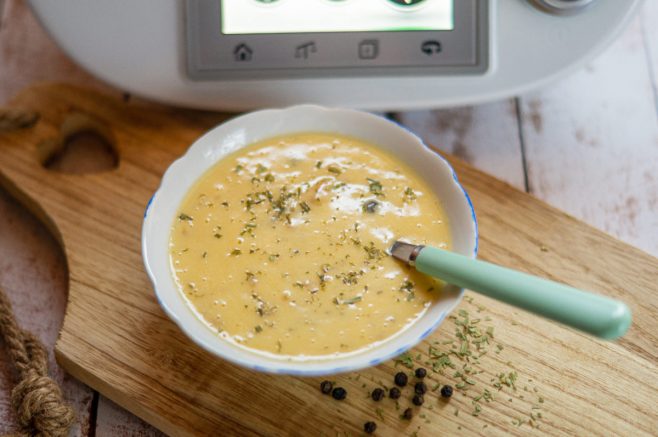
The tarragon reduction is the real flavour carrier
A Béarnaise is at its core a Hollandaise with a reduction of vinegar, tarragon, chervil, onion and black peppercorns. This reduction determines the flavour of the sauce, not the butter and not the egg yolk. If we cook the reduction for too short a time, the sauce tastes flat and sharply acidic. If we reduce it for too long, it turns bitter, because the peppercorns and the tarragon lose their volatile oils and only the bitter compounds remain.
Our ratio: 30 g herb vinegar (or tarragon vinegar if we have some), 10 black peppercorns, 1 tsp dried tarragon, 1/2 tsp dried chervil and a small onion chopped in the mixing bowl beforehand. Reduce it all for 5 minutes at Varoma temperature on speed 1 in reverse direction, without the measuring cup in the lid, so the steam can escape. Reverse direction matters here, because it stops the peppercorns from being crushed and drawing their heat into the reduction.
Fresh tarragon works well too and is our first choice in summer. We use 2 tbsp of finely chopped fresh tarragon in place of the dried. Fresh chervil is quite different in taste from dried, more anise-like, and we prefer it to the dried version. If you cannot find it, the sauce can be made with tarragon alone. Strictly speaking it is then called Sauce Béarnaise simple, and no one at the table will notice the difference.
Melt the butter gently, do not overheat it
This is the point at which most Béarnaisen fail. Melted butter and gently clarified butter are not the same thing, even though the terms are often used interchangeably. Melted butter means liquid, often hot and foamy, with some of the milk solids already separated. Gently melted butter is only just warm enough to become liquid, around 35 to 40°C, and still slightly cloudy from the buttermilk.
If we pour butter that is too hot into the egg yolk, the yolk coagulates immediately at the point of contact and the emulsion gets small, hard specks that cannot be stirred away. If we use butter that is too cold, there is not enough energy, and the yolk does not bind. The sauce then separates again after 5 minutes of standing. Our solution: melt the butter in a bain-marie or in the mixing bowl at 50°C on speed 1 for about 3 minutes, then add it to the egg yolk and reduction mix.
If the sauce curdles anyway
A Béarnaise that has become too warm is not lost. We put a tablespoon of cold water or an extra egg yolk in a clean bowl and drizzle the curdled sauce in slowly while whisking. This works in most cases, especially if the sauce has only just crossed the line and looks only slightly grainy. If the sauce is solidly scrambled with a clear puddle of butter, the only option is to use it as a base for a pan sauce and start again.
Another classic mistake for us: too much reduction added at once. If you squeeze out the whole reduction strainer in one go, you end up with an acidic sauce that tastes of pepper rather than herbs. We always add the reduction in two stages, first half, taste, then adjust.
What Béarnaise is not
Béarnaise is not a sauce you can keep warm. Above 75°C it curdles, below 50°C the butter solidifies again and the emulsion loses its creaminess. In plain terms: we make it last, when the steak is almost out of the pan. It can sit on a saucière kept at 60°C for at most 20 minutes before it turns dull. The idea of preparing it for a family meal and serving it an hour later does not work reliably. For that, the classic Hollandaise is more robust, or a dark pan sauce is a better option.
What we serve it with
The classic pairing is fillet of beef or boiled silverside, both cuts with a delicate flavour of their own that is complemented rather than overwhelmed by the tarragon acidity. With silverside and Béarnaise as an alternative to the classic horseradish and apple cream, we have had guests who have asked for nothing else ever since. It also goes well with asparagus, though with a little less pepper in the reduction, otherwise the heat overshadows the subtle asparagus flavour.
Another combination that works well for us: Béarnaise with grilled rack of lamb, especially if we replace the tarragon with a mix of tarragon and rosemary. With fish (salmon, halibut) the classic Hollandaise is usually the better partner, because the tarragon note can quickly become overpowering. A tried and tested combination for relaxed evenings is the sauce with sous-vide beef steak and roasted baby potatoes.
The leftovers
Leftover Béarnaise keeps covered in the fridge for two days, but it will set firm. Direct reheating does not work. We take the cold sauce and melt it portion by portion in a warm saucepan over the lowest heat, stirring constantly, or we use it as a spread on toast, which is our favourite way. A tablespoon of Béarnaise on toasted sourdough with a fried egg on top makes a very good Sunday breakfast.
Goes well with: asparagus and salmon fillet.
We do not recommend freezing. On thawing, the emulsion separates and the egg yolk develops a sandy texture that cannot be stirred back together.
If you are looking for more sauces made with the Thermomix®: classic Hollandaise sauce, dark pan sauce and mushroom cream sauce.