Real Bruschetta does not happen in the mixing bowl. It happens the moment we rub a raw garlic clove across warm, toasted Ciabatta. The warm bread draws out the essential oils from the garlic and lays down a layer of flavour that no amount of chopped garlic in the topping can replicate. Skip that step and you have topped bread, not Bruschetta.
We have been making Bruschetta with the Thermomix® regularly as a starter since our first trip to Italy, whenever we have guests over. In central and southern Italy, the dish came out of necessity: stale bread, a handful of tomatoes, garlic from the garden, good oil. That simplicity is exactly what makes it so demanding. Every ingredient has to be right because none of the others can cover for a weak one. With the Thermomix®, the work shifts entirely to preparing the topping, and the tricky part is not the blending but knowing when to stop.
Bruschetta with the Thermomix®

Ingredients 0 / 8 ✓
- 250 g cherry tomatoes
- 2 garlic cloves
- 1 onion
- 1 sprig oregano
- 1/2 tsp salt
- 3 tbsp olive oil
- 1 bunch basil
- 250 g Ciabatta or baguette
Instructions 0 / 11
-
1
Prepare the tomatoes.
Wash the tomatoes and halve them.
-
2
Chop the garlic.
Peel 1 garlic clove, place in the mixing bowl and chop for 3 sec / speed 7, then scrape down with the spatula.
-
3
Chop the onion.
Peel the onion, quarter it, place in the mixing bowl, chop for 4 sec / speed 6 and scrape down with the spatula.
-
4
Chop the oregano.
Wash the oregano, pull off the leaves, place in the mixing bowl, chop for 3 sec / speed 5 and scrape down with the spatula.
-
5
Steam the ingredients.
Add the salt and 2 tbsp olive oil and steam for 2 min / Varoma / speed 1.
-
6
Add the basil.
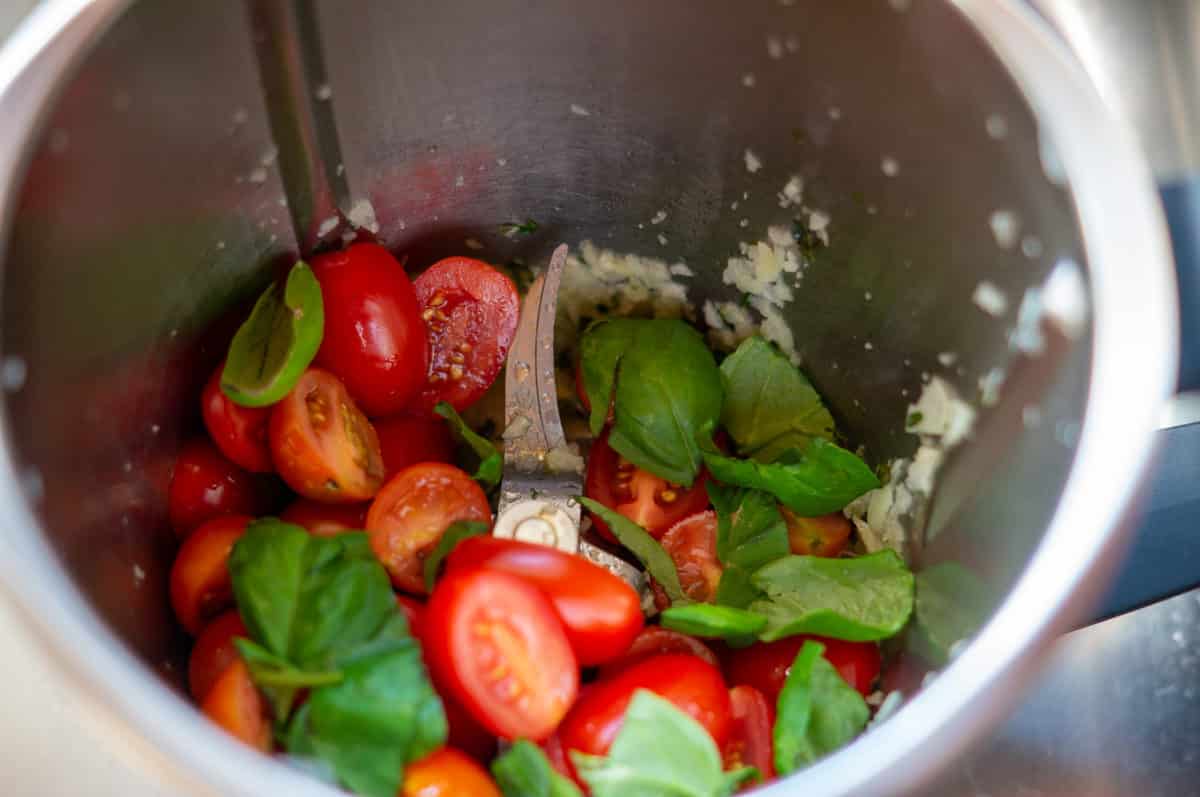
Wash and dry the basil, pull off the leaves, add to the mixing bowl together with the tomatoes and mix for 3 sec / speed 5.
-
7
Leave the mixture to rest.
Transfer the mixture to a sieve set over a bowl and leave, covered, in the fridge for at least 1 hour.
-
8
Preheat the oven.
Preheat the oven to 180°C fan.
-
9
Toast the bread.
Slice the baguette or Ciabatta and bake on the middle shelf of the oven for approx. 8 minutes.
-
10
Rub the bread with garlic.
Peel the second garlic clove and rub the baguette or Ciabatta slices with the cut side.
-
11
Top and serve.
Brush the slices with olive oil using a pastry brush, spoon over the drained Bruschetta topping and serve immediately.
Tip: Love cheese? Refine the classic recipe with Mozzarella. For a more robust, tangy flavour, try goat's cheese instead.
Video
Nutrition per serving
Why the garlic is used twice
The recipe card deliberately uses two garlic cloves, and each one has a different job. The first clove goes into the mixing bowl, is finely chopped for 3 seconds at speed 7 and then distributes itself evenly through the topping. This garlic note is mild because it is softened by the brief steaming at Varoma and by the olive oil. The second clove stays raw and is rubbed cut-side down across the warm bread. That is the real flavour carrier. Raw garlic on warm bread releases sharp sulphur compounds that the olive oil absorbs and carries through to the tomatoes. Put both cloves into the topping and you lose that top layer of flavour entirely.
Cherry tomatoes or pomodorini, nothing watery
We use 250 g cherry tomatoes because they are more flavourful and less watery than large beef tomatoes. In Italy, Bruschetta is classically made with pomodorini, small, fleshy San Marzano or Datterino tomatoes. If you can find them at the supermarket, use them. Vine tomatoes work too, but they release more juice. With large beef tomatoes, extend the draining time from one hour to an hour and a half, otherwise liquid will run out of the bread later. A cold tomato straight from the fridge always tastes flat, so we take them out 30 minutes before using them.
Also worth a look: Flower Butter with the Thermomix®.
Where Bruschetta goes watery
The most common mistake is leaving the tomatoes in the mixing bowl too long. Three seconds at speed 5 is enough. More than that turns the tomatoes to mush, and mush soaks straight through the bread. We deliberately run the Thermomix® at the lower speed 5 rather than 7 or 8 because the tomatoes should keep some texture. Chunky, not pureed. The second factor is the sieve. After blending, the mixture goes into a fine sieve over a bowl, covered, in the fridge for at least one hour. Skip that and you end up with a puddle on the plate. If you save the liquid that drains off, you have a tomato essence that works beautifully later as a salad dressing base or as a flavour base for a tomato soup made with the Thermomix®.
Olive oil carries the flavours
The oil here is not a topping, it is a carrier. 2 tbsp olive oil go into the mixing bowl when steaming at Varoma setting, and the rest is brushed onto the warm, garlic-rubbed bread at the very end. The bread soaks up the oil, and the oil binds the garlic and tomato flavour together. We use an extra virgin olive oil with a strong character. With a mild oil, the flavour disappears completely between the tomatoes and the bread. If you have a good bottle in the cupboard, save it for exactly these moments when it is served raw and uncooked rather than cooked off in a frying pan.
When the bread goes soft
Bruschetta is a dish you serve straight away. Once topped, the slices hold for 10 to 15 minutes at most, after which the residual moisture from the tomatoes soaks into the bread and the crunch is gone. We make the topping earlier in the day, leave it to drain in the sieve, and only top the slices when the guests are seated at the table. The Ciabatta goes into the oven at 180°C fan for about 8 minutes on the middle shelf. If you are baking the bread fresh, let it dry out slightly beforehand, otherwise it will turn chewy in the oven rather than crisp. Any leftover topping keeps in the fridge for two days and tastes more intense the next day because the garlic and basil have had time to infuse into the oil.
Mozzarella, goat’s cheese or plain
Classic Bruschetta al pomodoro is vegan and needs no cheese. If you want something richer, add a few pieces of buffalo Mozzarella on top before serving, around 50 g per person. Goat’s cheese brings a tangy note that contrasts well with the tomatoes. Freshly grated Parmesan works too, and we have a separate guide on how to grate cheese in the Thermomix®. If Bruschetta is to be the centrepiece of an Italian starter plate, we pair it with Basil Pesto from the Thermomix® on a second slice of bread and a cold Caprese with tomato, Mozzarella and basil. Three components, all from the same Thermomix®, all done in under 30 minutes of active time.
Fresh herbs, no dried spice blends
Fresh oregano and fresh basil cannot be swapped for dried herbs. Dried oregano has a bitter edge that becomes unpleasant in the warm topping. Fresh basil, on the other hand, loses colour quickly when blended, so it only goes into the mixing bowl in the final three seconds together with the tomatoes. A bunch of basil sounds like a lot, but in the finished topping you can barely taste it if you use less. For oregano, one sprig is enough. More than that overpowers the tomato flavour.
With this method we have put together well over 50 Italian starter evenings over the years, and Bruschetta was always the first thing to disappear. The order matters: chop garlic and onion separately, add oregano, steam, add tomatoes and basil at the end for a quick blend, drain, toast the bread, rub with the raw garlic clove, brush with oil, top and serve immediately. Every step is there for a reason, and none of them are optional.