Carrot and broccoli salad with the Thermomix® is our answer to the question of what to put on the table quickly when hunger has already struck and nobody fancies a limp, watery coleslaw. Ten minutes is all it takes, because we skip the classic salting and resting stage entirely and instead let the acidity from the yoghurt, apple cider vinegar, and orange juice do the work straight away.
This recipe has been in our collection since 2015 and we make it several times a month as a side with pan-fried meat, as a packed lunch for school, or simply as a light afternoon snack. The combination of 300 g carrots, 200 g broccoli florets, a pepper, and an apple gives four generous servings that we can also prepare the evening before and pack into meal-prep containers.
Carrot and Broccoli Salad with the Thermomix®

Ingredients 0 / 11 ✓
- 300 g carrots
- 30 g peanuts roasted, salted
- 200 g broccoli florets
- 1 apple
- 1 red pepper
- 50 g natural yoghurt (3.5% fat)
- 20 g olive oil
- 20 g orange juice
- 10 g apple cider vinegar
- 1/2 tsp salt
- 1/4 tsp pepper
Instructions 0 / 3
-
1
Peel the carrots.
Peel the carrots, cut into pieces, and place them in the mixing bowl together with the peanuts.
-
2
Prepare the vegetables.
Wash and trim the broccoli. Wash the apple and pepper, quarter them, and remove the core and seeds.
-
3
Chop the vegetables.
Add the remaining ingredients to the mixing bowl and chop using the spatula for 4 sec / speed 4.
Tip: Feel free to swap the peanuts for other nuts such as walnuts or cashews.
Video
Nutrition per serving
Why we chop the vegetables raw in the mixing bowl
In most classic carrot and broccoli salads, the broccoli is briefly blanched, refreshed in cold water, and then mixed with the carrots. That works, but it takes an extra 15 minutes and the vegetables lose a noticeable amount of crunch. We take a different approach: both vegetables go into the mixing bowl raw, are chopped at a controlled medium speed, and keep their bite as a result.
The key step: carrots and peanuts first, 4 sec / speed 5. The carrots are reduced to fine matchsticks without turning to mush. If you go to speed 8 or 9, you end up with carrot juice and carrot puree rather than salad. At 4 sec / speed 5 the blade hits the carrots just the right number of times to grate rather than pulverise them. The peanuts are coarsely chopped in the same step and their roasted aroma really develops once they are mixed with the moist vegetables.
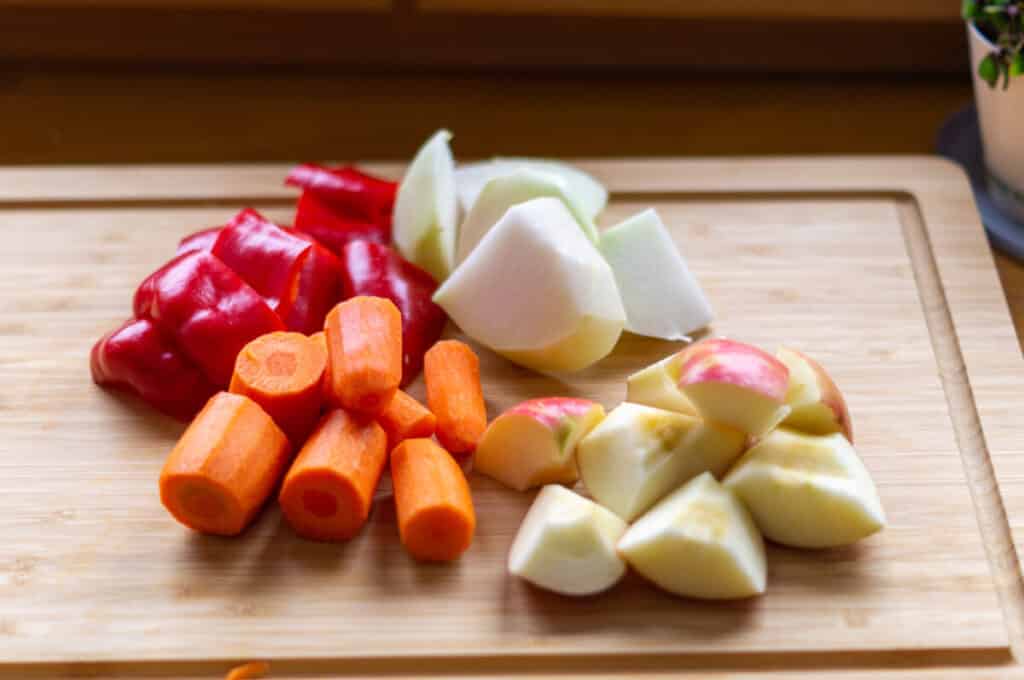
Immediately after, the broccoli florets, apple, and pepper go in, and everything is chopped again for 4 sec / speed 5. We use the spatula through the filler opening to push the pieces down. Without the spatula, too much stays stuck around the sides and gets chopped unevenly. The broccoli is cut into fine crumbs, almost like couscous, and that is precisely the point: at this size it absorbs the dressing straight away, with no watery broccoli liquid pooling at the bottom of the bowl.
Why we skip the salting stage
With carrot or coleslaw-style salads it is common to mix the grated vegetables with salt and leave them for 30 minutes until liquid is released. The liquid is then poured away and the salad becomes more compact. With this recipe we do not need to do that, and that is exactly why ten minutes is enough.
The acid combination in the dressing does the work that salt would otherwise do. 50 g natural yoghurt with 3.5% fat, 20 g olive oil, 20 g orange juice, and 10 g apple cider vinegar make a dressing that gently opens the cell walls of the carrots and pepper without drawing out too much moisture. The yoghurt binds the olive oil directly, and the two acids (acetic acid plus the fruit acid from the orange juice) penetrate the vegetable structure faster than plain salt water. We add only a small amount of salt at the end (1/2 tsp) and 1/4 tsp pepper to season the dressing, not to draw out liquid.
If you want to keep the salad in the fridge for longer than 24 hours, bear this in mind: without the salting stage, some liquid will seep out over time and the salad will be slightly softer on the second day. For a same-day portion or a packed lunch the following morning, this is not an issue.
The honey and mustard balance in the dressing
The original version uses natural yoghurt, olive oil, orange juice, and apple cider vinegar. We often round out the dressing by adding a scant teaspoon of honey and half a teaspoon of medium-hot mustard. The 30 sec / speed 4 with the yoghurt mix emulsifies the olive oil into the watery ingredients and produces a creamy sauce that does not separate when the salad sits in the fridge.
Important: the dressing is made in the clean mixing bowl, not in the same bowl as the chopped vegetables. If we try to combine everything in the mixing bowl, two problems arise. First, the vegetables keep getting chopped and turn to puree. Second, the dressing does not distribute evenly because everything at the blade is creamy while the top edges stay dry. So: transfer the vegetables from the mixing bowl into a large serving bowl, rinse the mixing bowl briefly, add the dressing ingredients, blend for 30 sec / speed 4, then pour the dressing over the vegetables and fold in with the spatula.
Where things go wrong and how to fix them
Broccoli turns to mush. The most common mistake is to combine both chopping stages and put the carrots and broccoli into the mixing bowl at the same time. Carrots are hard, broccoli is soft. By the time the carrots are roughly chopped after 4 seconds, the broccoli is already puree. That is why we run the two steps one after the other, each for 4 sec / speed 5, with spatula assistance.
Apple turns brown. If we make the salad more than 2 hours before serving, the apple can start to discolour. The orange juice in the dressing helps to prevent this because its vitamin C slows enzymatic browning. For extra peace of mind, add a teaspoon of lemon juice to the apple pieces before they go into the mixing bowl.
Salad turns watery. This happens when the broccoli is chopped too finely (longer than 4 seconds) or when frozen broccoli is used instead of fresh. Frozen broccoli releases water as it thaws, and that water ends up in the salad. For this recipe, fresh broccoli is essential, ideally cut directly from the stem into florets.
How we adapt the recipe depending on the occasion
Vegan without yoghurt. Instead of natural yoghurt, use 50 g plain soya yoghurt or 30 g cashew butter mixed with 20 g extra water. Both versions work just as well as dairy yoghurt in the dressing.
With cranberries and walnuts. For an autumn version, we add 30 g dried cranberries and swap the peanuts for 30 g walnuts. Fold the walnuts in after blending, because if the blade chops them too finely they turn bitter.
Asian variation. Use 10 g rice vinegar instead of apple cider vinegar, 20 g lime juice instead of orange juice, and add 1 tsp sesame oil and 1 tsp soy sauce. Keep the peanuts, leave out the apple. Goes well with pan-fried chicken strips or as a side with fried rice.
With toasted sunflower seeds. If peanut allergy is a concern, replace the 30 g peanuts with 30 g toasted sunflower seeds. Add them on top of the finished salad rather than in the mixing bowl, as they are smaller and would turn to paste very quickly.
What to serve alongside
We love serving this salad as a side with pan-fried chicken breast fillets, seared salmon, or small meatballs from the Varoma. It also works well at a barbecue because it does not warm up as quickly as a classic coleslaw. For a packed lunch, we pair it with cooked rice or a slice of wholemeal bread. If you are looking for more quick salad ideas, we have more inspiration in our basic broccoli salad recipe, our raw broccoli salad, or our guide to steaming broccoli perfectly in the Varoma.
How long the salad keeps
In the fridge, stored in a sealed container, the salad keeps for 24 hours without any loss of quality. After 36 hours the broccoli slowly darkens and the dressing draws a little liquid from the apple. We would not recommend eating it beyond 48 hours, as by then the carrots also lose their crunch. Freezing does not work for this salad because both the yoghurt and the raw vegetables release water on thawing and the salad becomes a soggy mass.
If we want to prepare the salad for the next two days, we leave the apple out and add it freshly chopped just before serving. This extends the shelf life to 48 hours without any browning.
What sets our version apart from other Thermomix® salads
Also pairs well with: wholemeal bread, hummus, and flatbread.
Most online recipes blend carrots and broccoli in a single step, often 5 sec / speed 4. The result is consistent, but the softer broccoli ends up finer than the hard carrots and loses its bite. We deliberately separate the two stages because we see the carrot as the main vegetable (300 g to 200 g broccoli, almost the reverse ratio of many other recipes) and want the carrot to keep its matchstick shape. On top of that: instead of a classic oil-and-vinegar dressing, we use a yoghurt dressing with orange juice because it binds the peanuts better and makes the salad creamier without making it heavy.
More quick side dishes made with the Thermomix®:
- Basic Thermomix® Broccoli Salad
- How to steam broccoli perfectly in the Varoma.
- Thermomix® Raw Broccoli Salad