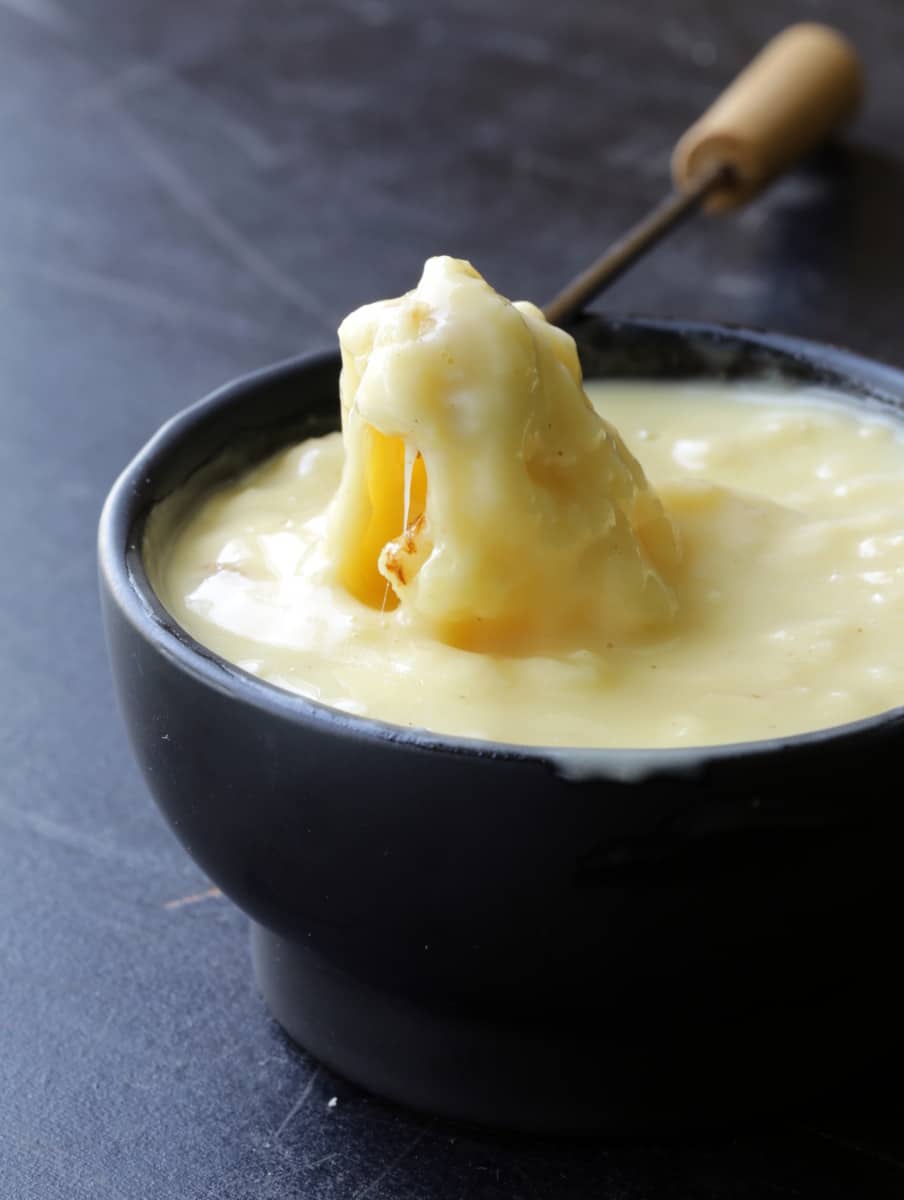
Cheese fondue is a firm fixture at every one of our winter gatherings. After 40 fondue evenings we have learned: melting cheese is physics, not intuition. 90°C for exactly 7 minutes at speed 2, any longer and it turns stringy, any hotter and the whey separates from the fat.
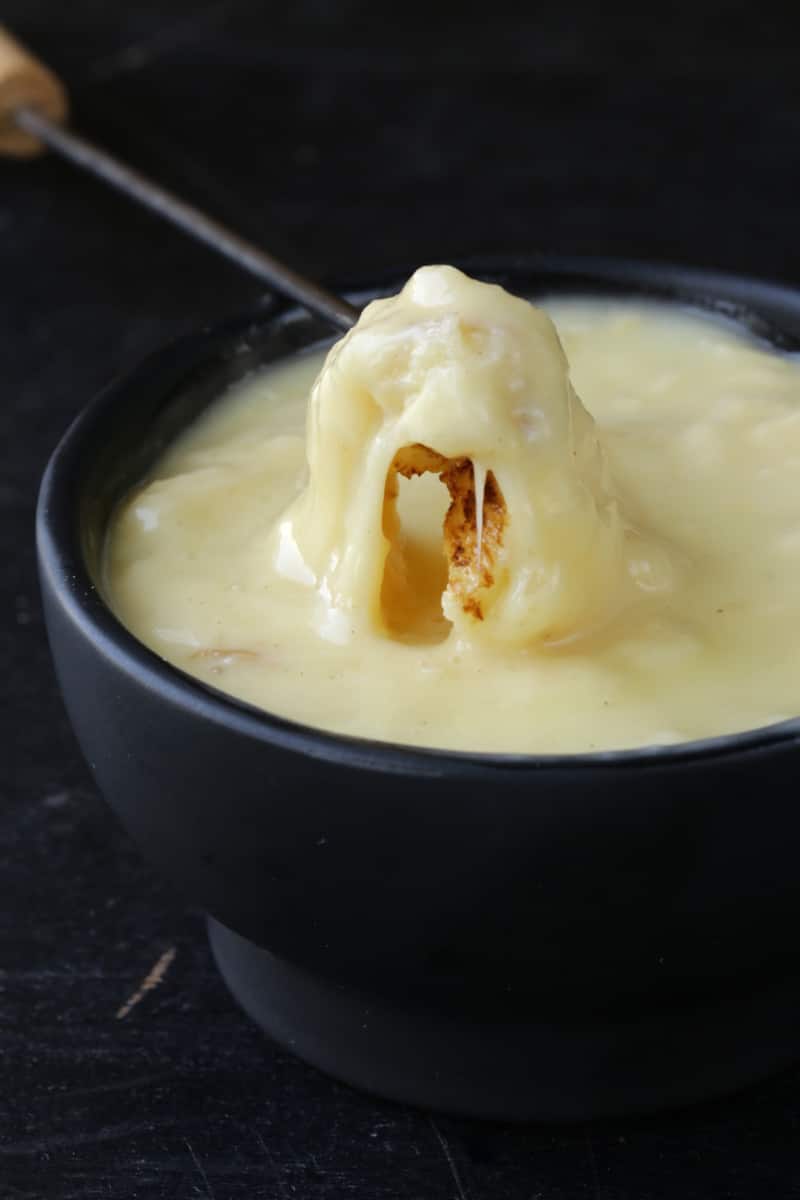
The Thermomix® controls the temperature automatically. A hob with a gas burner or electric ring creates hot spots, the cheese at the bottom of the pot burns while cold lumps are still floating on top. Speed 2 stirs slowly enough that the cheese mixture does not splatter, but quickly enough for an even consistency.
Cheese Fondue with the Thermomix®

Ingredients 0 / 9 ✓
- 2 garlic cloves
- 300 g Greyerzer cheese
- 300 g Gruyere cheese
- 200 g Emmental cheese
- 300 g white wine
- 20 g cornflour (cornstarch)
- 40 g kirsch
- 1 tsp paprika
- 1 tsp white pepper
Instructions 0 / 6
-
1
Chop the garlic.
Peel the garlic, place it in the mixing bowl and chop for 3 sec / speed 8.
-
2
Chop the cheese.
Cut the cheese into pieces and chop for 8 sec / speed 8.
-
3
Melt the cheese.
Add the wine and heat for 7 min / 90°C / speed 2.
-
4
Mix the alcohol.
Meanwhile, stir the cornflour and kirsch together in a cup.
-
5
Bring to the boil.
Add the remaining ingredients and bring to the boil for 3 min / 100°C / speed 3.
-
6
Serve.
Pour the cheese fondue into a heatproof dish or fondue pot and place it on a fondue burner.
Tip: Baguette cut into cubes is perfect for dipping.
Video
Nutrition per serving
Greyerzer and Gruyere are not the same thing
The recipe lists both, so why? Greyerzer (spelled with a y) is the German spelling for Gruyere AOP from Switzerland. The two cheeses in the recipe are actually identical, just labelled differently. We use 600 g Gruyere AOP (regardless of spelling) and combine it with 200 g Emmental. The 3:1 ratio determines the texture: Gruyere brings saltiness and creaminess, Emmental brings the holes and a mild, nutty note without bitterness.
If you can only find Emmental, the fondue still works. It will be milder and slightly less creamy. Austrian mountain cheese (Bergkäse) as a Gruyere substitute makes the fondue more savoury but less salty, so add an extra 1/4 tsp of salt.
Why cold cheese prevents lumps
Cheese straight from the fridge (below 8°C) melts more slowly than cheese at room temperature. That sounds counterintuitive, but it is intentional. When cheese heats up too quickly, the protein curdles before the fat distributes evenly, resulting in rubbery lumps. Cold cheese gives the white wine time to work into the cheese mixture and gradually loosen the proteins. The 7 minutes at 90°C are calculated for cheese at 8°C. Cheese at room temperature would be ready after 5 minutes, but by then it is often already overheated.
We cut the cheese into rough pieces (about 3 cm on each side) before they go into the Thermomix®. After 8 seconds at speed 8 the cheese is grated. Too fine makes it harder to control later, too coarse and it melts unevenly.
Mix the cornflour and kirsch separately
The 20 g of cornflour binds excess fat and prevents the cheese mixture from splitting. But cornflour clumps immediately if added directly to hot cheese. So we mix it with the kirsch in a cup outside the Thermomix®, which gives a milky suspension. This is only added after the 7 minutes of melting time, together with the paprika and pepper, and then brought to the boil for another 3 minutes at 100°C. In those 3 minutes the cornflour activates fully and binds the sauce.
Kirsch intensifies the cheese flavour because alcohol acts as a flavour carrier. Without alcohol (using vegetable stock instead of wine and no kirsch) the fondue works technically, but tastes noticeably flatter. We would then add 1 tsp of lemon juice to compensate for the missing acidity.
From the Thermomix® to the fondue burner
Cheese fondue must stay between 60 and 70°C while eating. Below 60°C the fat solidifies, above 70°C the emulsion breaks. The Thermomix® brings the mixture up to serving temperature but does not keep it warm, so you need a fondue pot with a rechaud (fondue burner) for that. We use chafing fuel paste, not candles. Candles do not deliver enough heat and after 15 minutes the fondue becomes thick and sticky.
If the fondue gets too thick while eating, add 2 tbsp of warm white wine and stir. That loosens the mixture immediately.
Storing and reheating leftovers
Leftovers keep in the fridge in an airtight container for 2 days. To reheat: put the fondue back into the Thermomix®, heat for 5 minutes at 80°C and speed 2, adding 50 g of white wine per 500 g of fondue. The emulsion partially breaks when it cools down and the extra wine restores it.
Freezing is possible (up to 1 month), but the texture suffers. After thawing the fondue is grainier. We only freeze leftovers if we plan to use them later as a sauce for baked dishes.
What other recipes do differently
Goes well with: white bread and jacket potatoes.
Most recipes go for moitie-moitie with equal parts Gruyere and Vacherin Fribourgeois. We deliberately use Gruyere with Emmental in a 3:1 ratio, because Vacherin can quickly become pungent and makes the melt less stable. For the white wine, some sources specifically recommend acidic varieties such as Silvaner or Pinot Gris, which matches our experience. Some recipes also rub the pot with half a garlic clove, something that is not needed in the Thermomix®. Cookidoo uses less cornflour but a longer cooking time at 90°C, which makes the mixture chewier. As accompaniments, cornichons, pears and small jacket potatoes often appear alongside the baguette, and they make a good addition.
More Thermomix® recipes with cheese: French baguette, cheese sauce, pizza dough.