Choux pastry is the only dough in our baking kitchen that starts on the hob and only goes into the oven afterwards. That is exactly what makes it a special case, and exactly why it works so reliably in the Thermomix®.
We have been making cream puffs with mango cream for years, whenever we want to surprise guests with something light and sweet. The fruity filling goes down better in summer than any buttercream, and the choux pastry around it is surprisingly straightforward once you understand the two heat phases.
Choux Pastry Basic Recipe with Mango Cream Puffs, Thermomix®

Ingredients 0 / 10 ✓
- 90 g butter
- 250 g water
- 1 pinch salt
- 200 g flour
- 1 tsp baking powder
- 5 egg
- 80 g sugar
- 100 g mango flesh
- 400 g double cream
- 2 sachet whipping cream stabiliser
Instructions 0 / 12
-
1
Cook choux pastry ingredients.
Butter cut into pieces. Add butter pieces, water and salt to the mixing bowl and cook for 4 minutes / 100°C / speed 1.
-
2
Mix the dough.
Add flour and baking powder and stir together for 2 minutes / speed 4. Remove the mixing bowl lid and leave the mixture to cool to 50°C.
-
3
Add the eggs.
Set the mixing bowl to 3 minutes / speed 5, start the machine and add the eggs one by one through the lid while it is running. Leave to run for a further 2 minutes to mix everything well.
-
4
Preheat the oven.
Preheat the oven to 170°C (fan 150°C, gas mark 2).
-
5
Prepare the baking tray.
Line a baking tray with baking paper.
-
6
Pipe the cream puffs.
Fill the dough into a piping bag and pipe mounds of about 3 x 3 cm onto the baking tray.
-
7
Bake the cream puffs.
Bake on the middle shelf of the oven for 20 to 25 minutes. Warning! Do not open the oven door beforehand, as the pastry may collapse!
-
8
Rinse the mixing bowl.
Meanwhile, rinse and dry the mixing bowl. Add sugar to the mixing bowl, pulverise for 10 seconds / speed 10 and set 2 tablespoons aside.
-
9
Chop the mango.
Add mango to the mixing bowl, chop for 5 seconds / speed 5 and set aside. Rinse the mixing bowl.
-
10
Whip the cream.
Insert the butterfly whisk. Add double cream and whipping cream stabiliser to the mixing bowl and whip at speed 3.5 until firm. Remove the butterfly whisk.
-
11
Mix mango and cream.
Add the mango flesh to the mixing bowl and fold in with the spatula.
-
12
Serve the cream puffs.
Slice the cream puffs in half, spread cream over the bottom halves and place the top halves back on. Dust with icing sugar and serve.
Tip: Instead of mango, you can also use berries. As these are slightly more tart, you may need to add a little more sugar to taste.
Video
Nutrition per serving
Why the Thermomix® gets the gelatinisation stage right every time
With traditional choux pastry, someone stands at the hob, brings water and butter to the boil, tips in the flour and stirs with a wooden spoon until a white film forms on the bottom of the pan. This stage is called gelatinisation, and it is the point where most people go wrong. Stop too soon and you get a sticky dough. Stir too long and you get a tough mass that will not rise later.
In the Thermomix® we handle this in two clean steps. First, 90 g butter cut into pieces, 250 g water and a pinch of salt go into the mixing bowl for 4 minutes / 100°C / speed 1. The butter melts, the water comes to the boil, everything heats evenly. Then we add 200 g flour and 1 tsp baking powder and set it to 2 minutes / speed 4. The mixing bowl works the flour into the mixture using the residual heat until a smooth ball forms. That residual heat is our gelatinisation, without having to stand at the hob doing hard work.
Important after that: remove the mixing bowl lid and leave the mixture to cool to 50°C. Anyone who skips this and tips the eggs into the still-hot dough will cause them to scramble instantly. The recipe cannot be rescued at that point.
Add the eggs one at a time, or the dough will not pipe
The second critical step is incorporating the 5 eggs. We set the mixing bowl to 3 minutes / speed 5, switch it on and add the eggs one at a time through the lid. One after another, not all at once. The dough needs a few seconds between each egg to absorb the liquid, otherwise the mixture splits and becomes runny. We then leave it to run for a further 2 minutes until everything has a consistent sheen.
The consistency we are looking for is thick and smooth. When the dough pulls away from the spatula in a wide point rather than dripping, it is ready. If it drips, it needs more flour or the mixture was still too warm when the eggs were added. If it is crumbly, there was too little egg or it cooled too much in the centre.
Keep the oven door closed, or everything will collapse
Choux pastry does not rise through yeast or baking powder alone, but through steam. In the oven, the moisture inside the dough evaporates rapidly and pushes the shell outwards. This only works if the heat stays constant. We bake the cream puffs at 170°C top/bottom heat (fan 150°C) on the middle shelf for 20 to 25 minutes.
Warning: the oven door must not be opened during the first 20 minutes. As soon as cold air reaches the half-baked cream puffs, the column of steam collapses and the puffs sink. We watch through the glass and trust the timer. Only when the shell looks golden brown and stable do we open it. Not before, not even briefly to turn them.
The mounds pipe best with a star nozzle in 3 x 3 cm portions. Mounds that are too small turn out dry; mounds that are too large stay damp inside. The spacing on the baking tray must be generous, because the puffs expand to twice their size during baking.
Mango and cream in parallel, because the mixing bowl knows what it is doing
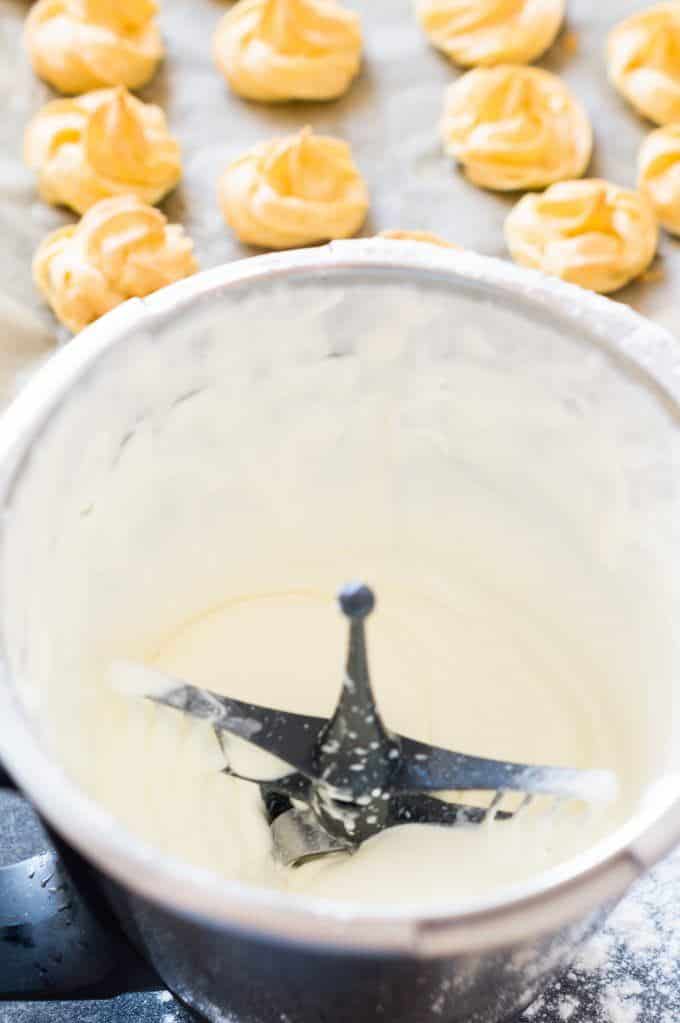
While the cream puffs are rising in the oven, there is time to make the filling in the mixing bowl. Rinse and dry the mixing bowl first, that is essential. Any residual moisture would cause the sugar to clump and stop the cream from whipping up firmly later. 80 g sugar go into the mixing bowl for 10 seconds / speed 10 and are turned into icing sugar. We set two tablespoons aside for dusting.
Then chop 100 g mango flesh for 5 seconds / speed 5 and remove. Rinse the mixing bowl again, insert the butterfly whisk and whip 400 g cold double cream with 2 sachets of whipping cream stabiliser at speed 3.5 until firm. Keep an eye on the mixing bowl and stop as soon as the cream is firm. Half a minute too long and the cream turns to butter.
We fold the blended mango in at the end with the spatula. Not in the running mixing bowl, because the cream will go liquid. Anyone who prefers mango pieces can skip the blending step and cut it into small cubes instead.
What can go wrong and why
The cream puffs stay flat. Usually someone opened the oven door midway through. Sometimes the dough was too warm when the eggs went in, which breaks the binding. Solution: next time, stick strictly to cooling to 50°C and do not touch the oven door until after 20 minutes.
The puffs split open at the bottom and the cream runs out. This happens when we fill them too early. Choux pastry must be completely cool before the cream goes in. Leave them to cool on a wire rack, otherwise condensation forms underneath and makes the base soggy.
The dough is runny after adding the eggs. The mixture was too hot when the eggs were added. Unfortunately, nothing can be done with this dough. Next time, use a thermometer or leave the mixing bowl open for longer.
Other fillings we have tried
Strawberry instead of mango works just as well, but the berries must be well drained before blending. Otherwise the cream becomes watery.
Plain vanilla is the classic option. Scrape out a vanilla pod and whip it with the cream, then a warm chocolate sauce goes perfectly alongside.
Savoury as profiteroles with cream cheese, smoked salmon and dill works with the same dough. The choux pastry basic recipe contains no sugar, so this works without any adjustment.
What we serve alongside
A cup of homemade iced coffee or a glass of sparkling wine rounds it off perfectly. Anyone who wants to go bigger can build the cream puffs into a croquembouche, a tower of stacked filled puffs spun with caramel threads. This works better on a cooler day, as the cream softens too quickly in the heat.
As a choux pastry variation, we have also covered further basic pastry doughs in the Thermomix®, for anyone who wants to try shortcrust or yeast dough first.
Storing and preparing ahead
Unfilled choux pastry shells keep in an airtight tin for two days at room temperature. Cream puffs do soften over time, but can be crisped up again in the oven at 150°C for 5 minutes.
Freezing also works. Unfilled and well wrapped, the puffs keep for up to three months. Leave to thaw at room temperature, crisp up briefly in the oven, then fill fresh.
Filled cream puffs cannot be stored. The cream makes the base soggy within a few hours. So we fill them only when the guests are already on their way.
What other recipes do differently
Many guides bring water and butter only briefly to the boil and add the flour in portions. We do it differently: in the Thermomix® we run 5 minutes at 100°C at speed 1, then add all the flour at once. This ensures the mixture binds reliably with no lumps. Other recipes fold in the eggs straight away, which makes the dough scramble. We wait for it to cool and add the eggs one by one through the lid opening. When baking, many skip the star nozzle, yet it creates even ridges and a stable shape. And while others open the oven door midway, we keep ours closed, otherwise the puffs collapse.
Goes well with: Vanilla ice cream, strawberry jam and warm cherries.
Once you have mastered choux pastry confidently, eclairs, profiteroles and Paris-Brest are well within reach. More guides to sweet Thermomix® classics:
- Baking with the Thermomix®: an overview
- Whipping cream in the Thermomix®
- Basic pastry doughs in the Thermomix®