We toast the cloves, star anise and cinnamon in a pan before they go into the Thermomix®. This is not an optional step. Dry heat opens up the essential oils that would otherwise stay locked inside the milk. Without toasting, the chai tastes flat.
Chai is not spiced tea with milk. Chai is milk that absorbs spices. The difference lies in the ratio: 1000 g of milk to a handful of spices. The milk becomes the carrier, not the diluter.
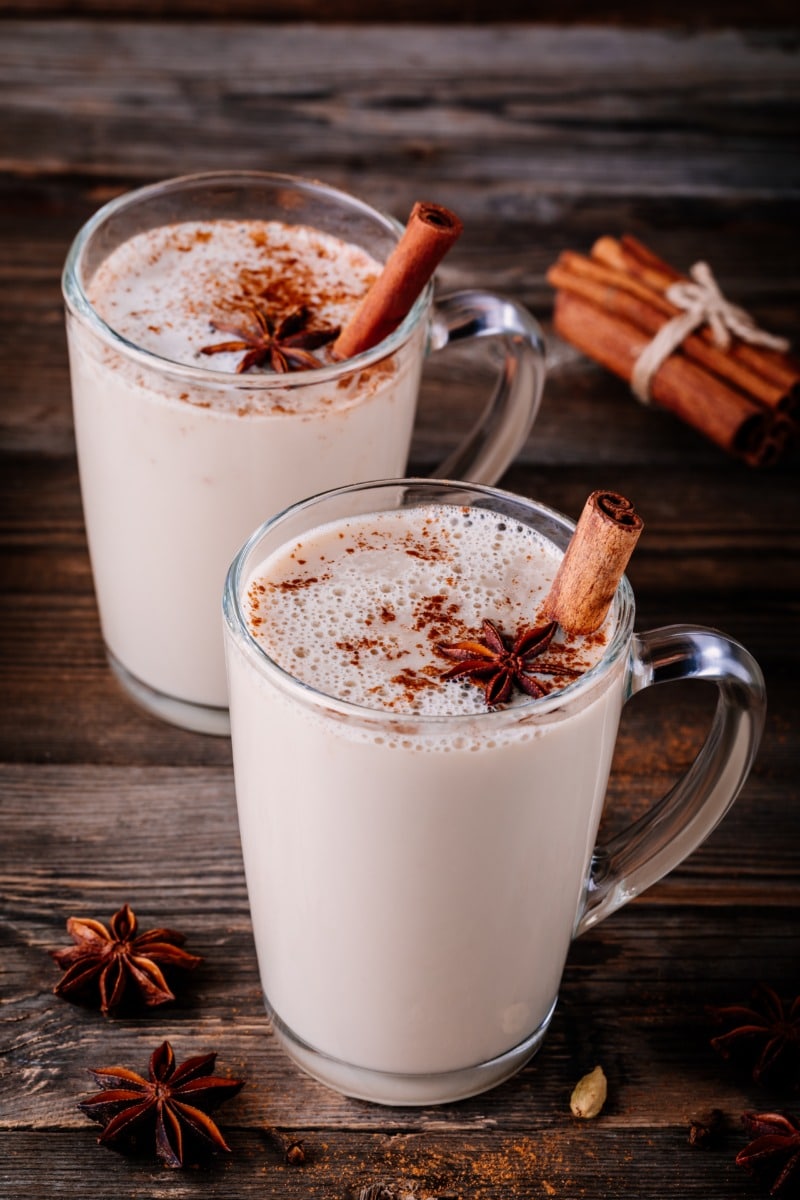
Christmas Chai with the Thermomix®

Ingredients 0 / 6 ✓
- 8 cloves
- 2 star anise
- 1 tsp ground cinnamon
- 1000 g milk
- 3 tbsp black tea loose leaf
- 20 g honey
Instructions 0 / 4
-
1
Toast the spices.
Place the spices in a dry frying pan and toast over a low heat until they start to smell fragrant.
-
2
Heat spices with milk.
Transfer the spices and milk to the mixing bowl and heat for 10 min / 80°C / reverse direction / speed 1.
-
3
Brew the tea.
Add the tea leaves and honey, mix for 5 sec / speed 4 and leave to steep for 5 minutes.
-
4
Serve.
Strain the chai through a sieve into tea glasses.
Tip: For an alcoholic version, add a splash of dark rum to each glass just before serving.
Video
Nutrition per serving
Why the spices need to go in the pan first
Cloves, star anise and ground cinnamon all contain essential oils. These oils are locked inside the cell walls. Dry heat in the pan breaks those walls open. The oils are released, oxidise slightly and develop their full aroma. We can smell it immediately.
If we added the spices directly to the cold milk, the oils would remain largely sealed in. The milk would only draw them out slowly. The result is a mild, almost neutral drink. Toasting is what makes the difference between the scent of spice and the taste of spice.
80°C instead of 100°C in reverse direction
The milk is heated at 80°C in reverse direction, not brought to the boil. There are two reasons for this. First, milk starts to scorch on the base above 85°C. The Thermomix® prevents this by stirring, but 100°C is unnecessarily close to that threshold. Second, the milk proteins denature at too high a temperature. The milk turns grainy.
Reverse direction stirs gently without breaking up the spices. We want to extract the aromas, not pulverise the spices. After 10 minutes the milk is thoroughly infused. Longer adds nothing, the extraction is complete.
Black tea after the spiced milk
The black tea goes into the mixing bowl after the spices, not at the start. If it cooked from the beginning, the tannins would leach out too strongly. The chai would turn bitter. 3 tbsp of loose-leaf tea mixed for 5 seconds at speed 4 distributes the leaves evenly. Then leave to steep for 5 minutes, with no further heat.
The honey goes in at the same time as the tea. It sweetens and rounds off the tannins. 20 g is a suggestion. If you prefer it sweeter, use more. If you want a stronger tea character, reduce the honey to 10 g.
The sieve is essential
Before serving, the chai must be strained through a sieve. The spices and tea leaves stay behind. Without a sieve, every sip will be grainy. The sieve should have a fine mesh. A tea strainer will do. A fine-mesh sieve is better.
We pour the chai directly into tea glasses. The glasses should be warmed first. A cold glass cools the chai too quickly. Pour hot water into the glass, leave for 30 seconds, empty it out, then pour in the chai.
Variation with dark rum
A splash of dark rum just before serving turns the chai into a warming winter drink for adults. The rum should be full-bodied, not mild. The spice notes stand up well to alcohol. 2 cl per glass is a good starting point. More will overpower the milk.
Goes well with: Spekulatius biscuits, gingerbread and cinnamon stars.
The rum goes into the glass, not into the mixing bowl. Heat causes alcohol to evaporate. We want to taste the rum, not cook it away.