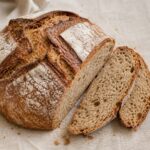
Sourdough bread with no starter culture and no days of planning ahead. The sachet of sourdough extract gives a classic yeast dough genuine sourdough character in under 2 hours total. No feeding, no starter, no waiting for the right pH level.
We bake this loaf regularly when guests drop by unexpectedly or when the last bought loaf has been finished. The Thermomix® kneads the dough in 4 minutes and the kneading mode develops the gluten structure evenly. The bread baking pot mimics the steam environment of a professional oven and creates that crispy crust.
Sourdough Bread with the Thermomix®
Ingredients 0 / 8 ✓
- 350 g plain wheat flour
- 120 g rye flour
- 120 g spelt flour
- 1/2 cube fresh yeast
- 1 sachet sourdough extract
- 2 tsp honey
- 2 tsp salt
- 400 g water
Instructions 0 / 4
-
1
Add all ingredients to the mixing bowl, knead for 4 minutes / kneading mode, then cover and leave to prove for 1 hour.
-
2
Preheat the oven to 250°C top and bottom heat and prepare a bread baking pot.
-
3
Turn the dough out onto a floured work surface, shape it into a loaf, and place it in the pot.
-
4
Dust the dough with flour, score it in a cross pattern, close the lid, and bake for 50 minutes.
Nutrition per serving
Why sourdough extract instead of a real sourdough starter
Sourdough extract is dried, inactivated sourdough in powder form. It brings the typical aromatic compounds and organic acids that give bread its sourdough flavour. But it no longer ferments actively.
That is why we also need yeast for the rise. Half a cube is enough, because the dough only needs to prove for 1 hour rather than overnight. The extract provides the flavour, the yeast provides the lift. Without yeast the dough would remain flat and dense.
A real sourdough starter would require 5 to 7 days of feeding, daily additions of flour and water, a constant room temperature, and regular checks on fermentation activity. For a spontaneous weekend loaf that is simply not an option.
The flour blend determines the crumb
350 g of wheat flour forms the base. Wheat has the highest gluten content and develops, during kneading, the elastic network that traps the bubbles of gas produced by the yeast. Without this foundation the bread would collapse after baking.
120 g of rye flour gives the bread its dark colour and hearty flavour. Rye contains pentosans that bind water and keep the crumb moist. Too much rye makes the dough sticky and hard to shape, which is why it stays at 20% of the total weight.
120 g of spelt flour adds a nutty note and a slightly open structure. Spelt is lower in gluten than wheat but loosens the crumb and prevents the bread from becoming too dense. This three-way blend of wheat, rye, and spelt strikes a good balance between structure, flavour, and texture.
Honey activates the yeast faster
2 tsp of honey is not a flavouring ingredient here, it is food for the yeast. Yeast converts sugar into carbon dioxide and alcohol. The faster this process starts, the shorter the proving time.
Honey dissolves instantly in the dough and is available to the yeast within the first few minutes. Without honey the yeast would start more slowly and the dough would need 90 minutes rather than 60 minutes to prove. Granulated sugar has a similar effect, but honey also brings enzymes that deepen the aroma of the bread.
Kneading mode for 4 minutes without stopping
The kneading mode of the Thermomix® works with slow, steady rotation. 4 minutes is the minimum time for the gluten to develop fully. Less than that and the dough stays crumbly, with the individual flour particles failing to come together into an elastic network.
After 2 minutes the dough already looks homogeneous, but the gluten structure is not yet stable. The final 2 minutes ensure that the dough does not tear when shaped and that the gas bubbles are held in during proving. A dough that has been kneaded for too short a time will rise but then collapse during baking.
After kneading the dough sticks slightly to the mixing bowl. This is normal and a sign of sufficient hydration. Simply scrape it out with a spatula, transfer it to a bowl, cover, and leave to prove.
The bread pot replaces the steam oven
A cast-iron or ceramic bread baking pot retains heat and keeps moisture inside. During baking the dough releases water vapour, which circulates in the closed pot and keeps the surface of the bread moist. This allows the crust to expand for longer before it sets.
Without a pot the crust would harden immediately and the bread could not continue to rise. The result would be a flat loaf with a dense crumb. The lid stays on for the full 50 minutes so that the steam cannot escape.
250°C top and bottom heat is the right temperature for the oven spring phase in the first 15 minutes. During this phase the dough expands to its maximum, the yeast releases gas one last time before dying at above 60°C. After 20 minutes the temperature inside the pot drops to around 220°C, which is ideal for crust formation without burning.
Scoring prevents uncontrolled tearing
The cross-shaped score before baking gives the bread defined weak points. During oven spring the dough expands and the tension in the surface increases. Without scoring the bread would burst at its weakest point, often at the side or underneath.
Use a sharp knife or a razor blade to score 1 cm deep, with a swift, clean cut rather than a sawing motion. Do not press the dough down. The cross shape distributes the tension evenly and creates the classic rustic look with the crust opening along the cuts.
Cooling on a wire rack
After 50 minutes take the bread out of the pot and leave it to cool on a wire rack. Do not leave it in the pot, otherwise the steam condenses on the underside and the crust goes soft.
Wait at least 30 minutes before slicing. The crumb sets during this time and the starch crystallises. A loaf cut too early will squash and the slices will be soggy. Only after cooling does the characteristic firm yet moist texture develop.
The bread keeps for 3 to 4 days in a bread bin or a linen bag. Do not store it in the fridge, as this dries out the crumb. It freezes well sliced, so you can toast individual slices straight from the freezer.
Goes well with: Butter, cheese and jam.
Goes well with: Banana bread with the Thermomix®.