Baked chicken with the Thermomix® sounds contradictory at first, because the meat cooks in the oven. We use the Thermomix® for the spice paste, and that paste is what decides between juicy and dry. Garlic and onion are finely chopped, not roughly hacked, so the paste coats the meat evenly and caramelises in the oven rather than burning.
How to make juicy baked chicken with the Thermomix®: Mix the spice paste (garlic 3 sec / speed 8, onion 5 sec / speed 6, then oil and spices 5 sec / speed 3), pound 4 chicken breast fillets to 2 cm, rub with the paste and bake at 220 °C top and bottom heat for 16 to 18 minutes. Switch on the grill for the last 2 to 3 minutes, then leave to rest for 5 minutes. This keeps the fillet juicy inside and gives it a crispy crust on the outside.
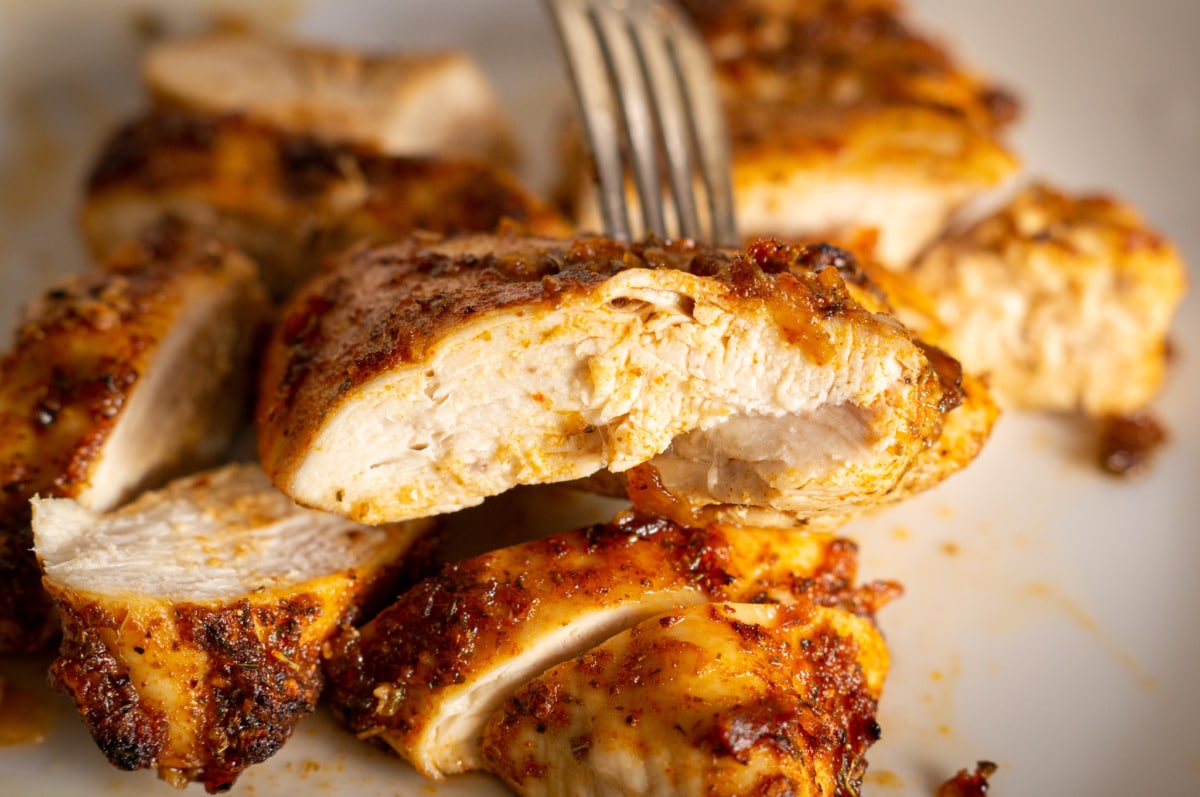
We make this baked chicken regularly when time is short but a plain pan-fried fillet just will not do. What makes it special: we do not sear anything and add no stock. The fillets go into the oven raw, and the spice paste does the rest. In just under 20 minutes you have a main course with 46 g of protein per serving, at around 300 calories.
Juicy Baked Chicken with the Thermomix®

Ingredients 0 / 9 ✓
- 2 garlic cloves
- 1 onion
- 1 tbsp oil
- 1 1/2 tsp hot smoked paprika
- 1 tsp dried oregano
- 1 tsp salt
- 1 tbsp brown sugar
- 1/2 tsp cayenne pepper
- 4 chicken breast fillets
Instructions 0 / 7
-
1
Preheat the oven to 220 °C top and bottom heat, or 200 °C fan.
-
2
Peel the garlic, place in the mixing bowl and chop for 3 sec / speed 8, then push down with the spatula.
-
3
Peel the onion, halve it, place in the mixing bowl and chop for 5 sec / speed 6, then push down with the spatula.
-
4
Add the oil, paprika, oregano, salt, sugar and cayenne pepper and mix for 5 sec / speed 3.
-
5
Line a baking tray with foil. Pound the chicken fillets to a uniform 2 cm thickness at the thickest point using a meat mallet. The fillets should all be the same thickness. Rub them thoroughly with the spice paste and place on the baking tray.
-
6
Bake the chicken fillets for approximately 16 to 18 minutes, switching on the grill for the last 2 to 3 minutes so they turn golden brown and crispy at the edges.
Warning: Keep a close eye on them so they do not go too dark.
-
7
Leave the baked chicken to rest for 5 minutes before serving so the juices can redistribute.
Tip: If you are unsure about the cooking time, check with a meat thermometer. The internal temperature should reach 75 °C, at which point the meat is cooked through.
Serve with a fresh salad and baguette, vegetable rice, or potatoes roasted alongside in the oven.
Nutrition per serving
Why brown sugar belongs in the spice paste
Brown sugar caramelises at 160 °C and forms a thin crust. This seals the surface and keeps the juices inside the meat. Without sugar the paste darkens but the meat stays pale and loses moisture. 1 tbsp is enough for 4 fillets; any more and the crust turns bitter.
Hot smoked paprika provides the colour, and the 1/2 tsp of cayenne pepper brings the heat. Sweet paprika works too but does not go as red. The combination of 1 1/2 tsp paprika, 1 tsp oregano and 2 garlic cloves is deliberately Mediterranean, not a BBQ profile. If you prefer it milder, simply leave out the cayenne.
The Thermomix® chops the garlic and onion so finely that no coarse pieces remain to burn in the oven. 3 seconds at speed 8 for the garlic, 5 seconds at speed 6 for the onion. Chopping by hand always leaves chunks that turn black and bitter. This is the one point where the Thermomix® genuinely makes a difference here.
The critical 16 to 18 minutes at 220 degrees
220 °C top and bottom heat is the threshold at which the surface caramelises before the inside dries out. Many recipes work with 160 to 180 °C for 30 to 40 minutes. That works, but tends to dry out the fillet because it spends longer in the oven. At 240 °C the paste burns. Fan at 200 °C distributes the heat more aggressively, so plan for roughly 15 minutes in that case.
For the last 2 to 3 minutes we switch on the grill. That crisps up the edges and gives the crust its dark colour. Do not leave the oven during this time, as the grill can darken the meat quickly. As soon as the edges are golden brown, take it out immediately.
Check the internal temperature with a meat thermometer: 75 °C means fully cooked, 70 °C means still slightly pink in the centre. We take ours out at 73 °C because the meat continues to cook as it rests. Many sources suggest 80 to 85 °C for extra juiciness. For a thin fillet that is too high and the result turns stringy. At 73 °C plus resting time we land right in the juicy range.
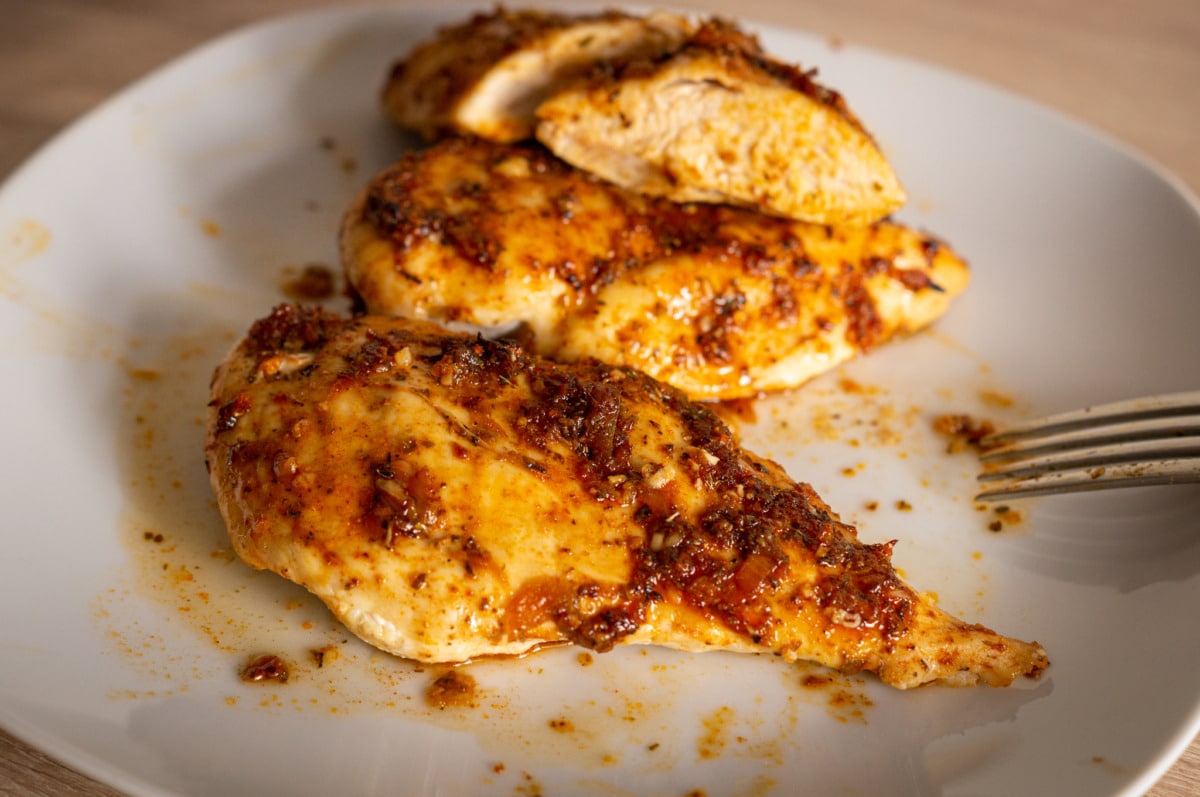
These three pitfalls cost you the juiciness
The fillets are different thicknesses
Chicken breast fillets taper to a point on one side. The thin end is dry by the time the thick centre is just cooked through. This creates the impression that the whole recipe does not work, when in fact the only issue is uneven thickness.
Our solution: Pound the fillets to a uniform 2 cm at the thickest point using a meat mallet. Use the mallet, not your hand. The mallet stretches the fibres rather than compressing them. Evenly thick fillets cook through evenly.
The meat is cut immediately after baking
Straight from the oven, the juices are under pressure. Cut immediately and they run onto the board. The fillet turns dry, no matter how well it was baked.
Our solution: Leave to rest for 5 minutes, then cut. During this time the juices redistribute through the meat. Do not cover the fillets with foil, as the steam softens the crust. Simply leave them uncovered on the tray. With a whole chicken we would wait 10 minutes; for a thin fillet, 5 minutes is enough.
Garlic and onion burn in the oven
If you chop garlic and onion by hand you end up with coarse pieces. These sit on the surface and turn black and bitter at 220 °C before the meat is done.
Our solution: Chop in the mixing bowl for 3 seconds at speed 8, then push down with the spatula and mix with oil and spices into a paste (5 sec / speed 3). The fine paste coats the meat as a thin film and caramelises rather than burning.
Ways to vary the baked chicken
With yoghurt marinade: Stir 2 tbsp of natural yoghurt into the spice paste. The lactic acid makes the meat extra tender and the crust a little thicker. Works well if the fillets marinate for 30 minutes beforehand.
Mediterranean with lemon: Add the zest of half a lemon and 1 tsp of dried thyme to the paste. Goes well with roasted vegetables and a spoonful of tzatziki.
Spicier than BBQ: Replace the 1/2 tsp of cayenne with 1 tsp of smoked paprika plus 1/2 tsp of chilli flakes. This gives a smoky heat without the taste of a ready-made marinade.
Mild for children: Leave out the cayenne entirely and use 1 tsp of honey instead of brown sugar. The crust turns slightly sweeter and goes down well with children.
Side dishes that suit the short baking time
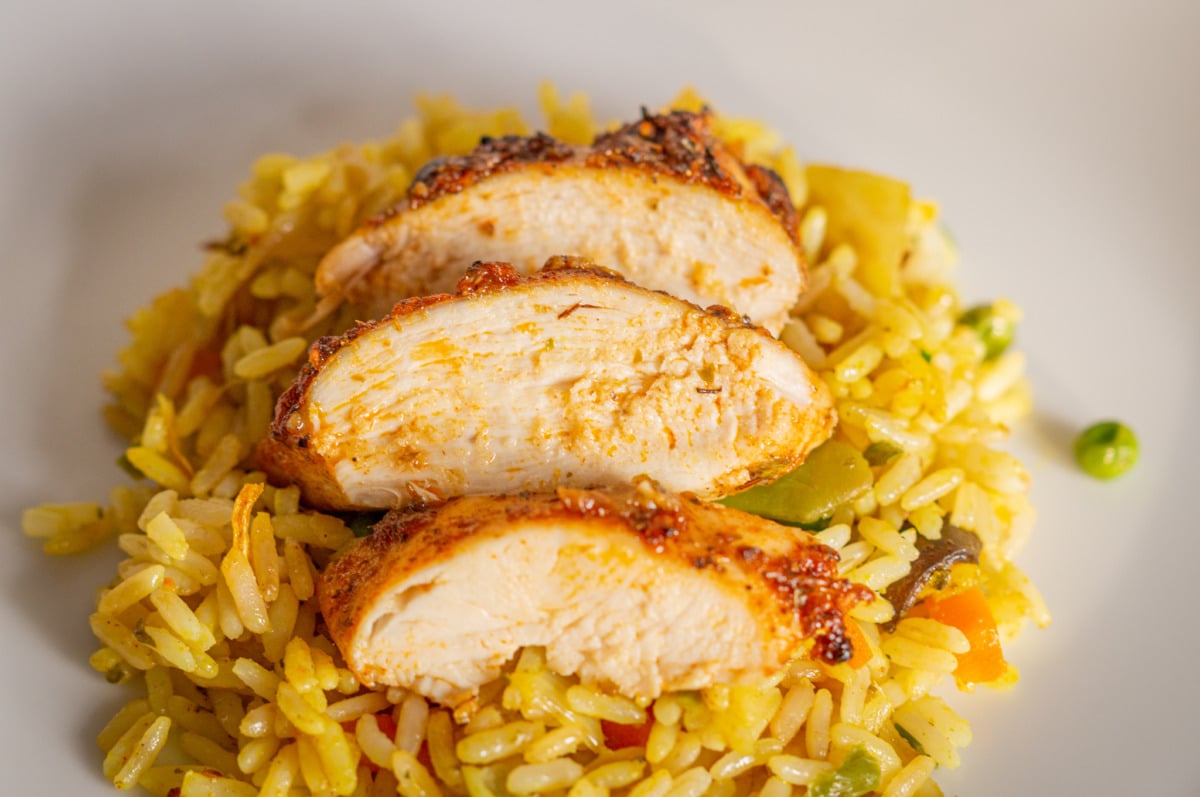
18 minutes is too short for raw potatoes in the oven, but enough for par-cooked vegetables. We place strips of pepper or courgette directly beside the fillets for the second half of the baking time. The spice paste colours them and the vegetables roast alongside.
The biggest advantage with the Thermomix®: while the chicken bakes, the rice runs in the mixing bowl. Everything is ready at the same time, without a second pot. Sweet potato gratin from the Thermomix® goes nicely alongside when there is a little more time, or a quick salad with baguette, since the crust on the chicken already brings plenty of roasted flavour.
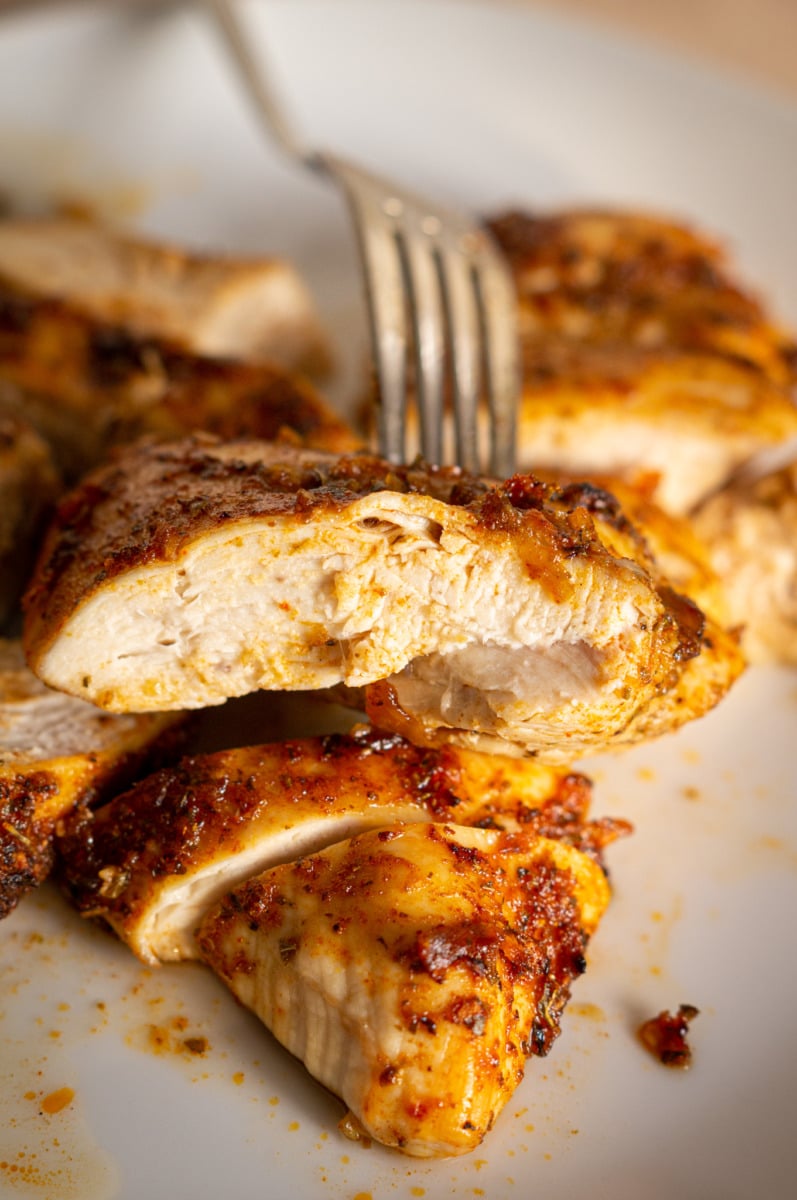
Storing and reheating the baked chicken
Leftover fillets keep for 3 days in the fridge in a sealed container. Let them cool completely before refrigerating, otherwise condensation forms and the crust goes soggy. Sliced cold, the leftovers work well in a sandwich or a salad.
Reheat in the oven at 150 °C for 8 to 10 minutes to keep the crust crispy. In the microwave the fillet quickly turns chewy as it overcooks. Frozen, the fillets keep for 3 months. Thaw overnight in the fridge, then reheat as fresh. Raw marinated fillets can also be frozen and will marinate through as they thaw.
Frequently asked questions about baked chicken with the Thermomix®
Goes well with: Potato salad, baguette and coleslaw.
For more quick main courses with the Thermomix®, try our one-pot salmon pasta and sweet potato gratin.