Lasagne is our Sunday dish, when everyone has time and the kitchen is allowed to fill with the smell of Bolognese for two hours. We have been making it with the Thermomix® for years, because the Bolognese and bechamel are made one after the other in the same mixing bowl and at the end there is only one baking dish and one bowl to wash up.
The most important point first, because this is where most lasagnes go wrong: we do not pre-cook the lasagne sheets. They go in dry between the Bolognese and the bechamel. During the 35 minutes in the oven they absorb exactly the liquid they need from both sauces. Pre-cooked sheets bring extra water with them, which makes the lasagne soggy at the bottom and dry at the top. Dry sheets, on the other hand, cook to a perfect al dente in the sauce and hold their layer when cut.
Lasagne with the Thermomix®

Ingredients 0 / 18 ✓
- 100 g Emmental cheese
- 2 onions
- 2 garlic cloves
- 2 carrots
- 20 g olive oil
- 400 g mixed minced meat
- 100 g red wine
- 400 g chopped tomatoes (tinned)
- 3 tsp vegetable stock powder
- 3 tsp dried basil
- 60 g butter
- 60 g flour
- 600 g milk
- 1 tsp salt
- 1 pinch nutmeg
- 1 tsp freshly ground pepper
- 300 g Mozzarella
- 12 lasagne sheets
Instructions 0 / 10
-
1
Grate the cheese.
Cut the Emmental cheese into pieces, place in the mixing bowl and chop for 6 sec / speed 8. Set aside.
-
2
Chop the vegetables.
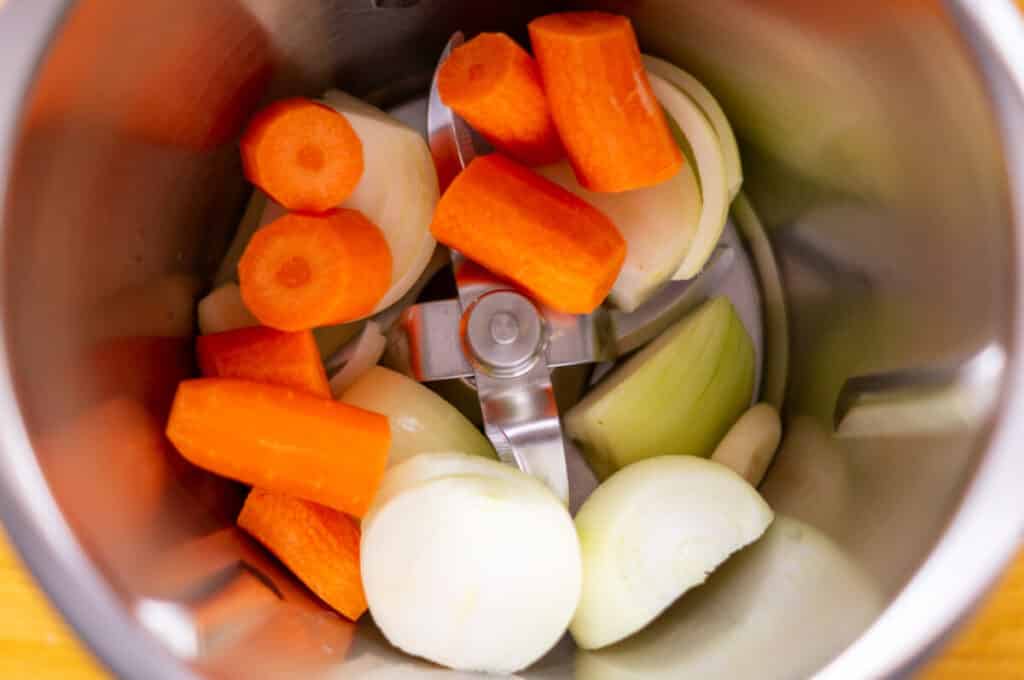
Peel the onions and halve them, peel the garlic, and place both in the mixing bowl. Peel the carrots, cut into pieces and add. Chop for 5 sec / speed 5 and scrape down with the spatula.
-
3
Sweat the vegetables.
Add the olive oil and cook for 3 min / Varoma / speed 1.
-
4
Brown the minced meat.
Add the minced meat and cook for 5 min / Varoma / reverse direction / speed 1.
-
5
Cook the sauce.
Add the remaining ingredients for the sauce and cook for 7 min / 100°C / reverse direction / speed 1. Season the sauce to taste and set aside. Rinse the mixing bowl.
-
6
Melt the butter.
Place the butter in the mixing bowl and melt for 2 min / 100°C / speed 1. Add the flour and cook for 2 min / Varoma / speed 1.
-
7
Cook the sauce.
Add the remaining ingredients for the bechamel sauce and cook for 10 min / 90°C / speed 3.
-
8
Preheat the oven and slice the Mozzarella.
Meanwhile, preheat the oven to 200°C top and bottom heat. Slice the Mozzarella.
-
9
Layer the lasagne.
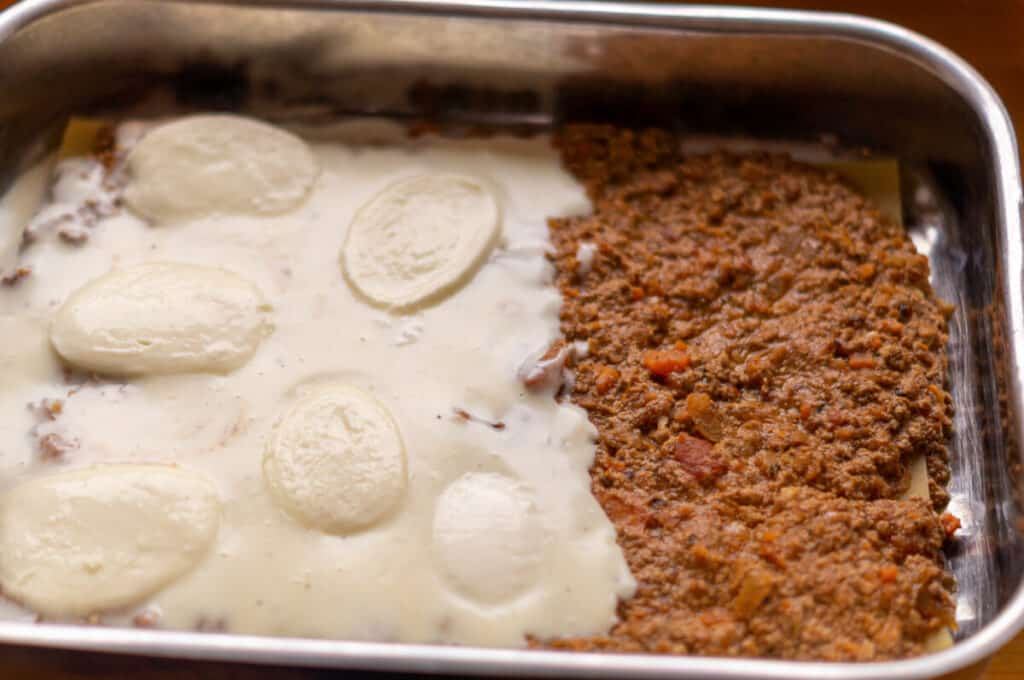
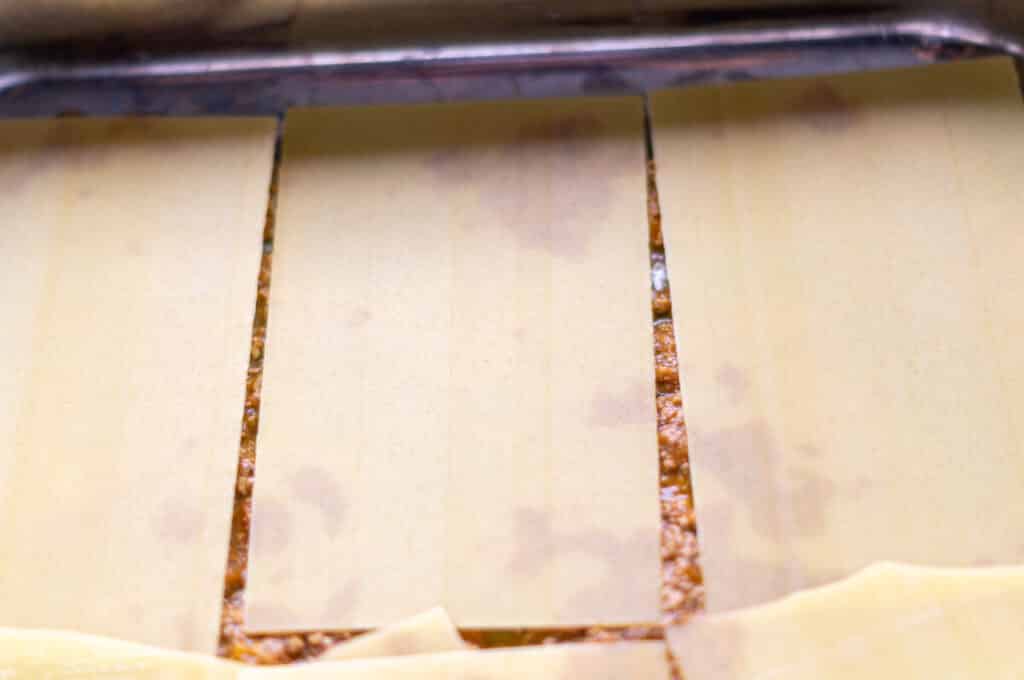
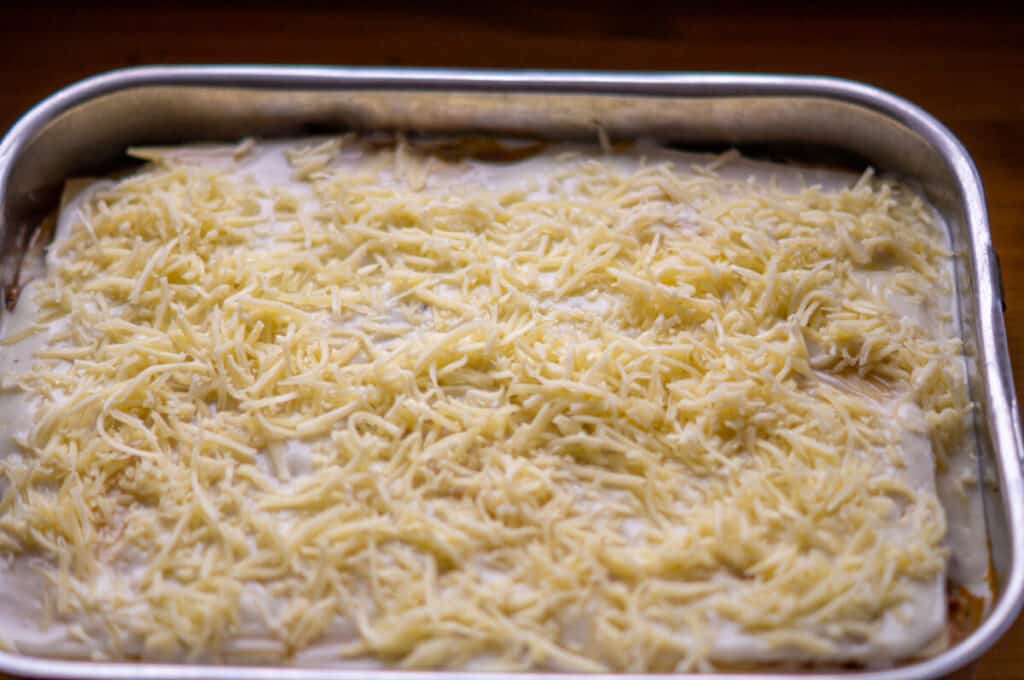
Spread a thin layer of meat sauce on the base of the baking dish, then lay the lasagne sheets on top. Layer with meat sauce, a little bechamel sauce, Mozzarella slices and lasagne sheets again. Repeat. Spread bechamel sauce over the final lasagne sheets, scatter the Emmental cheese on top and bake on the middle shelf of the oven for 35 minutes.
-
10
Serve.
Remove the lasagne from the oven, leave to cool for 5 minutes, cut into portions and serve.
Tip: For a vegetarian lasagne, simply replace the minced meat with vegetarian mince.
Video
Nutrition per serving
Why Bolognese and bechamel turn out better in the Thermomix®
The Bolognese starts by chopping the onions, garlic and carrots for 5 seconds at speed 5. By hand that would take 8 to 10 minutes of dicing and you would never get such an even result. The Thermomix® chops the vegetables finely enough that they melt into the sauce as it cooks and bind it to a smooth consistency. We then sweat the olive oil and vegetables for 3 minutes at Varoma. Then the 400 g of minced meat goes in, 5 minutes at Varoma in reverse direction. The reverse direction matters here: in normal direction the mince would be crushed to a paste, but in reverse direction it stays crumbly and keeps the texture that a proper Bolognese needs.
When deglazing with 100 g of red wine and 400 g of chopped tomatoes we add 3 tsp of vegetable stock powder and 3 tsp of dried basil straight away, then cook for 7 minutes at 100°C in reverse direction. Anyone with more time can leave the sauce to simmer on with the lid off afterwards, the longer it goes the rounder the flavour. We do that while setting up the bechamel or laying the table. Before layering, season thoroughly: salt and pepper are often missing, as the stock and tomatoes bring some seasoning but rarely enough.
The bechamel is made in the same mixing bowl once we have removed the Bolognese and given it a quick rinse. We melt 60 g of butter for 2 minutes at 100°C, then add 60 g of flour and sweat it for 2 minutes at Varoma. Those two minutes matter, otherwise the sauce tastes of raw flour. We then pour in 600 g of milk, season with salt, a pinch of nutmeg and pepper, and cook for 10 minutes at 90°C at speed 3. This is the moment where the Thermomix® solves a classic problem: bechamel lumps on the hob the moment you stop stirring. In the mixing bowl that does not happen. 90°C is enough to bring it to a smooth, thick consistency without it catching on the bottom.
Layer with dry sheets so the lasagne holds together
We spread a thin layer of Bolognese on the base of the baking dish first, otherwise the lasagne sheets stick. Then we lay down the first 3 to 4 dry sheets, followed by Bolognese, a ladle of bechamel, a few Mozzarella slices, then sheets again. We repeat this pattern until the dish is full, getting at least three layers. The final lasagne sheets get a generous covering of bechamel, then the grated Emmental on top. The top layer must be completely covered with bechamel, otherwise the sheets dry out in the oven and go hard.
35 minutes at 200°C top and bottom heat on the middle shelf is enough to cook the sheets through and at the same time turn the cheese layer golden brown. If the cheese browns too quickly after 25 minutes, we loosely cover the dish with foil for the final 10 minutes. After baking there must be a 5-minute rest, otherwise the sauce runs out when cutting and the layers slide apart.
Where most lasagnes go wrong
The lasagne is soggy at the bottom
This happens when the Bolognese goes into the dish too runny, or when the sheets were pre-cooked. The sauce should have the consistency of a thick ragù after cooking, dropping from the spoon but not running freely. Our solution: If the Bolognese is too thin, we let it reduce for a further 5 minutes at Varoma with the mixing bowl lid off. And lasagne sheets ALWAYS go in dry.
The top sheets go hard
If the top layer is not completely covered with bechamel, the sheets dry out in the oven, their edges become brittle and they do not bite through properly. Our solution: The final sheet layer really does need a generous amount of bechamel, better too much than too little. Only then add the cheese. If the bechamel is running short, it is better to leave out an extra layer.
The Bolognese tastes flat
With only 7 minutes of cooking time a Bolognese does not develop its full depth. That is enough for a quick weekday version, but the full flavour only comes with slow cooking. Our solution: Anyone with time can let the sauce simmer for a further 20 to 30 minutes in a normal pot over low heat after the Thermomix® cooking. A splash of milk or double cream takes the edge off the acidity of the tomatoes and rounds out the sauce. Adding a bay leaf to cook alongside deepens the flavour further.
Variations we have already tried
Vegetarian with lentils or mushrooms: Instead of minced meat we use 200 g of red lentils plus 200 g of finely diced button mushrooms. The lentils absorb the tomato juices as they cook and mimic the texture of mince surprisingly well. Anyone who prefers vegetarian mince can substitute it 1:1, but cook for only 3 minutes rather than 5, otherwise it dries out.
With spinach instead of Mozzarella in the layers: 300 g of defrosted, well-squeezed frozen spinach between the sauce layers gives the lasagne more colour and a slightly bitter contrast to the bechamel. We then save the Mozzarella for the top layer.
With a Ricotta layer: We mix 250 g of Ricotta with one egg yolk and a little nutmeg, and use it in place of one of the bechamel layers in the middle. This makes the lasagne noticeably more Italian and creamier, but requires no extra baking time.
What else to put on the table
We classically serve the lasagne with a green salad, which offsets the richness of the bake. A bowl of rocket with shaved Parmesan and balsamic vinegar goes almost better than any other salad. For anyone who wants bread alongside: our pizza dough from the Thermomix® works just as well baked as small pieces of Focaccia. We have described the homemade bechamel sauce in the Thermomix® in more detail in a separate recipe, for anyone who needs it for other bakes or cannelloni.
Storing and freezing
In the fridge the lasagne keeps covered for 3 to 4 days. Reheated it often tastes even better, as the flavours have had time to develop. To reheat, we place individual portions in a small baking dish, drizzle with a little milk and bake covered at 180°C for 15 to 20 minutes. In the microwave it goes mushy, so we avoid that.
Goes well with: Parmesan and Ciabatta.
Also worth trying: Cacio e Pepe Thermomix®.
Freezing works very well. We portion the fully baked lasagne into individual pieces, pack them into freezer containers and freeze for up to 3 months. Defrost overnight in the fridge, then reheat as described above. To freeze unbaked: that also works, but bake directly from frozen at 180°C for 60 minutes, then 10 minutes at 200°C to brown the top.
More Italian classics in the Thermomix® can be found in our pizza dough recipe and our recipe for bechamel sauce.