Lemon salt made in the Thermomix® only works if the lemon zest is ground before the remaining salt is added. Otherwise the essential oils do not distribute evenly and the salt ends up tasting of lemon in some spots while other areas are completely bland.
We make lemon salt in larger batches and give it away regularly. The two-phase method has proved to be the only reliable way to do this.
Lemon Salt with the Thermomix®
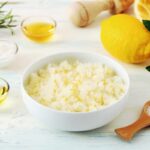
Ingredients 0 / 4 ✓
- 100 g salt coarse
- 10 g lemon zest organic, untreated, cleaned
- 2 tbsp mixed peppercorns
- 1 tbsp fenugreek seeds
Instructions 0 / 3
-
1
Pulverise.
Place 50 g salt, lemon zest, mixed peppercorns and fenugreek seeds into the mixing bowl and pulverise for 1 min / speed 10.
- 100 g salt
- 10 g lemon zest
- 2 tbsp mixed peppercorns
- 1 tbsp fenugreek seeds
-
2
Mix.
Add the remaining salt and fold in for 10 sec / speed 3.
-
3
Fill.
Fill into sterilised, dry jars and use as needed.
Alternative: If you prefer a fine salt rather than a coarse one, you can pulverise all the salt at once.
Note: Make sure to use untreated fruit. Wash your lemons thoroughly before peeling them.
Tip: You can also use orange zest, or a mix of lemon and orange zest.
Video
Nutrition per serving
Why the zest is ground first
Lemon zest contains essential oils stored in tiny glands just beneath the surface. When you pulverise at speed 10, these glands burst and the oil is released. With only 50 g of salt in the mixing bowl, the oil spreads across a small amount of material and can distribute evenly when the remaining salt is folded in afterwards.
If you add all 100 g of salt from the start, the zest will still be ground, but the oil immediately clings to too much salt and forms clumps. These clumps will not break up again, even with longer blending.
Which salt we use
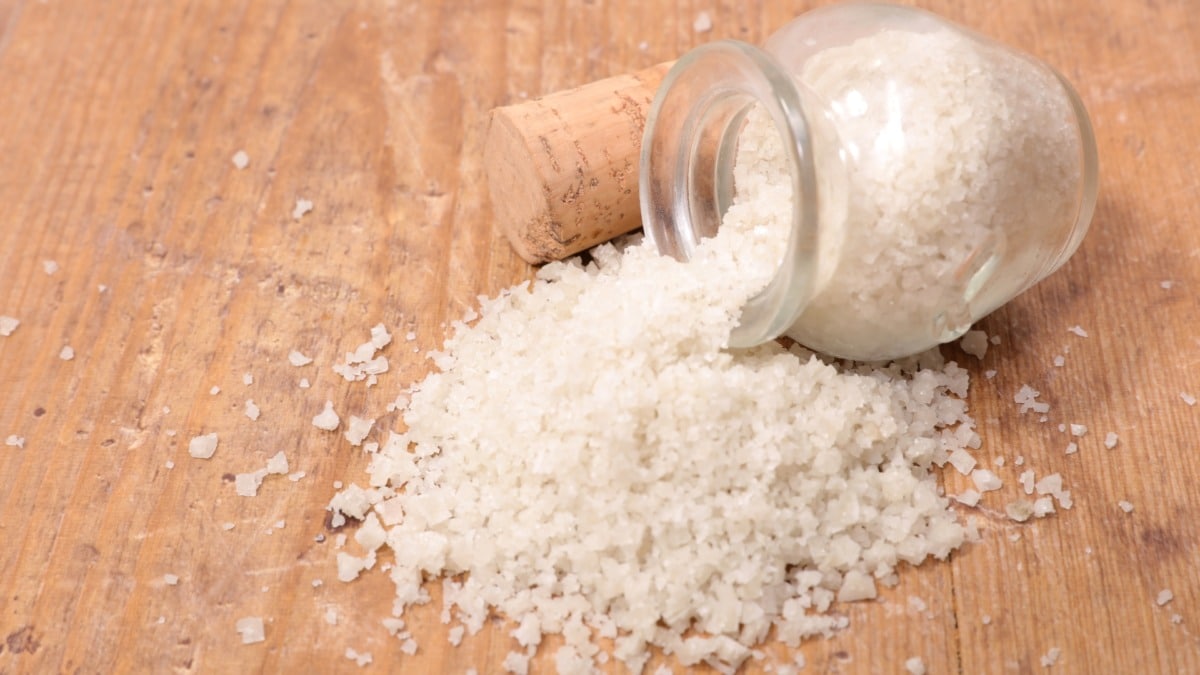
We use medium-coarse sea salt for this recipe. Sea salt retains a small amount of residual moisture and absorbs the essential oils from the lemon zest more readily than bone-dry rock salt. Fleur de sel also works, but it is a waste for a salt that will be pulverised in the Thermomix®. The delicate flakes break up anyway.
We do not use iodised table salt from the supermarket. The added iodine gives a faintly metallic aftertaste that clashes with the lemon. If table salt is all you have at home, it will do in a pinch, but the result is noticeably flatter.
Coarse or fine
The recipe card calls for 50 g of salt to be pulverised, with the remaining 50 g left coarse. This gives a blend that sticks to the finger but still has some texture.
If you prefer a fine lemon salt, add all 100 g of salt in the first step so everything gets pulverised. The downside is that oil distribution is less even and you will need an extra 30 seconds at speed 10 for the flavours to spread properly.
Dried zest or fresh
We use fresh zest. The version where you pre-dry the zest for 2 to 3 days on a sheet of baking paper does produce a longer-lasting salt, but at the cost of flavour. Essential oils measurably evaporate during air-drying. Freshly grated zest releases far more fragrance into the salt.
To keep the salt dry regardless, we spread it on a baking tray for 15 minutes at 60 degrees fan-assisted after blending. The residual moisture evaporates while the aroma stays locked into the salt. If you do not want to switch the oven on, simply leave the salt uncovered on a plate for 24 hours. Both methods work.
Fenugreek as a hidden flavour booster
Fenugreek seeds have a slightly nutty, almost caramel-like flavour. In this lemon salt they stop the lemon from tasting too sharp. Without fenugreek the salt smells like cleaning fluid. With 1 tbsp of fenugreek it becomes a well-rounded seasoning salt.
The mixed peppercorns add heat and visual accents. If that is too much for you, reduce to 1 tbsp. Going below 1 tbsp, however, makes the salt flat.
Organic and untreated only
Lemons from the supermarket are usually coated in wax or treated with preservatives. These substances sit on the skin and cannot be washed off completely. In lemon salt they would be ground in along with everything else, making the salt inedible.
Only buy lemons labelled “untreated” or “organic”. Wash them thoroughly under warm water and dry them before zesting.
Orange zest as an alternative
Orange zest works on exactly the same principle as lemon zest. The flavour is sweeter and less sharp. A mix of 5 g lemon zest and 5 g orange zest produces a well-balanced citrus salt.
Important: oranges must also be organic and untreated. With conventionally grown oranges the wax coating is often even thicker than on lemons.
Sterilising jars
The salt itself keeps indefinitely. Moisture is the only enemy. If the jar is not completely dry, the salt will draw in the residual moisture and clump together.
Sterilise the jars in boiling water for 10 minutes and leave them to cool completely on a clean tea towel. Only fill them once they are fully dry. Seal the jars immediately after filling.
A small trick from Grandma’s pantry: we place a single uncooked grain of rice in each jar. The rice grain draws the tiniest bit of residual moisture from the air and the salt stays free-flowing, even if the jar is opened frequently. One grain is enough for a 200 ml jar, you do not need more.
As a gift in a screw-top jar
Lemon salt is one of our standard dinner party gifts. We fill it into small 100 ml clip-top jars, stick on a handwritten label with the date and a serving suggestion, and it is ready. The materials cost under two euros per jar and the whole thing takes ten minutes for six jars.
At Christmas we pair the jar with homemade rosemary oil and a wooden spoon to make a small gift set. One important detail for the label: include a best-before date (six months from filling), even though the salt technically keeps longer. That way the aroma is always at its freshest.
How we use the salt
Lemon salt goes well on grilled fish, pan-fried chicken and in salad dressings. We also sprinkle it over roasted vegetables before they go into the oven. The lemon note intensifies with the heat.
For pasta or risotto the salt is too intense. The lemon flavour would dominate the dish.