A bunch of parsley keeps in the fridge for five days before it turns yellow. Ground into coarse sea salt, that same bunch stays good for six months without losing its aroma. This is not nostalgia from a grandmother’s pantry, it is simple food chemistry: salt draws out water, and without water there is no spoilage.
We have been making our herb salt in two versions for years. The quick version uses dried herbs from the storecupboard and is ready in ten minutes. The summer version uses 300 g of fresh herbs from the garden, which we pre-dry in the oven at 50°C for one hour before they go into the mixing bowl. Both go into screw-top jars and sit within arm’s reach next to the pepper mill and the olive oil all year round.
Mediterranean Herb Salt with the Thermomix®
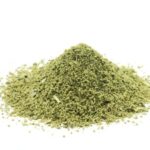
Ingredients 0 / 7 ✓
- 1 garlic clove
- 150 g coarse salt
- 4 tsp dried rosemary
- 2 tsp dried oregano
- 2 tsp dried thyme
- 2 tsp dried marjoram
- 4 tsp dried basil
Instructions 0 / 2
-
1
Peel the garlic clove, add to the mixing bowl, chop for 3 sec / speed 8 and push down with the spatula.
-
2
Add the remaining ingredients to the mixing bowl and chop for 10 sec / speed 9.
Nutrition per serving
Why 250 g of salt to just a few tablespoons of herbs
The ratio in the basic recipe looks unbalanced at first glance. 250 g coarse sea salt, plus around 7 tbsp of herbs and 1 tsp of chilli flakes. The logic: the salt is not just a seasoning here, it is a preservative. It removes every trace of free moisture from the mixture, and that is precisely why the jar keeps for six months without anything going mouldy or musty. If you reverse the ratio and use more herbs than salt, you get a lovely green mixture that develops mould spots by April.
The Thermomix® is the right tool for this step because it grinds the herbs and the salt at a single speed: 10 seconds at speed 10, push down once with the spatula, and if needed run for a further 5 seconds at speed 10. Two things happen at once. The salt crystals break open the herb cells and release the essential oils, while the salt surfaces bind the aromatic compounds. In a pestle and mortar this takes twenty minutes and never comes out as even.
Fresh herbs need a drying step first
The most common question about this recipe is about fresh herbs from the garden. The answer: they work, but only with an extra drying step. We harvest 300 g before the plants flower, pick off the leaves, rinse them in cold water and shake them dry in a tea towel. They then go onto a baking-paper-lined tray in the oven. 50°C fan, one hour, door left slightly ajar so the moisture can escape. Using 60°C risks brown edges and lost essential oils. Skipping the drying step and grinding wet leaves directly with salt produces a green paste that shows mould spots within three weeks.
After drying, the home-dried herbs replace the dried herbs from the basic recipe. The grinding process is identical and the ratio of salt to herbs stays the same. We use 40 g coarse salt to 300 g fresh herbs for the drying step itself, then grind the dried mixture with the remaining 210 g of salt from the recipe.
Three blends, three characters
We give you three recipes in this post. The classic blend with wild garlic, parsley, thyme, marjoram, oregano, rosemary and chilli flakes works with almost everything: roasted vegetables, fried potatoes, salad dressing, tomato soup. The garlic version uses one fresh garlic clove, chopped for 3 seconds at speed 8 and then processed with 150 g salt and herbs. It tastes noticeably rounder than any garlic-granule blend from the supermarket, because the fresh allicin is released during grinding.
The Mediterranean herb salt is our favourite blend for pasta, pizza and Bruschetta. 4 tsp rosemary, 4 tsp basil, 2 tsp each of oregano, thyme and marjoram, plus one garlic clove and 150 g coarse salt. If you want Italy in a jar, use this blend. It keeps for around four to five months, slightly shorter than the classic version, because the basil content is high and basil loses its aroma faster than rosemary or thyme.
What really happens during storage
Three things determine shelf life: how dry the herbs are, how airtight the jar is, and protection from light. We fill clean screw-top jars straight after grinding, press the salt down gently with a dry spoon and seal them immediately. Our jars live on the kitchen shelf, not on the windowsill. Sunlight bleaches the green colour within eight weeks, and the flavour suffers soon after.
If the salt clumps after two weeks, one herb was not quite dry enough. This is not a disaster. We put the open jar in the oven at 50°C for one hour, let it cool and seal it again. The flavour does not change, and the clumping usually resolves itself. Grey, blue or black mould spots, on the other hand, are a stop signal. The jar needs to go. Mould in salt is rare, but it happens when the herbs were too moist.
Where herb salt really shines
We use our herb salt wherever plain salt would be too one-dimensional. Over baked potatoes just before serving, because the heat opens up the essential oils immediately. In potato soup made with the Thermomix®, once the soup is already creamy and just needs one final seasoning note. On tomatoes with Mozzarella, a drizzle of olive oil and nothing else. In a salad dressing with mustard, vinegar and oil, instead of separate salt and a herb mix. On grilled meat directly after turning, never before, because salt draws out the juices and the herbs would burn on the grill.
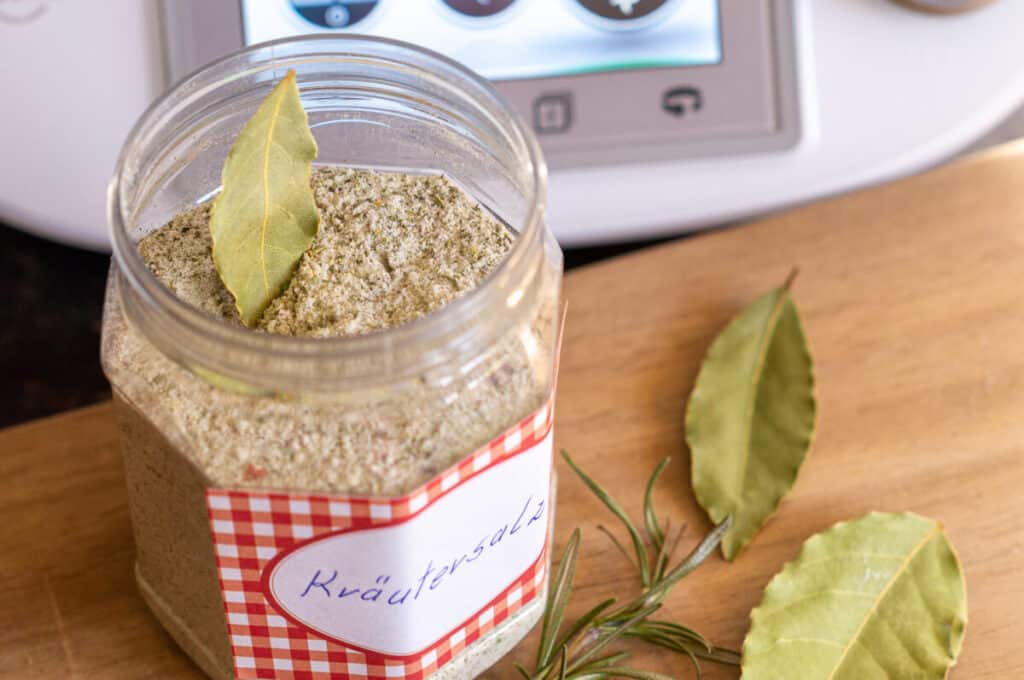
Filled into small screw-top jars with a handwritten label, herb salt also makes a gift that feels far more personal than a bottle of wine. For a larger batch we simply scale up the basic recipe and fill from the mixing bowl into several 90 ml jars. One run gives you four to five gifts.
6 months, sealed tight and kept in the dark
In a sealed screw-top jar, kept dark and at room temperature, the classic herb salt stays aromatic for six months. The Mediterranean blend with its high basil content lasts around four to five months, after which the flavour fades, though it is still usable. Older herb salt that is no longer quite fresh goes into stocks and braises, where the loss of aroma does not show.
We have gathered more basic recipes for the Thermomix® in our basic recipes collection.
Goes well with: Pasta.
Also great with: Lemon Salt Paste Thermomix®.
Freezing is neither necessary nor sensible. Salt draws in moisture from the freezer environment as soon as the jar is opened, causing it to clump irreversibly. Dry storage is the correct method.