We knead the olives in AFTER the first proving time. That is the difference from most other recipes. Olive brine inhibits the yeast. If the olives are in the dough from the start, the bread turns out denser and less airy.
The recipe takes 85 minutes in total, including 50 minutes of pure proving time. The Thermomix® handles the rest in 10 minutes: chopping the walnuts, activating the yeast, kneading the dough, and working in the olives. The oven forms the crust at 225°C in 25 to 30 minutes.
Olive and Walnut Bread with the Thermomix®
Ingredients 0 / 7 ✓
- 50 g walnut halves
- 125 g water
- 1/2 cube fresh yeast
- 40 g olive oil + more for brushing
- 1 tsp salt
- 250 g plain flour (Type 550) + more for dusting
- 100 g black olives (pitted)
Instructions 0 / 7
-
1
Chop the walnuts.
Place the walnuts in the mixing bowl and chop for 3 sec / speed 5, then set aside.
-
2
Warm the yeast.
Add the water, yeast and olive oil to the mixing bowl and warm for 2 min / 37°C / speed 2.
-
3
Knead the yeast dough.
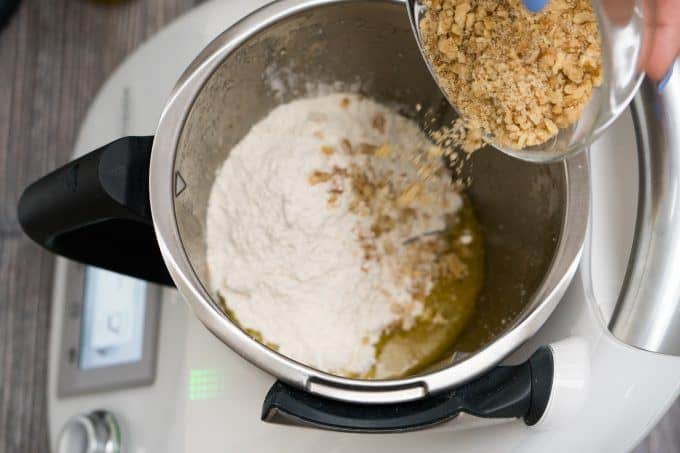
Add the salt, flour and chopped walnuts to the mixing bowl and knead for 3 min / kneading mode, then set aside, cover with a tea towel and leave to rise for 50 minutes.
-
4
Chop the olives.
Meanwhile, place the olives in the mixing bowl and chop for 2 sec / speed 4.
-
5
Preheat the oven.
Preheat the oven to 225°C (fan: 200°C, gas: mark 6-7) and line the baking tray with baking paper.
-
6
Knead in the olives.
Add the dough to the olives in the mixing bowl and knead for 1 min / kneading mode.
-
7
Bake the bread.
Dust the work surface with flour, shape the dough into a loaf, place it on the baking tray and bake on the middle shelf for 25 to 30 minutes.
Variation: Add chilli peppers, sun-dried tomatoes or rosemary needles to the bread dough. Simply chop them in Step 4 together with the olives.
Nutrition per serving
Why the olives go in after proving
Olives contain salt and brine. Both draw moisture out of the dough and slow down the yeast. If we knead the olives straight in with the flour and yeast, the dough takes longer to rise or stays more compact. That is why we chop the 100 g of black olives only after the 50 minutes of proving time and then knead them in for 1 minute on kneading mode.
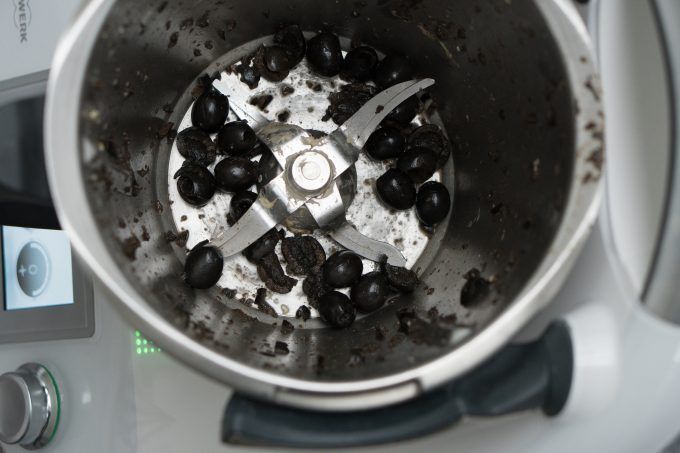
The second kneading distributes the olives evenly without deflating the already airy dough too much. Kneading mode protects the gluten structure that has developed during the 50 minutes.
Chop the walnuts first and set aside
The 50 g of walnut halves go into the mixing bowl at speed 5 for 3 seconds. This gives coarse pieces, not a nut paste. We want texture and bite, not a smooth mash. After chopping, remove the nuts and add them back later with the flour.
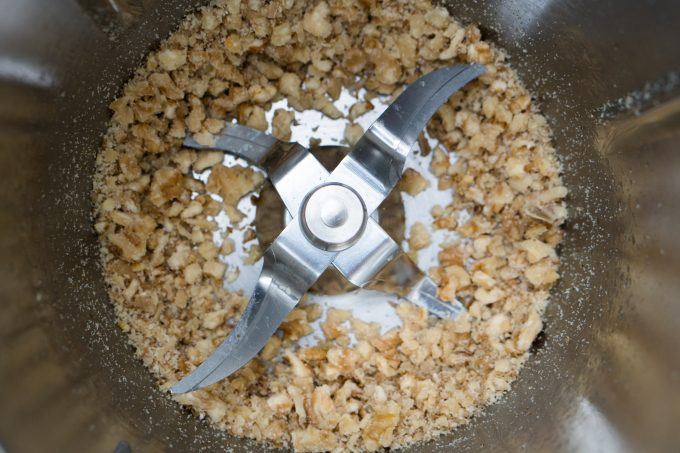
If you prefer not to use walnuts, cashews or pine nuts work equally well. Keep the quantity the same. Cashews give a milder flavour, while pine nuts are finer and more expensive.
Activating the yeast at 37°C
We warm 125 g of water, half a cube of fresh yeast and 40 g of olive oil for 2 minutes at 37°C on speed 2. This is the optimum temperature for yeast. At 40°C and above the yeast dies; below 30°C it becomes sluggish. 37°C is the sweet spot we have used for years.
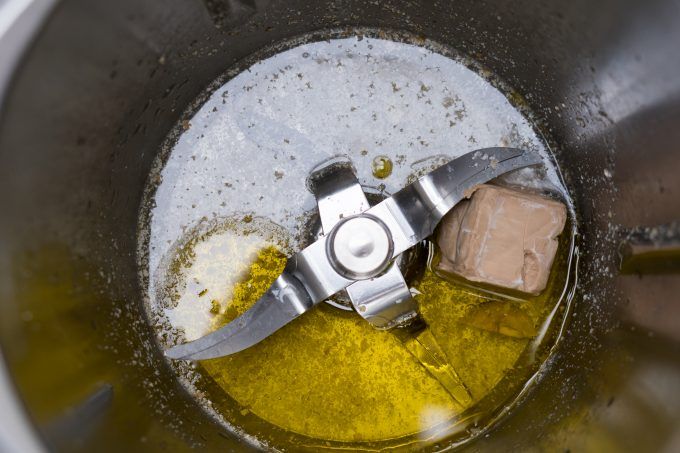
The olive oil makes the dough more supple and gives a finer crumb. Without oil the bread turns out drier. 40 g is the minimum for a 250 g flour recipe.
3 minutes on kneading mode for an elastic dough
After activating the yeast, add 1 tsp of salt, 250 g of plain flour Type 550 and the chopped walnuts to the mixing bowl. Three minutes on kneading mode develops the gluten. The dough becomes elastic and smooth. Too short and the bread will be dense. Too long and the gluten is overstretched, causing the dough to tear during proving.
Transfer the dough to a large bowl, cover with a tea towel and leave to rise in a warm spot for 50 minutes. In winter we place the bowl on a warm radiator or inside the switched-off oven with just the light on. In summer, room temperature is fine.
225°C for a crispy crust
The oven must be fully preheated to 225°C top and bottom heat before the bread goes in. Fan setting: 200°C. This high temperature caramelises the starch on the surface and creates the crispy crust. At 180°C the bread stays pale and soft.
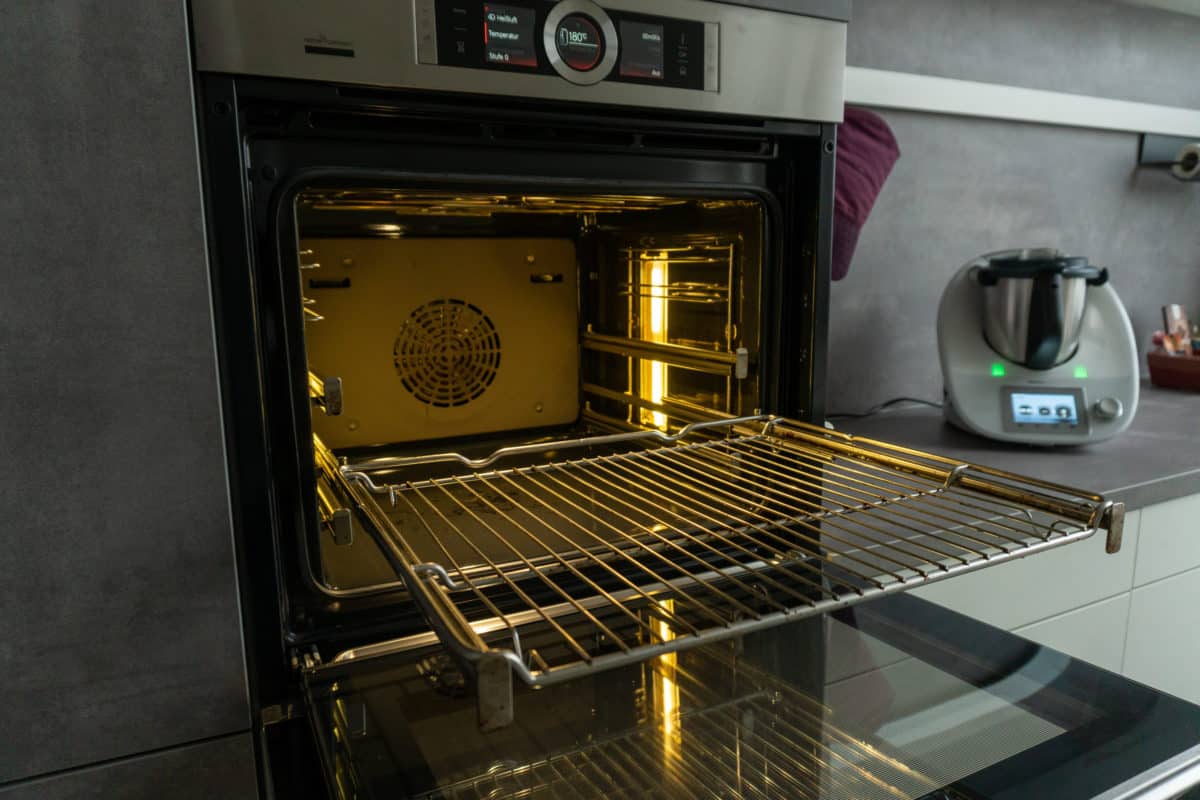
Bake the bread on the middle shelf for 25 to 30 minutes. Check after 20 minutes: if the crust is already very dark, lay a loose sheet of foil over the top. This prevents burning without reducing the heat.
Shaping the dough into a round loaf
After the second kneading (1 minute with the olives), turn the dough out onto a floured work surface. Use your hands to shape it into a ball, working from the outside in and pulling the surface taut. This gives the loaf tension so it rises evenly in the oven.
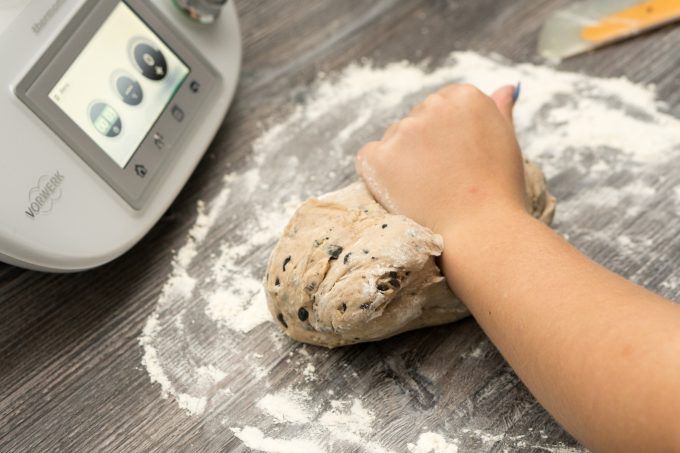
If you like, score a cross or diamond pattern into the surface with a sharp knife or a razor blade. This is not just decorative: the cuts let steam escape and prevent the crust from splitting in random places.
Leftovers the next day
Serve with: butter, hummus and cheese.
Also pairs well with: Swabian bread rolls with the Thermomix®.
The bread keeps for 3 to 4 days in a bread bin or wrapped in a tea towel. Avoid plastic bags as they soften the crust. Freezing works well: slice the bread, freeze in portions in a freezer bag, and toast individual slices straight from frozen whenever needed.
More bread recipes: Mediterranean rolls, farmhouse bread, pizza dough.