Mie noodles and reverse direction always go hand in hand for us. Anyone who runs the mixing bowl in normal direction with these long, thin egg noodles ends up with 2 cm little fragments on the plate instead of long strands. That is why this one-pot recipe explicitly calls for reverse direction in three consecutive steps, and that is exactly what sets it apart from an Asian stir-fry done in a regular pan.
This recipe is our classic Thursday dish. We originally put it together because by the evening we had no energy left for a wok, a frying pan, and three chopping boards. These days it comes around so often that we know the quantities by heart: 600 g vegetable stock, 150 g mie noodles, 200 g white cabbage, 200 g Chinese cabbage. From those ingredients, four servings are ready in 25 minutes without touching a second pot.
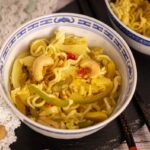
Quick Asian Noodles with the Thermomix®
Ingredients 0 / 17 ✓
- 1 piece ginger 2 x 2 cm
- 1/2 chilli
- 100 g celery
- 3 spring onions
- 2 peppers yellow, green
- 200 g white cabbage
- 2 tbsp curry oil
- 600 g vegetable stock
- 150 g mie noodles
- 1/2 tsp salt
- 1 tsp curry powder
- 150 g tinned pineapple drained weight
- 50 g pineapple juice
- 200 g Chinese cabbage
- 20 g soy sauce
- 30 g sweet chilli sauce
- 40 g cashew nuts
Instructions 0 / 5
-
1
Chop the vegetables.
Peel the ginger, add to the mixing bowl together with the chilli and chop for 3 sec / speed 8. Peel the celery, cut into pieces and add. Wash the spring onions, halve them, add to the mixing bowl, chop for 5 sec / speed 5 and push down with the spatula.
-
2
Cook the vegetables.
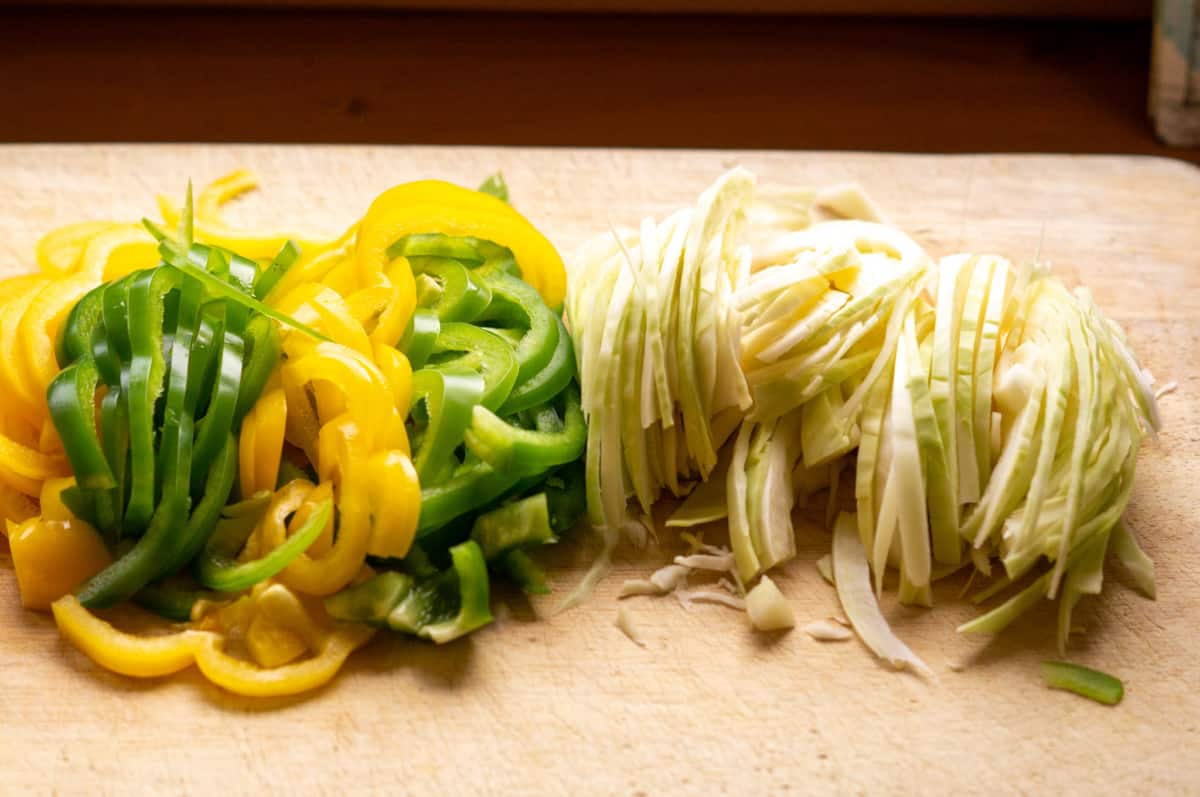
Wash the peppers, halve them, remove the seeds and stalk, cut into thin strips and add. Trim the white cabbage, remove the stalk, cut into fine strips, add together with the curry oil and steam for 6 min / Varoma / reverse direction / speed 1.
-
3
Add remaining ingredients and cook.
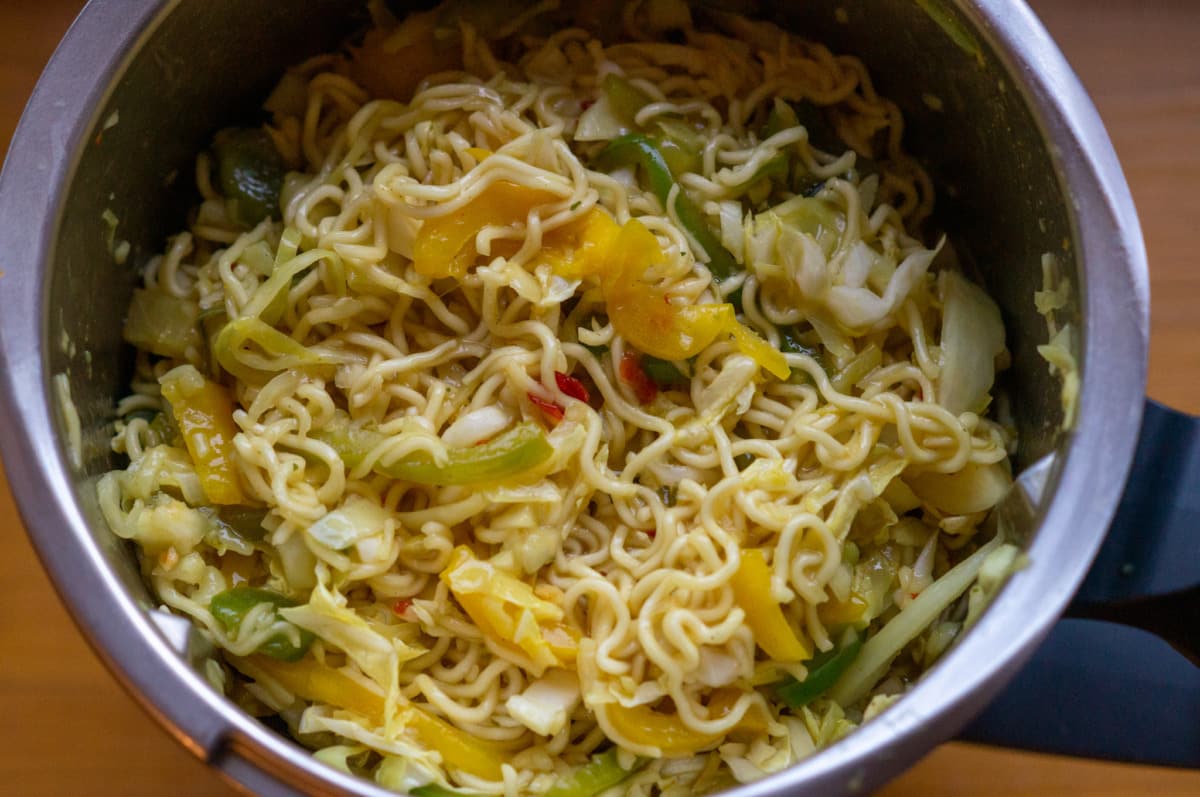
Add the vegetable stock, mie noodles, salt, curry powder, pineapple pieces and pineapple juice and cook for 5 min / 95°C / reverse direction / speed 1.
-
4
Slice the Chinese cabbage and add.
Wash the Chinese cabbage, cut into strips and add together with the soy sauce and sweet chilli sauce, stir everything with the spatula and finish cooking for 3 min / 100°C / reverse direction / speed 1.
-
5
Serve.
Divide the noodles immediately between plates and serve topped with cashew nuts.
Tip: Make sure the mie noodles are fully covered by liquid when cooking so they cook evenly.
Video
Nutrition per serving
Reverse direction with mie noodles is not optional, it is essential
Mie noodles are thinner than spaghetti and noticeably longer. We buy them at Asian grocery shops as dried bundles that unravel during cooking. That is exactly where things get delicate in the Thermomix®. As soon as the bundles open up, long strands float through the mixing bowl, and if the blade runs in normal direction it cuts those strands into 1 to 2 cm pieces. The end result still tastes fine, but it looks like chopped soup garnish rather than Asian noodles.
In reverse direction the blade runs with its blunt side leading. It pushes the noodles through the mixing bowl instead of cutting them. The same principle applies to spaghetti, glass noodles, and rice ribbon noodles. In this recipe three steps run consecutively in reverse direction: the 6-minute steaming of the pepper and white cabbage, the actual noodle-cooking step with the vegetable stock, and the final 3-minute step with Chinese cabbage and soy sauce. Deviate once and you get fragments.
Soy sauce goes in last, otherwise it turns bitter
We add the 20 g of soy sauce and the 30 g of sweet chilli sauce only in the final step together with the Chinese cabbage. The reason is chemistry. Soy sauce contains amino acids and residual sugars from fermentation that lose their delicate roasted notes after extended cooking above 95°C and instead taste flat and salty. Sweet chilli sauce has the same effect, because the sugar caramelises quickly and tips into bitterness. Three minutes at 100°C is precisely the threshold at which the flavours draw into the dish at their best without breaking down.
Asian Vegetable Rice works exactly the same way: soy sauce goes in only when the rice is almost done. The same principle applies to our Asian Chicken Sweet and Sour recipe. Once you have taken that on board, you immediately taste the difference compared to Asian stir-fries where the sauce cooks along the whole time.
Pineapple and pineapple juice are not decorative, they are functional
We originally tested the recipe without pineapple, because the dish already brings sweet chilli sauce. The result was flat. With the 150 g of pineapple pieces and 50 g of pineapple juice a fruity acidity comes into play that balances the saltiness of the soy sauce. The pineapple enzyme also helps to keep the mie noodles from becoming sticky. If you have no pineapple at home, you can replace it with tinned mango, but add 1 tbsp of lemon juice to maintain the acidity.
Pitfalls we have encountered ourselves
Mie noodles sticking out above the stock
If the bundles are poking out of the stock when you add them, they cook unevenly. The top layer stays hard while the bottom turns mushy. Our fix: before starting the 5-minute step, push the noodles fully under the liquid with the spatula. If that is not enough because the vegetables are sitting too high, add 50 to 100 g of extra stock. It does not affect the flavour, but the noodles cook evenly.
Chinese cabbage turns mushy instead of staying crisp
The Chinese cabbage must not go in with the first ingredients, only in the final 3-minute step. Three minutes at 100°C is enough to soften the strips without them falling apart. If we add the Chinese cabbage earlier, after 8 minutes of total cooking time it becomes a flat mass with no bite. The timing separation of white cabbage first and Chinese cabbage last is the second major lever in this recipe.
Curry oil gives too little flavour
Curry oil is more restrained compared to freshly ground curry or curry paste. That is why, in addition to the curry oil, we add 1 tsp of ground curry powder with the mie noodles into the stock. That way the curry flavour enters the dish once during the initial cooking and once during the simmering step, without becoming overpowering.
Three variations we make regularly
With chicken: Cut 250 g of chicken breast into strips and add after step 1 together with the spring onions and celery. Pre-cook for 4 min / 100°C / reverse direction / speed 1, then continue as normal. This creates a more filling version for Sunday evening.
With peanuts instead of cashews: We occasionally swap the 40 g of cashew nuts for roasted peanuts. The peanuts bring more depth and pair better with the sweet chilli sauce. If you want a sesame note, you can also toast 1 tbsp of sesame seeds and scatter them over the finished noodles.
Spicier: Instead of half a chilli we use a whole one, plus 1 tsp of sambal oelek added with the soy sauce. That takes the dish from family-friendly territory into the heat range of a proper Asian takeaway.
What goes well with one-pot Asian noodles
As a starter we like to make our Pointed Cabbage and Celery Salad, because it stays cool and provides a crisp contrast to the warm main course. Anyone who has not yet mastered the cabbage step in this recipe will find the right speeds and timings in our guide to Shredding White Cabbage in the Thermomix®. For dessert we often serve tinned mango with coconut milk, which saves effort and works beautifully with the sweet chilli note of the main course.
How long the noodles keep
The Asian noodles keep in the fridge in a tightly sealed container for 2 days. We reheat leftovers in a frying pan with 1 tbsp of water, not in the microwave. The microwave makes the noodles rubbery. Freezing does not work reliably because the mie noodles lose their bite after thawing and the Chinese cabbage turns watery. Better to cook a smaller portion than to freeze leftovers.
Once you have cooked this recipe with reverse direction and soy sauce added at the end, you will not want to go back to the pan. More one-pot Asian classics from us: Asian Vegetable Rice, Asian Chicken Sweet and Sour, and our Pointed Cabbage and Celery Salad as a side dish.