Spaghetti with herb cream cheese and mince sauce from the Thermomix® is what we put on the table after long working days. 25 minutes from onion to plate, and the sauce comes out reliably creamy every time. The one thing that matters: cook the vegetable stock and cream cheese together at 90 °C on reverse direction, never hotter. That way the protein does not split and the sauce stays silky.
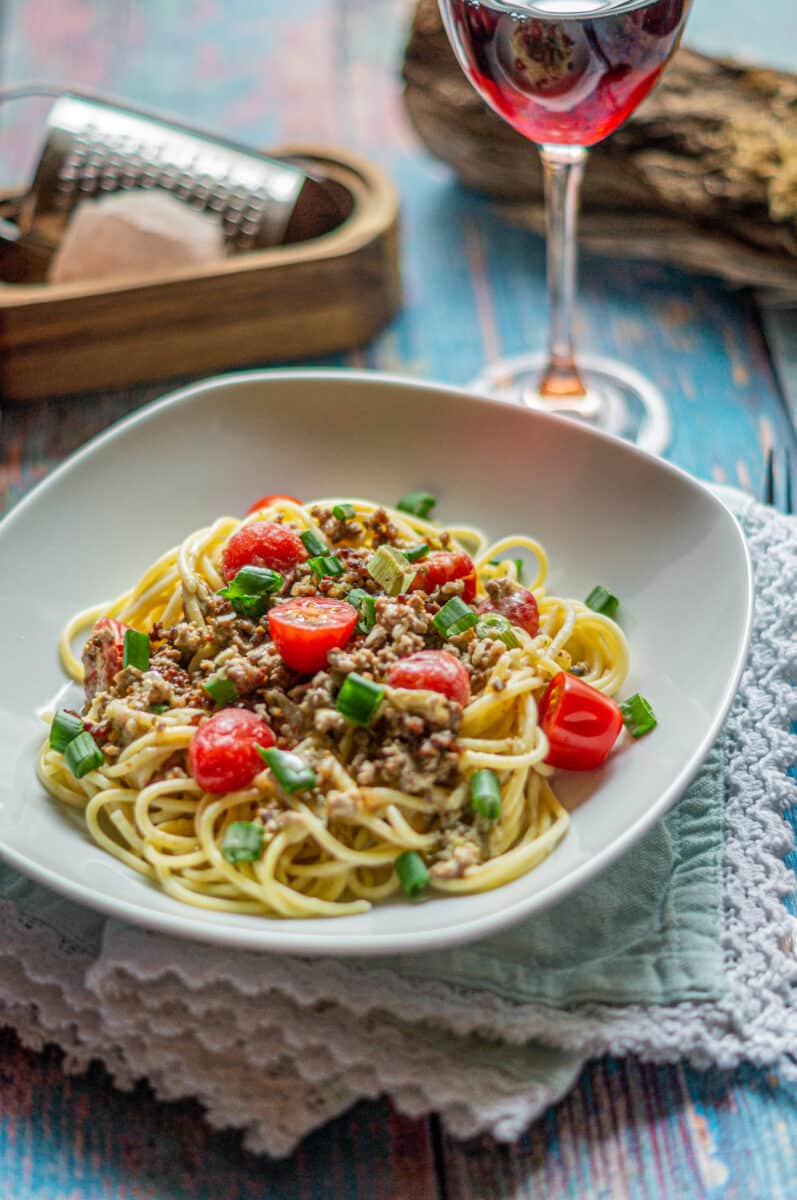
The recipe stands or falls on the cream cheese emulsion. We add 300 g vegetable stock and 300 g herb cream cheese together to the mixing bowl and cook for 6 minutes at 90 °C on reverse direction, speed 1. Any hotter and the cream cheese turns grainy because the proteins split out. Any cooler and the sauce stays thin and separates when it sits. Reverse direction prevents air from being beaten in, which would destabilise the emulsion. This is exactly where the Thermomix® makes the difference: it holds 90 °C precisely while stirring gently at the same time. On the hob you would need to adjust the heat constantly.
Spaghetti with Herb Cream Cheese and Mince Sauce, Thermomix®

Ingredients 0 / 10 ✓
- 500 g spaghetti
- 5 spring onions
- 10 g olive oil
- 300 g vegetable stock
- 300 g herb cream cheese e.g. Bresso® herb cream cheese with Provencal herbs
- 1 tsp Dijon mustard
- 1 tsp white pepper
- 1/2 tsp salt
- 400 g mixed mince (beef and pork)
- 300 g cherry tomatoes
Instructions 0 / 8
-
1
Cook the spaghetti.
Cook the spaghetti in plenty of salted water according to the packet instructions and keep warm.
-
2
Chop the spring onions.
Meanwhile wash and trim the spring onions, slice one into rings and set aside. Place the other four in pieces in the mixing bowl and chop 5 sec / speed 5, then push down with the spatula.
-
3
Sweat.
Add the olive oil to the mixing bowl and steam for 3 min / Varoma / speed 1.
-
4
Cook the remaining sauce ingredients.
Add the vegetable stock, cream cheese, mustard, pepper and salt to the mixing bowl, mix for 5 sec / reverse direction / speed 4 and cook for 6 min / 90°C / reverse direction / speed 1.
-
5
Brown the mince.
Meanwhile fry the mince in a non-stick pan without any fat until crumbly.
-
6
Prepare the tomatoes.
Wash and halve the tomatoes.
-
7
Add the mince and tomatoes.
Add the mince and tomatoes to the mixing bowl and heat for 3 min / 90°C / reverse direction / speed 1.
-
8
Serve the Bresso spaghetti.
Plate the spaghetti with the herb cream cheese and mince sauce and serve garnished with the spring onion rings.
Tip: You can use any pasta you like. If you add 1 tbsp of tomato puree in step 4, the sauce takes on a lovely colour and becomes even more flavoursome.
Nutrition per serving
Why 90 °C is the limit for the cream cheese sauce
Cream cheese is made up of milk protein and fat held in a fine suspension. Above about 95 °C the protein contracts and forces the fat out. The result: small lumps, a watery puddle and a slightly greasy mouthfeel. Many recipes online cook the sauce at 100 °C and shore it up with double cream and cornflour. That only works because the starch and cream fat mask the separation. We do not need that workaround if we keep the temperature cleanly at 90 °C.
The Dijon mustard plays a double role. 1 tsp of it balances the richness of the cream cheese and mince, and the mustard acts as a mild emulsifier that distributes the fat more finely. Medium-hot mustard also works, but Dijon has more acidity and less heat. That suits the Provencal herbs in the Bresso better. If you cannot find herb cream cheese: plain cream cheese plus 1 tsp dried Provencal herbs gives the same result.
Mince in the pan, not in the mixing bowl
We fry the 400 g mixed mince separately in the pan without any fat. In the Thermomix® mince does brown, but it does not go crumbly. It sticks to the base and releases fat into the sauce, which makes it oily. In the non-stick pan the fat separates cleanly, the mince stays loose and we add it to the sauce without any excess fat.
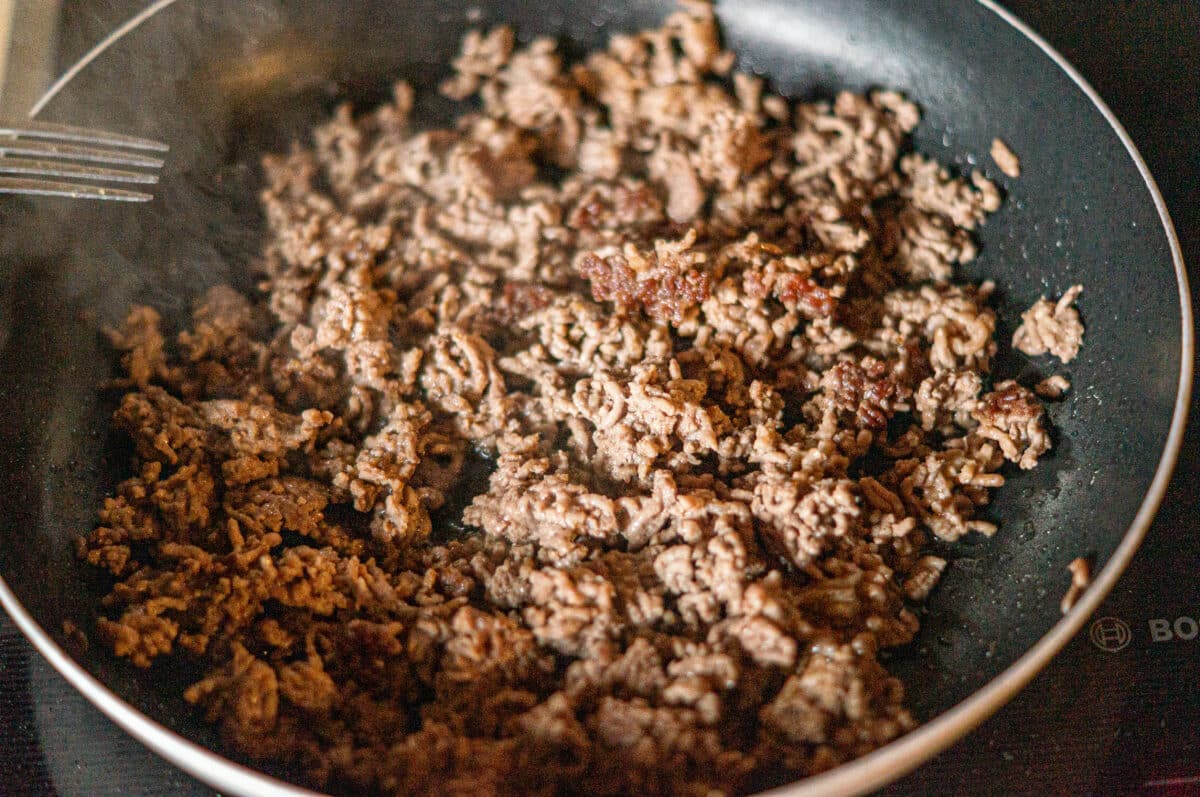
Mixed mince from beef and pork brings more flavour than pure beef mince. The pork fat carries the herbs from the cream cheese better. If you use beef mince, add 1 tsp of olive oil to the pan, otherwise the mince will turn dry.
Spring onions: 4 into the sauce, 1 as a garnish
We chop 4 of the 5 spring onions in the Thermomix® at speed 5 for 5 seconds. That gives fine pieces that soften when sweated. The fifth we slice by hand into thin rings and scatter over the finished spaghetti fresh. This adds bite and a visual contrast.
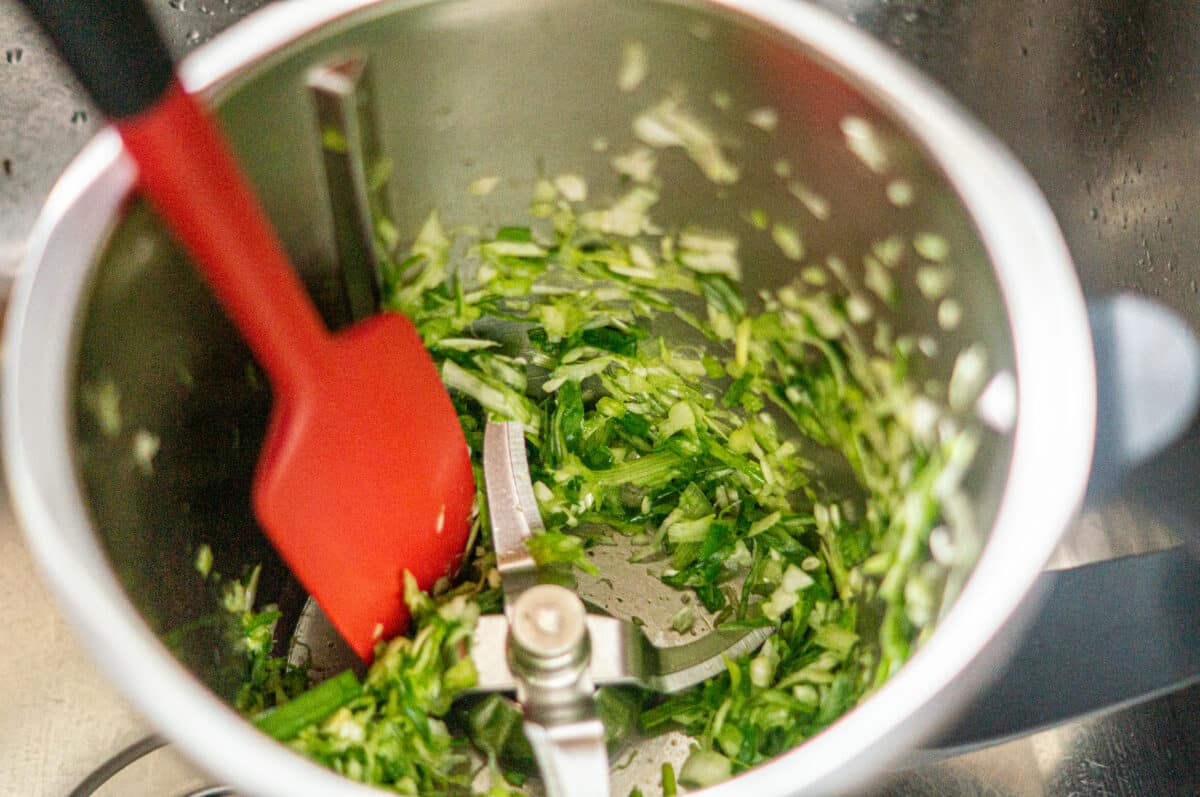
Then 10 g of olive oil goes in and we sweat the onions for 3 minutes at Varoma on speed 1. No longer, or the sugars caramelise and the sauce turns sweet.
Cherry tomatoes halved, not blended
We wash and halve the 300 g cherry tomatoes by hand. In the Thermomix® they would turn to a puree and the sauce becomes too thin. Halved, they keep their shape and give small bursts of acidity when serving. We add the mince and tomatoes only after the cream cheese is cooked and heat everything for just 3 minutes at 90 °C on reverse direction, speed 1. No longer, or the tomatoes burst and water down the sauce.

Spaghetti in the saucepan, the mixing bowl makes the sauce in parallel
We cook the 500 g spaghetti in parallel in a saucepan following the packet instructions. You could theoretically cook them in the Thermomix®, but then the mixing bowl is blocked during the sauce. That division of labour is the whole point of the Thermomix®: while the spaghetti cook on the hob, the mixing bowl chops, sweats and cooks the complete sauce. This saves around 10 minutes compared to working in sequence.
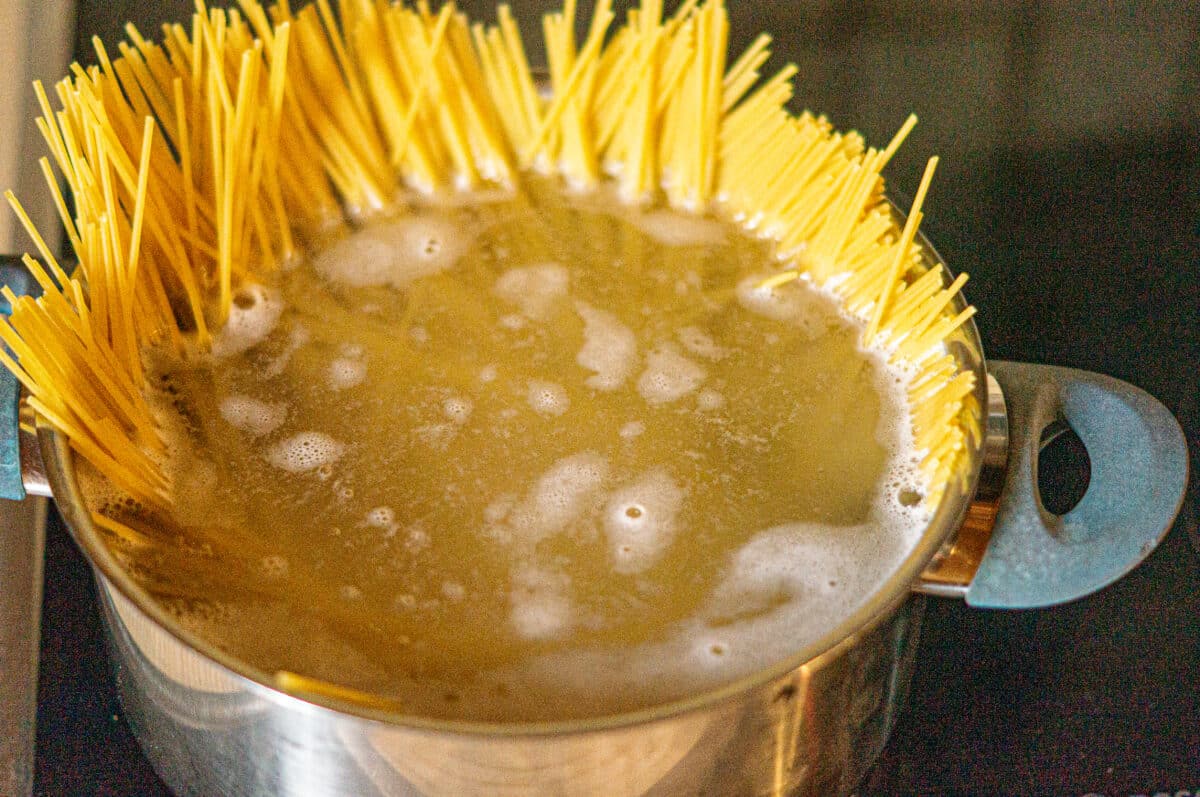
A spoonful of the starchy pasta water is our insurance against the sauce seizing up. If the sauce looks too thick when plating, we stir in 2 to 3 tbsp of pasta water. The starch binds the sauce and keeps the emulsion stable without diluting it.
Three pitfalls that ruin the sauce
The sauce splits and goes grainy
This almost always happens because the temperature is too high. Cooking the sauce at 100 °C or heating the cream cheese for too long drives the protein out of suspension. Our fix: Keep it consistently at 90 °C on reverse direction, speed 1, and after adding the mince and tomatoes heat for no more than 3 minutes. If it has already split, 1 tbsp of cold cream cheese stirred in off the heat will help.
The sauce is too thin
Usually it comes down to too much liquid or a cream cheese with too little fat. Our fix: Use cream cheese with at least 60 per cent fat in dry matter and give it 1 to 2 minutes to rest before serving. The sauce thickens noticeably as it cools. If you are in a hurry, mix 1 tsp of cornflour with 2 tbsp of cold vegetable stock, stir it into the mixing bowl and cook for another 2 minutes at 90 °C.
The mince makes the sauce oily
This comes from the frying fat making its way into the sauce base. Our fix: Fry the mince in the pan and drain off the fat before adding it, or briefly rest the mince on kitchen paper. The flavour stays, the excess fat stays out.
How to adapt the herb cream cheese sauce
With tomato puree for more colour: Add 1 tbsp of tomato puree when cooking the sauce ingredients. The sauce turns a rich orange instead of pale beige and tastes more robust. That said, the recipe is perfectly complete without it.
Vegetarian without mince: Replace the mince with 250 g fried chestnut mushrooms or 200 g plant-based mince. The cream cheese emulsion stays exactly the same.
Bulk it out with vegetables: Add 150 g broccoli florets to the spaghetti cooking water for the last 4 minutes. The vegetables cook at the same time and you need no extra pot.
Spicier: Sweat 1/2 a finely chopped chilli together with the spring onions, or stir 1/4 tsp of chilli flakes into the finished sauce.
Which pasta and sides work well
Short pasta such as penne or fusilli also work instead of spaghetti, as the creamy sauce clings better in the ridges. A simple green salad on the side is all you need. If you are looking for more quick pasta from the Thermomix®, we have the right classics: Spaghetti Bolognese with the Thermomix®, Carbonara with the Thermomix® and a Spelt Bolognese with the Thermomix® as a meat-free alternative.
How to store leftovers properly
The sauce keeps in the fridge for 2 days in a sealed container. When reheating, add 1 to 2 tbsp of water or vegetable stock because the cream cheese thickens further. Warm it slowly over a medium heat and do not bring it to the boil, or the cream cheese will split again. Freezing does not work well because the emulsion separates on thawing and the sauce turns grainy. We store cooked spaghetti separately from the sauce and only combine them when reheating, so they do not go mushy.
Frequently asked questions about the herb cream cheese sauce
Goes well with: Parmesan and Ciabatta.