Wild garlic salt is our answer to a simple question: what do we do with the last two handfuls of wild garlic left in the basket after making pesto, soup, and rolls? The season runs from early March to late May, and then it is gone. Without preserving, the leaves wilt within two days.
We have made our wild garlic salt every spring for years, using 100 g of wild garlic and 100 g of coarse sea salt, an exact fifty-fifty split. That fills a 200 g jar and lasts us around six months. If you push the wild garlic proportion up to 80 percent, you get a more intense salt and also reduce the sodium per pinch. Our standard stays at 50/50 because the salt remains grainy and free-flowing rather than clumping into a green paste.
Wild Garlic Salt with the Thermomix®
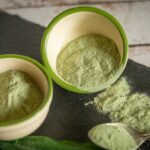
Ingredients 0 / 2 ✓
- 100 g wild garlic
- 100 g coarse salt
Instructions 0 / 4
-
1
Oven.
Preheat the oven to 60 °C and line a baking tray with baking paper.
-
2
Prepare the wild garlic.
Wild garlic leaves wash, pat dry, spread on the baking tray and leave to dry for 1 hour 30 minutes with the oven door slightly ajar. (On newer models, follow the manufacturer's instructions for the "Drying Herbs" programme.)
-
3
Chop with the salt.
Place the wild garlic and salt in the mixing bowl and chop for 8 seconds / speed 10. Spread the mixture on the baking tray and dry in the oven at 60 °C for 1 hour.
-
4
Fill into jars.
Place the coarse wild garlic salt back in the mixing bowl, grind for 15 seconds / speed 10, then fill into a clean, dry preserving jar and store sealed.
Tip: Use this salt to make wild garlic butter, and to season grilled meat, soups, and stews.
Video
Nutrition per serving
Why the wild garlic has to go into the oven twice
This is the step where most wild garlic salt recipes go wrong, and the reason our jar in the cupboard never goes mouldy. Fresh wild garlic is roughly 85 percent water. If we put the leaves straight into the mixing bowl with the salt and chop for 8 seconds at speed 10, the result is a wet green seasoning paste, not a salt. That paste will go mouldy in a sealed jar within two weeks.
So we work in two drying stages. First we dry the washed wild garlic for 1 hour 30 minutes at 60 °C in the oven, with the door slightly ajar so the moisture can escape. On newer models, the built-in programme for drying herbs handles this automatically. The leaves are ready when they crumble to a powder between your fingers. Then we blend them for 8 seconds at speed 10 with the coarse salt. The salt acts as a grinding partner, giving the leaves friction and breaking them down cleanly.
After blending, the mixture goes back onto the baking tray for another hour at 60 °C. The chopping step releases any remaining moisture from the wild garlic, and the salt draws it in. Without this second drying run, you end up with a slightly clumping salt that sticks together in the jar. With it, the salt is free-flowing and keeps almost indefinitely, provided the jar is clean, dry, and sealed airtight.
Picking and preparing wild garlic before it goes into the oven
Wild garlic grows in damp broadleaf woodland, especially under beech trees, and is often confused with lily of the valley or autumn crocus. Both are poisonous. Our most reliable way to tell them apart: rub a leaf between your fingers and smell it. If it smells of garlic, it is wild garlic. If there is no smell, or a floral scent, put the leaf down. Lily of the valley leaves also grow in pairs from a single stalk, whereas wild garlic leaves come up individually from the soil.
We are very thorough when washing. Wild garlic often carries soil and small insects, and nothing gets cleaned in the oven. We fill the sink with cold water, swish the leaves through twice, then pat them dry with a tea towel. We do not cut off the stalks as they taste just as strong as the leaf and will be pulverised in the mixing bowl anyway.
Why grinding everything at once does not work
The recipe deliberately works in two grinding stages. The first pass is 8 seconds at speed 10, which gives a coarse wild garlic salt with clearly visible salt crystals and fine wild garlic flakes. This is exactly the stage we fill into decorative salt mills when the salt is intended as a gift. In the mill it is freshly ground at the table, and the aroma comes through at its best.
For our everyday jar, we go one step further and grind the finished salt again for 15 seconds at speed 10. That makes it fine-grained like table salt, ready to go straight onto buttered bread, into quark, or onto a steak. If you want to keep the aroma at its peak, do not grind everything fine at once. Leave part of it coarse and grind more as you need it. Freshly ground, the aroma is noticeably stronger than after three months in the jar.
What we season with it
Wild garlic salt replaces regular salt for us whenever the garlic and leek aroma is an advantage. On buttered bread with soft salted butter, in homemade quark with chives, in a salad dressing of olive oil and lemon. When grilling, we rub steaks and chicken breast with it ten minutes before putting them on the grill, which gives a green crust and replaces a whole seasoning step. In soups and stews we add it only at the end, otherwise the aroma cooks off.
A quick wild garlic butter works well too: knead 250 g of room-temperature butter with two level teaspoons of wild garlic salt, shape into a roll in cling film, and leave to firm up in the fridge. It keeps there for two weeks, and in the freezer for three months. If you still have fresh wild garlic left over, combine it with our Thermomix® wild garlic pesto, wild garlic soup, wild garlic rolls, and wild garlic spread. If you like the preserving method, our homemade herb salt uses exactly the same approach for parsley, chives, and more.
If the salt turns damp or clumps
Three signs tell us something went wrong in the drying process. First: the salt feels clammy in the jar after a week. The second drying phase was either too short or the oven temperature too low. Spread the salt back onto a baking tray and dry for another 30 minutes at 60 °C.
Second: the salt turns from a bright green to brownish after two months. This happens with too much light or too high a storage temperature. We keep the jar in a kitchen cupboard, not on the worktop, and not next to the hob. The flavour is still fine; it is only the colour that suffers.
Third: small white spots appear on the salt after three weeks. That is mould, and the jar goes in the bin. The cause is almost always residual moisture, meaning the leaves were still green and flexible after the first drying run. Wild garlic must crackle when you touch it after the first oven session. It is better to dry for 20 minutes longer than to risk a mouldy jar.
Wild garlic salt as a gift from the kitchen
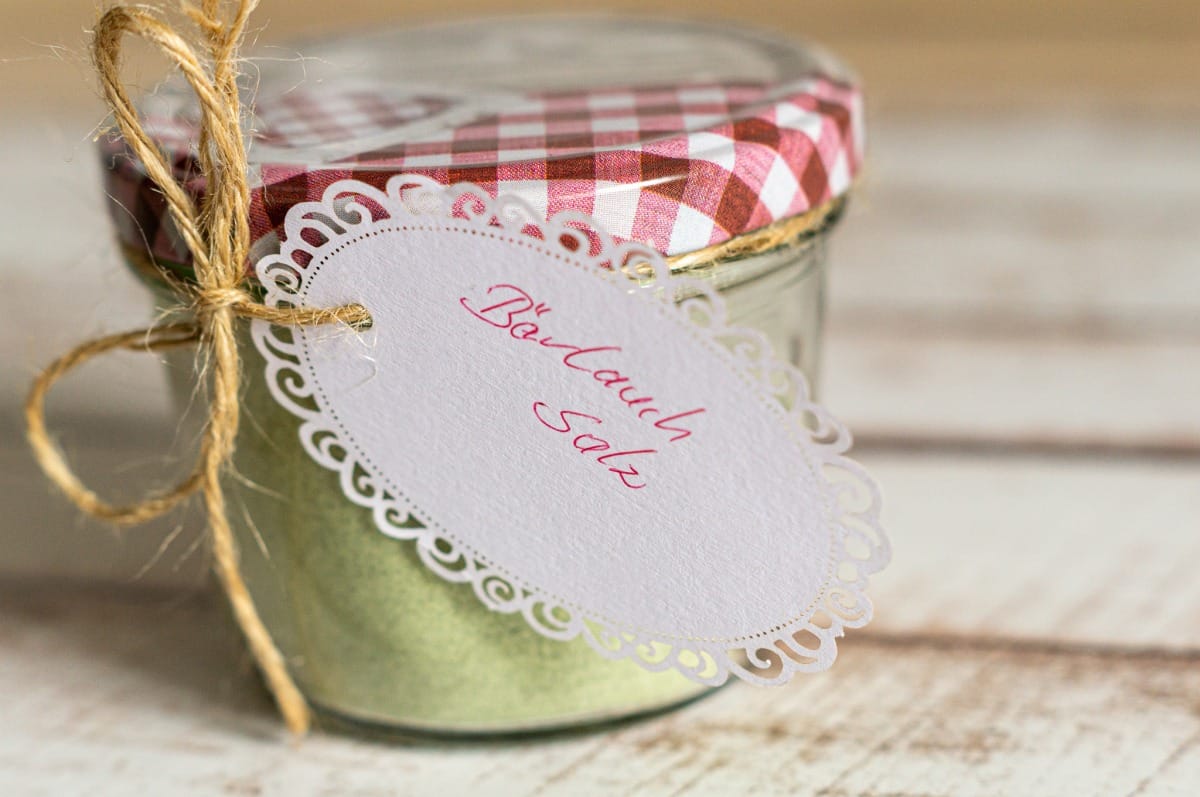
Every spring we fill three or four extra jars and give them to neighbours and family. For this we use small clip-top jars of 120 ml or decorative ceramic salt mills. The coarse salt from step 3 goes into the mill, that is, before the final grinding step. For the finely ground version as a gift, stick on a label with the ratio (50 percent wild garlic, 50 percent coarse sea salt) and a note on shelf life. Stored in a cool, dark place it keeps for a year, with the most intense flavour in the first six months.
How other recipes approach this
Goes well with: Soups.
Also worth trying: Thermomix® puff pastry.
We looked at the three most popular wild garlic salt recipes for the Thermomix® and found three clear differences. Food with Love works with a ratio of 1:2.5 (100 g wild garlic to 250 g coarse Fleur de Sel) and dries at 100 °C for one hour, which is faster but produces a flatter aroma. Zaubertopf uses 1:1 with coarse sea salt and dries at only 60 °C for 90 minutes, which is very gentle. Myfoodstory leaves the leaves to dry in the sun for two hours, which rarely works in March. We deliberately stay with 50:50 coarse sea salt and 60 °C over the full drying time, because this balance preserves the wild garlic aroma best and gives a reliably repeatable result.
More spring recipes with wild garlic and other foraged herbs can be found in our wild garlic recipes and our herb salt guide.