This vegetable stock paste made with the Thermomix® uses 150 g of salt per 1 kg of vegetables. That sounds like a lot, but the salt preserves the paste for 6 months in the fridge. In the finished stock, only the flavour comes through.
We have been making this paste regularly for years. By now we know exactly what matters: sterilised jars, the right amount of salt, and lovage as an essential ingredient. Homemade vegetable stock paste replaces shop-bought stock cubes completely. No flavour enhancers, no additives. Just vegetables, salt, and herbs.
Vegetable Stock Paste with the Thermomix®

Ingredients 0 / 8 ✓
- 300 g celeriac
- 300 g carrot
- 100 g parsley root
- 250 g leek
- 100 g onion
- 150 g salt
- 3 tsp dried lovage
- 40 g sunflower oil
Instructions 0 / 3
-
1
Prepare and chop the vegetables.
Wash, trim and cut the vegetables into 2 x 2 cm pieces, add to the mixing bowl and chop for 8 seconds / speed 7, using the spatula to push the mixture down. Scrape down with the spatula and chop for a further 5 seconds / speed 6.
-
2
Mix in the remaining ingredients.
Add the salt, lovage and oil, mix for 5 seconds / speed 5, scrape down with the spatula and mix again for 5 seconds / speed 5.
-
3
Fill the jars.
Fill the paste into sterilised preserving jars, seal and store in the fridge until needed.
Tip: Replace one teaspoon of shop-bought vegetable stock with about 1 to 2 tsp of your fresh vegetable stock paste. The flavour is incomparably better.
Nutrition per serving
Salt preserves, the vegetables do the seasoning
150 g of salt per roughly 1000 g of vegetables gives a salt content of around 15 per cent. That is the preservation threshold for 6 months’ shelf life in the fridge (source: “Das große Buch vom Einmachen”, Thorbecke Verlag 2018, pp. 142 to 145). Less salt means a shorter shelf life. With a 10 per cent salt content the paste keeps for only 6 to 8 weeks.
But the salt stays in the jar. For one portion of stock you use just 1 teaspoon of paste per 250 ml of water. That portion contains about 0.75 g of salt, which makes for a low-salt stock. Most of the salt remains in the paste and works there as a preservative, not as a seasoning.
Celeriac, carrot, and parsley root are the three pillars
Celeriac provides the savouriness. The essential oils in celeriac give the stock its main flavour. Carrot brings sweetness and balances the salt. Parsley root adds the earthy undertone that gives the stock its depth. Together these three vegetables form the classic soup stock base.
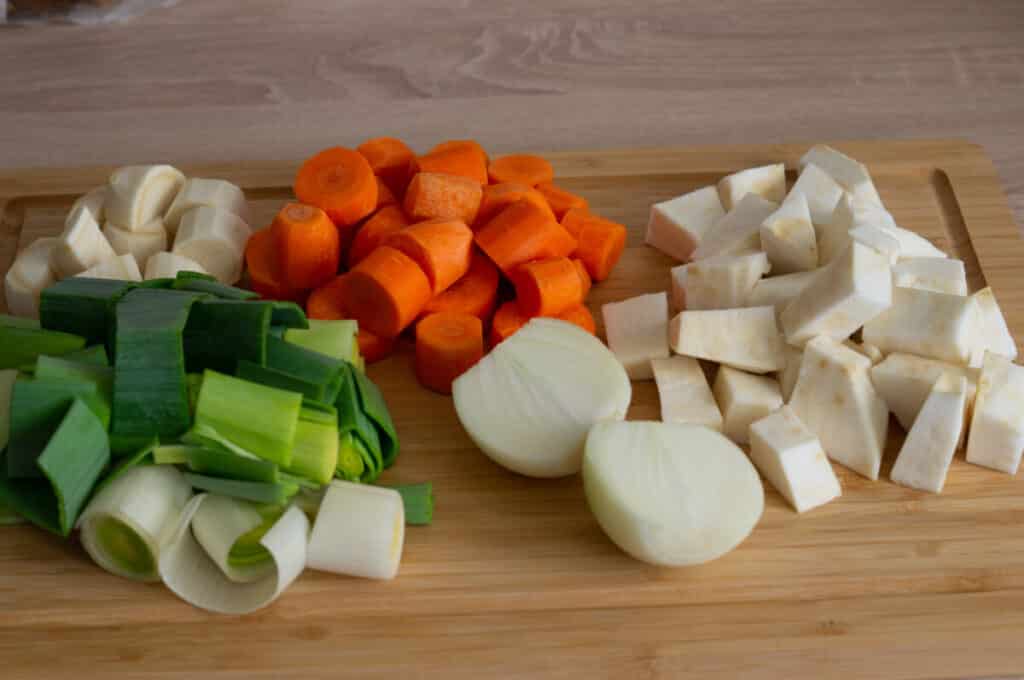
Leek and onion are aromatics, not structural ingredients. They round out the flavour, but the base comes from celeriac, carrot, and parsley root. If you leave out any one of these three, the paste is missing a whole layer of flavour.
Lovage is not optional
Lovage contains phthalides, essential oils that produce the characteristic “Maggi-style” flavour (source: “Gewürze: Eine Kulturgeschichte”, Wissenschaftliche Verlagsgesellschaft 2020, p. 287). Without lovage the paste tastes only salty and vegetably, not like stock. No other herb can do the same job.
We use dried lovage. 3 teaspoons of dried lovage are equivalent to around 6 to 8 fresh lovage stalks. Dried is more concentrated and keeps better. Fresh lovage brings more moisture into the paste and shortens its shelf life.
1 teaspoon in 250 ml of water equals 1 stock cube
The dosage for soups, sauces, and Risotto is straightforward: 1 teaspoon of paste per 250 ml of water gives a standard vegetable stock. That is equivalent to a standard shop-bought stock cube (source: Knorr product information 2024, standard stock cubes contain 10 to 11 g of salt per cube for 250 ml). For hearty stews use 1.5 teaspoons, and for children’s soups just 0.5 teaspoons because of the salt content.
The paste dissolves in hot water instantly. No stirring or waiting required. Simply add the paste to the boiling water, give it a brief stir, and it is done.
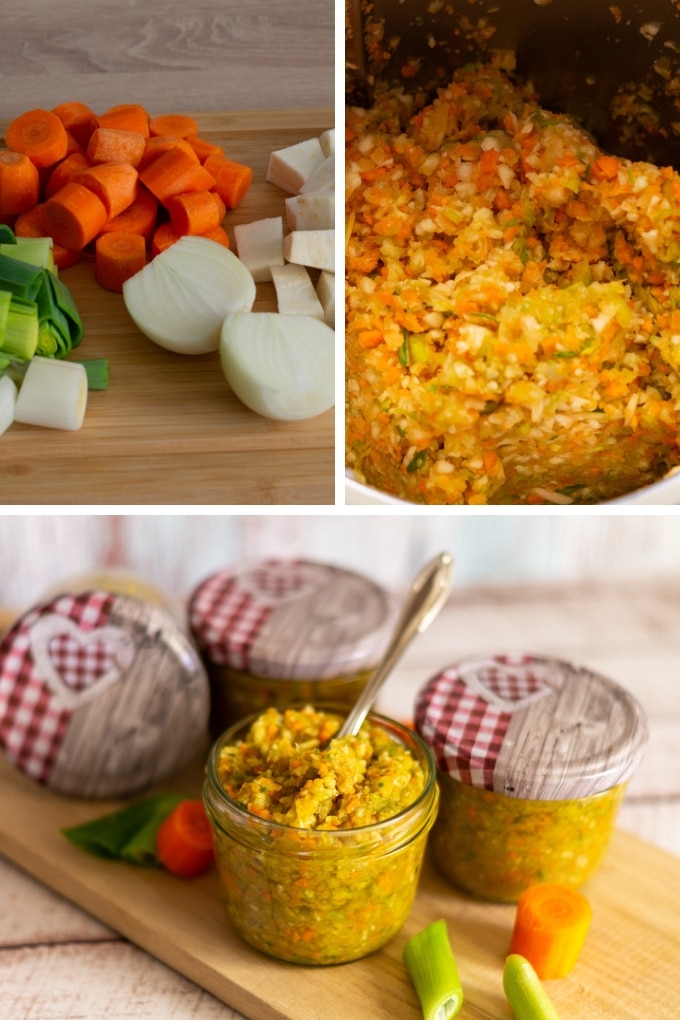
Sterilise the jars: 15 minutes in the oven at 100 °C
The paste itself is not cooked. Raw vegetables retain their vitamins and nutrients. But the jars must be sterile, otherwise mould will form after 3 to 4 weeks (source: Robert Koch Institute, “Leitfaden Lebensmittelhygiene”, updated 2023; 100 °C for 15 minutes kills vegetative bacteria and yeasts).
We sterilise the jars in the oven: 100 °C top and bottom heat for 15 minutes. Rinse the jars with hot water first, then arrange them on the oven rack. Boil the lids separately in a pan for 10 minutes. After sterilising, do not touch the insides of the jars with your hands.
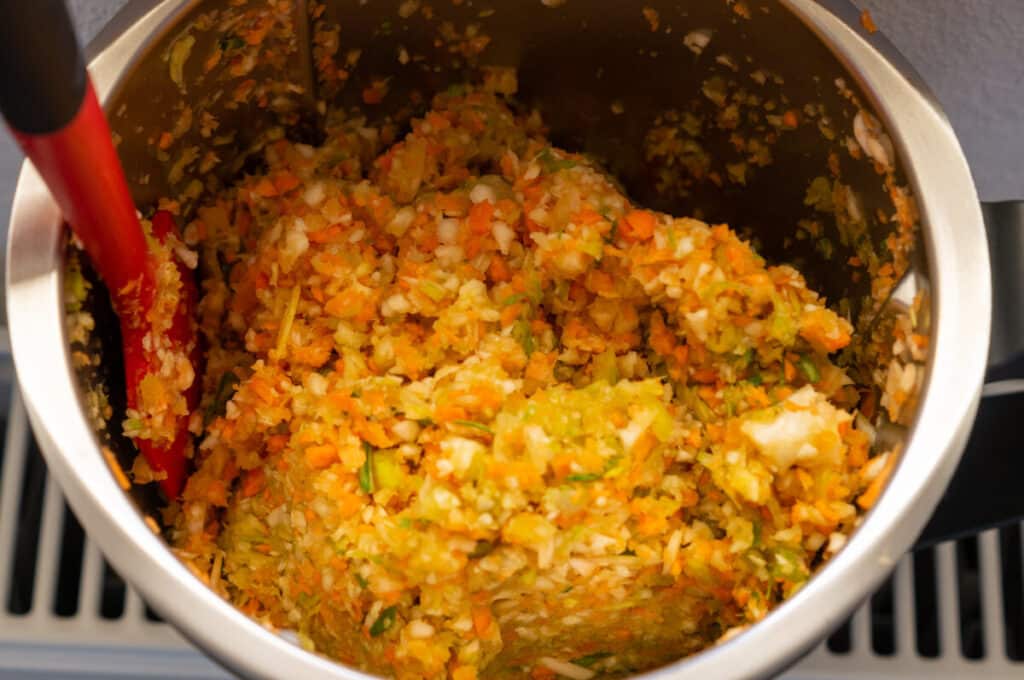
Shelf life depends on four factors
Whether the paste keeps for 6 months or goes mouldy after just 4 weeks comes down to these four points:
- Salt content of at least 15 per cent. Less salt shortens the shelf life. At 10 per cent salt content the paste keeps for only 6 to 8 weeks.
- Sterilised jars. Non-sterilised jars carry bacteria and yeasts. The paste will go mouldy after 3 to 4 weeks.
- Oil layer intact. The sunflower oil floats on top and forms an oxygen barrier. This prevents mould. If the oil layer is broken, air reaches the paste and it spoils faster.
- Always use a clean spoon. Never introduce crumbs or food residue into the jar. Any contamination shortens the shelf life.
With all four factors met, the paste keeps for 6 months in the fridge. Without sterilisation, only 6 to 8 weeks. Freezing in an ice-cube tray extends the shelf life to 12 months.
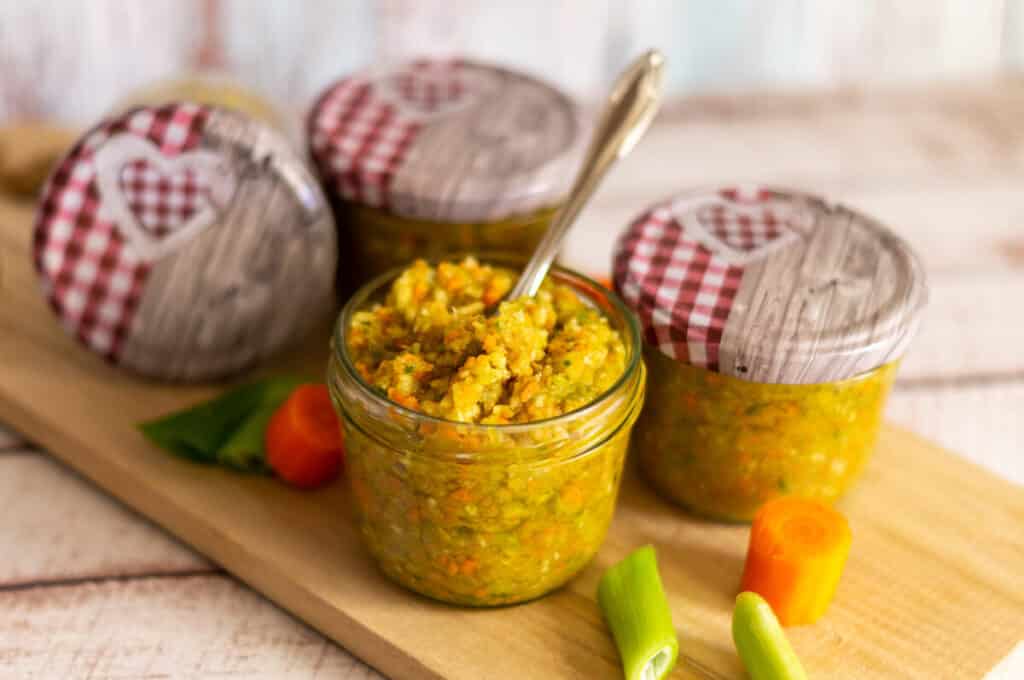
Freeze in portions rather than one large jar
For large batches, freezing makes sense. We fill the paste into ice-cube trays, 1 teaspoon per compartment. After 2 hours the cubes are frozen and can be transferred to a freezer bag. One cube equals one portion of stock for 250 ml of water.
Vegetable pastes with a high salt content remain spreadable even after thawing, thanks to the brine (source: “Haltbarmachen von Lebensmitteln”, Ulmer Verlag 2021, p. 98). Frozen paste keeps for 12 months without any loss of quality. You can add the cubes directly from the freezer to a hot pan; they dissolve as soon as they hit the heat.
The paste works identically with all Thermomix® models. The TM7, TM6, TM5, and TM31 all chop raw vegetables at speed 7 and speed 6 equally effectively. There is no difference in the settings or the result.
How this paste compares to granulated stock
A look at the ingredient list of standard granulated stock shows the difference clearly. Typical supermarket products contain yeast extract as a flavour enhancer, hydrogenated palm oil as a carrier fat, maltodextrin as a filler, and added flavourings. Our paste has 3 ingredients: vegetables, salt, and lovage. Full stop.
The cost comparison is equally clear. 1 kg of vegetables plus 150 g of salt costs us around 4 euros and yields about 700 g of paste, which is around 140 portions of stock. A 150 g tin of granulated stock at 3.50 euros gives roughly 75 portions. We pay less than half the price per cup of stock and know exactly what is in it.
Our recipe compared to Cookidoo and other versions
The official Vorwerk version on Cookidoo® uses 150 g of salt per 850 g of vegetables, which is around 12.5 per cent salt content (source: Cookidoo® recipe “Gewürzpaste für Gemüsebrühe”, accessed 2026). Other popular versions use 180 g of sea salt per kilogram of vegetables and state a shelf life of “several months” without a precise figure. We deliberately go slightly higher at 15 per cent salt and therefore guarantee a safe 6 months in the fridge, plus 12 months as ice cubes in the freezer. Shop-bought stock cubes from major brands achieve the same shelf life only with palm oil, yeast extract, and maltodextrin as carriers. Our paste achieves it with three ingredients.
We have collected more basic recipes for the Thermomix® in our basic recipes collection.
The vegetable stock paste works perfectly with these recipes: Potato Soup with the Thermomix®, Tomato Sauce Thermomix®, Vegetable Stew, Thermomix® Curry, Risotto, Thermomix® Pumpkin Soup, Gyros Soup, Pancake Soup, Tomato Soup, Leek Soup, and Cheesy Leek Soup.