When we cook white cabbage in a pot of boiling water, it almost always ends up mushy. That does not happen in the Varoma® of the Thermomix®, and the reason is straightforward: steam cooks more slowly and gently than boiling water. The leaves keep their bite, their pale colour and, above all, their own flavour, which otherwise half disappears into the stock.
We have been steaming white cabbage in the Varoma® for years, usually as a side dish with smoked pork chops or roast pork, sometimes as the base for cabbage rolls, and sometimes simply with a little butter and caraway seeds as a main course. 500 g of white cabbage leaves consistently need 25 minutes at Varoma / speed 1, with 500 g of vegetable stock in the mixing bowl below. This timing applies equally to the TM31, TM5 and TM6 because the steam temperature in the Varoma® is independent of the model.
Steamed White Cabbage in the Thermomix® Varoma®
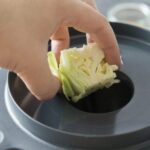
Ingredients 0 / 2 ✓
- 500 g white cabbage
- 500 g vegetable stock
Instructions 0 / 3
-
1
Prepare the cabbage.
Separate the leaves from the white cabbage, trim and wash them.
-
2
Add the stock.
Pour the vegetable stock into the mixing bowl.
-
3
Cook the cabbage.
Distribute the white cabbage leaves across the Varoma® tray and Varoma® steaming tray insert. Place the Varoma® on top and cook for 25 min / Varoma / speed 1.
Video
Nutrition per serving
Why the moment you add salt changes everything
The most important point first, because it explains most failures: we do not salt the cabbage before cooking, and we do not salt the stock either. Salt draws water out of cell walls, and that is exactly what makes white cabbage tough and rubbery. In the Varoma®, the cabbage should be absorbing moisture, not losing it. So the salt goes on after cooking, ideally together with melted butter, caraway seeds or pepper. If you are using a stock with a high salt content, dilute it or use unsalted vegetable stock instead.
This is not just a matter of taste. We have run the comparison often enough: 500 g of cabbage with salted stock alongside 500 g in unsalted stock. After 25 minutes the first batch is noticeably more compact, firmer, almost squeaky to chew. The second is soft enough to bite through but still holds the structure that tells you it is cabbage and not mash.
25 minutes is not a guideline, it is a fixed point
With a conventional pot, cooking time is a negotiation, because the water temperature can vary and pots differ in how well they retain heat. In the Varoma® there is exactly one temperature and a constant stream of steam. That is why the 25-minute rule for 500 g of white cabbage leaves works so reliably. For 1 kg of cabbage we extend the time to 35 minutes and place the thicker leaves at the bottom of the Varoma® tray, with the more delicate ones on the steaming tray insert above.
If you are unsure after 25 minutes, push a wooden skewer through a leaf at the stem. If it goes through without resistance, the cabbage is done. If it catches, simply add another 5 minutes at Varoma / speed 1. 500 g never needs longer than 35 minutes, otherwise the cabbage overcooks, loses its colour and turns watery.
Remove the core, separate the leaves
The second mistake we see often: if you place the cabbage in thick wedges in the Varoma®, you get pieces that are soft on the outside and raw in the middle, because the steam cannot reach the interior. The trick is to separate the leaves individually from the core. Take the cabbage, cut out the core in a wedge shape using a pointed vegetable knife, then peel the leaves away from the outside inwards. The first two or three outer leaves are often damaged and can go. The rest gets washed and halved once if the leaves are large.
We spread the leaves loosely across the Varoma® tray and the steaming tray insert. The steam needs gaps to circulate. If you pack the cabbage in tightly, it cooks unevenly: soft on the outside, half-raw inside. Better to do two rounds of steaming one after the other than to press everything in at once.
If the cabbage still turns out mushy
We see the same three causes come up again and again. First: pieces that are too small. If you shred the cabbage into fine strips and fill the Varoma® with them, you will have a cabbage mash after 25 minutes. For steamed white cabbage with bite, the leaves should stay whole or be halved at most.
Second: too much liquid in the mixing bowl. 500 g of stock is enough for 25 minutes of steam. Filling the bowl more risks splashing through the Varoma® lid and produces a soggier cabbage, because too much condensate drips back down. Third: salting beforehand, as already mentioned.
What we do with the finished cabbage
Straight from the Varoma® into a bowl, tossed with 30 g of melted butter and 1 tsp of whole caraway seeds, salt and pepper to taste. That is our standard side dish with bratwurst, smoked pork chops or roast pork. If you like, add a splash of apple cider vinegar at the end, which lifts the natural sweetness in the cabbage.
For cabbage rolls, pre-cooking in the Varoma® is by far the best approach, because the leaves get exactly the right pliability without tearing. Leave the whole outer leaves to cool after steaming, then flatten the thick central ribs and fill. If you want something lighter in calories, eat the cabbage plain as a low-carb side with a little mustard and diced ham, which works well as a lunch too.
We never throw away the stock from the mixing bowl. It has absorbed 25 minutes of cabbage flavour and is the perfect base for a quick cabbage and potato soup the next day. Simply add a few diced potatoes, some minced pork sausage and a portion of leftover steamed cabbage and cook for 12 min / 100°C / speed 1.
Steamed cabbage keeps for 3 days in the fridge
In a sealed container in the fridge, the white cabbage stays fresh for 3 days. When reheating, a pan with a little butter works best. Avoid the microwave, as it draws more moisture out and the cabbage loses its bite. Freezing works well with steamed white cabbage, unlike raw coleslaw. Freeze it in portions, thaw overnight in the fridge and finish briefly in a pan.
If you are steaming the cabbage as preparation for cabbage rolls, you can layer the cooled leaves flat on top of each other and freeze them. When thawed, they are just as pliable as freshly steamed, which saves half an hour of prep on the day you make the rolls.
Why steam means more vitamins and less smell with white cabbage
Goes well with: bacon and mashed potatoes.
White cabbage is packed with vitamin C, but only if that vitamin does not end up in the cooking water. With conventional boiling, up to 60 per cent of the vitamin C dissolves into the stock. When steaming in the Varoma®, most of it stays in the leaf. The same applies to the sulphur-containing glucosinolates that give cabbage its characteristic flavour. In water they get diluted; in the Varoma® they stay in the cells. That is why our Varoma® cabbage tastes more aromatic and at the same time milder in smell. Anyone who knows the strong cabbage odour from a boiling pot will notice the difference immediately: 500 g of stock in the mixing bowl evaporates slowly and under control, leaving the kitchen almost odour-free. That is, alongside bite and colour, the third reason we never cook white cabbage in an open pot anymore.
Find more basic Varoma® recipes in our Varoma® guide, matching main courses among our Thermomix® recipes, and for classic side dishes browse our side dish collection.