We bake cheesecake in the Thermomix® at least once a month. 1 minute on Dough mode for the shortcrust pastry, 30 seconds at speed 4 for the quark filling, 75 minutes in the oven: 16 slices that taste even better the next day.
This recipe is our classic for birthdays, Sunday afternoon coffee and unexpected guests. The base comes out crisp, the filling made with 1 kg of low-fat quark turns creamy, and the Thermomix® takes care of all the kneading and mixing. We show you exactly where cheesecake tends to go wrong and how to avoid it.
The perfect Thermomix® Cheesecake

Ingredients 0 / 13 ✓
- 110 grams sugar
- 1 sachet vanilla sugar
- 120 grams butter a little more to grease the mold
- 300 grams flour a little more for kneading
- 1/2 sachet baking powder
- 2 eggs
- 280 grams sugar
- 2 sachet vanilla pudding powder
- 580 grams milk
- 120 grams sunflower oil
- 4 eggs
- 5 drops lemon aroma
- 1000 grams Low-fat quark
Instructions 0 / 7
-
1
Teig.
Add all ingredients for the dough to the mixing bowl and knead for 1 min./kneading speed.

-
2
Ruhen.
Knead dough again with hands on a floured countertop, wrap in plastic wrap and refrigerate for 30 minutes.


-
3
Creme.
Add all ingredients except curd to the mixing bowl and mix for 30 sec./speed 4.
-
4
Backofen.
Add the quark and mix for 30 sec./speed 3. The filling is very liquid, but this is normal. Preheat oven to 175 °C convection heat.
-
5
Springform.
Grease springform with butter. Roll out the chilled dough on a floured countertop and place in the springform pan, making sure to raise the edges.
-
6
Füllung.
Pour the filling on the dough and bake on the middle rack of the oven for 1 hour 15 minutes. After 30 minutes of baking, cover the cake with aluminum foil. After the baking time, leave the cake in the closed oven for another 15 minutes.
-
7
Kühlen.
Do not cut the cake until it has cooled completely.


Tip: It's best to bake your cheesecake the day before and let it cool thoroughly in the refrigerator.
Nutrition per serving
1 minute on Dough mode: the Thermomix® kneads the shortcrust pastry
The shortcrust pastry is the foundation. 120 g butter, 110 g sugar, 1 sachet of vanilla sugar, 2 eggs, 300 g flour and half a sachet of baking powder go into the mixing bowl and are processed for 1 minute on Dough mode. The Thermomix® kneads the dough evenly, so you don’t have to press and crumble it by hand.
Wrap the finished dough in cling film and refrigerate for at least 30 minutes. Cold dough rolls out more easily and won’t tear when you press it up the sides of the springform tin. We press the dough about 3 cm up the sides to leave enough room for the quark filling.

30 seconds at speed 4: the quark filling becomes smooth
For the filling, add 280 g sugar, 2 sachets of vanilla pudding powder, 580 g milk, 120 g sunflower oil, 4 eggs and 5 drops of lemon flavouring to the mixing bowl and mix for 30 seconds at speed 4. Then add 1 kg low-fat quark and mix for another 30 seconds at speed 3.
Important: fold in the quark briefly and at a lower speed. Mixing for too long makes the filling runny because the quark loses its structure. 30 seconds at speed 3 is plenty. The vanilla pudding powder ensures the filling sets during baking without becoming dry or hard.
Pour the quark filling into the prepared springform tin and place it on the lower rack in the oven at 175 °C fan. Bake for 75 minutes in total, placing a sheet of foil loosely over the top after 30 minutes.
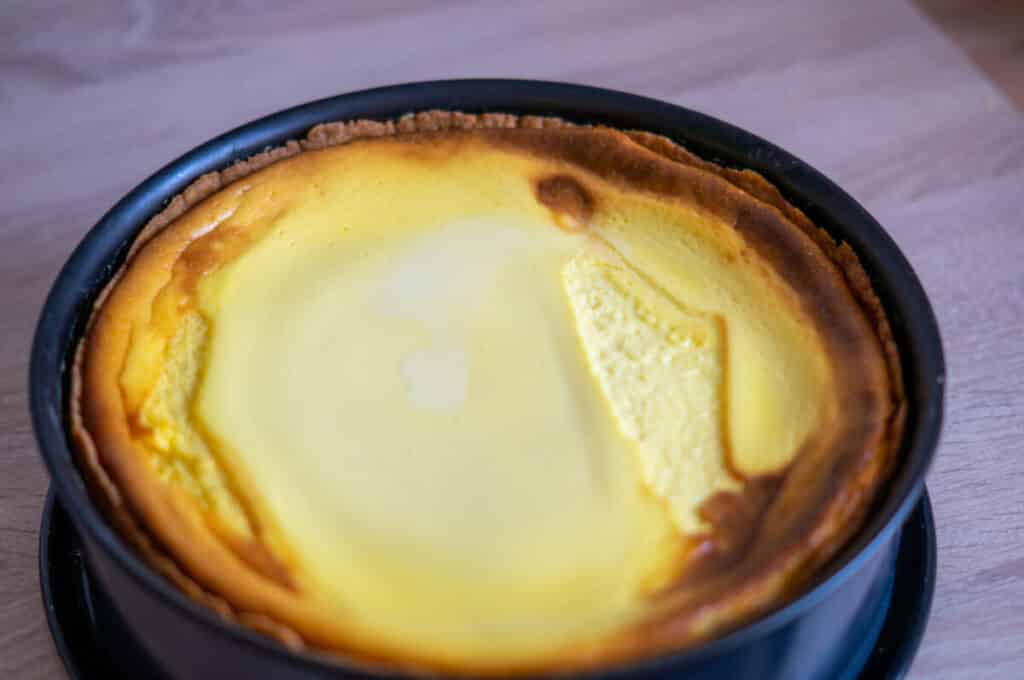
Sinking centre, cracks, soggy base: solving 3 problems
The centre sinks
This almost always happens when the cheesecake cools down too quickly after baking. The temperature difference between the hot oven and a cool kitchen causes the quark filling to collapse inward.
Our fix: After 75 minutes, switch off the oven and open the door a crack. Leave the cheesecake in the switched-off oven for at least 30 minutes before taking it out. This lets it cool slowly so the centre stays firm.
The surface cracks
Cracks form because of excessive heat or a lack of cover. The temperature also drops every time you open the oven door while baking, and the cheesecake reacts to that with stress cracks.
Our fix: After 30 minutes of baking, lay a sheet of foil loosely over the cheesecake so the surface doesn’t dry out. Keep the oven door closed for the entire baking time. An oven thermometer helps you check whether your oven actually holds the 175 °C you set. Many ovens deviate by 10 to 20 degrees.
The base turns soggy
A soft base happens when the shortcrust pastry wasn’t cold enough or the tin wasn’t prepared properly. The moist quark filling then soaks into the pastry.
Our fix: Chill the dough for at least 30 minutes. Grease the springform tin with butter and dust it lightly with flour. For extra insurance, blind-bake the base for 10 minutes at 180 °C before adding the filling.
Chocolate, berries, mandarins: 4 variations
Chocolate cheesecake: Add 2 tablespoons of cocoa powder to the quark filling and mix in at speed 4. Works especially well with a biscuit base instead of shortcrust pastry.
Berry cheesecake: Scatter 200 g of fresh or frozen berries over the shortcrust base before pouring on the quark filling. The berries sink in slightly and form a fruit layer.
Mandarin cheesecake: Drain 2 tins of mandarins and spread them over the base. Replace the lemon flavouring with orange flavouring or freshly grated orange zest.
Crustless cheesecake: If you want something quicker, skip the shortcrust pastry. Grease the springform tin, pour in the quark filling directly and bake at 175 °C for about 60 minutes. Our crustless cheesecake from the Thermomix® shows the recipe in full detail.

To cut clean slices, dip a sharp knife in hot water and wipe it between cuts. A cake server lifts the slices onto the plate in one piece without them breaking.
Zupfkuchen, Solero cake and more baking recipes
If you enjoy this cheesecake, you will also love our Russian Zupfkuchen from the Thermomix®. Similar baking method, similar texture, but with a chocolate dough. For summer we recommend the Solero cake from the Thermomix®. For an easy everyday cake, our Rührkuchen from the Thermomix® fits the bill.
Goes well with: Coffee.
Also worth a try: Cookie cups with chocolate cream.
A glass of Thermomix® advocaat goes nicely alongside. Or try the cheesecake liqueur with it. You’ll find all our other ideas in our collection of Thermomix® cake recipes.
3 days in the fridge, freeze in slices
Cheesecake keeps covered in the fridge for 3 to 4 days. We think it tastes best on the second day, when the flavours have had time to develop and the filling firms up a little. You can also freeze the cake in slices: wrap each one individually in cling film and place in a freezer bag. It keeps for up to 3 months. To thaw, leave overnight in the fridge.
Can I prepare the dough the day before?
Yes. The shortcrust pastry keeps in cling film for up to 2 days in the fridge. Before rolling it out, let it sit at room temperature for 15 minutes so it becomes pliable again.
Why does the recipe need vanilla pudding powder?
The pudding powder binds the filling during baking. Without it the quark mixture stays too soft and the cheesecake still wobbles after 75 minutes. We tested both versions: with pudding powder it turns out reliably every time.
Full-fat quark instead of low-fat quark?
It works, but the filling becomes richer and may need 5 to 10 extra minutes in the oven. Low-fat quark gives the best texture: firm enough to slice, creamy enough in the mouth. If you use full-fat quark, reduce the sunflower oil to 80 g.
Another classic recipe for the Thermomix®: rice pudding from the Thermomix®.