Beaten egg whites fail at two thresholds, both below 1%: 0.1% egg yolk contamination stops them stiffening completely, and so does 0.5% fat in the mixing bowl. Being completely fat free is not a suggestion, it is a physical requirement. We show you how to get the mixing bowl truly fat free and why speed 3.5 is exactly the right speed.
Beaten egg whites from the Thermomix® turn out in 3 minutes at speed 3.5, as long as the mixing bowl and butterfly whisk are completely fat free and no egg yolk gets into the egg white. The recipe card below shows the basic version for 3 egg whites. For meringue or larger quantities, you will find specific adjustments further down.
Whipping Egg Whites in the Thermomix®

Ingredients 0 / 2 ✓
- 3 egg whites
- 1 pinch salt
Instructions 0 / 4
-
1
Prepare mixing bowl.
The mixing butterfly whisk must be absolutely free of grease. Insert the butterfly whisk into the mixing bowl.

-
2
Separate eggs.
When separating the eggs, carefully make sure that no yolk gets into the egg whites.
-
3
Whip foamy.
Add egg whites and salt to the mixing bowl and stir for 3 minutes/speed 3.5.
- 3 egg whites
- 1 pinch salt
-
4
Add stirring time.
If the egg whites are still not firm enough, add another 1 - 2 minutes/speed 3.5 mixing time.


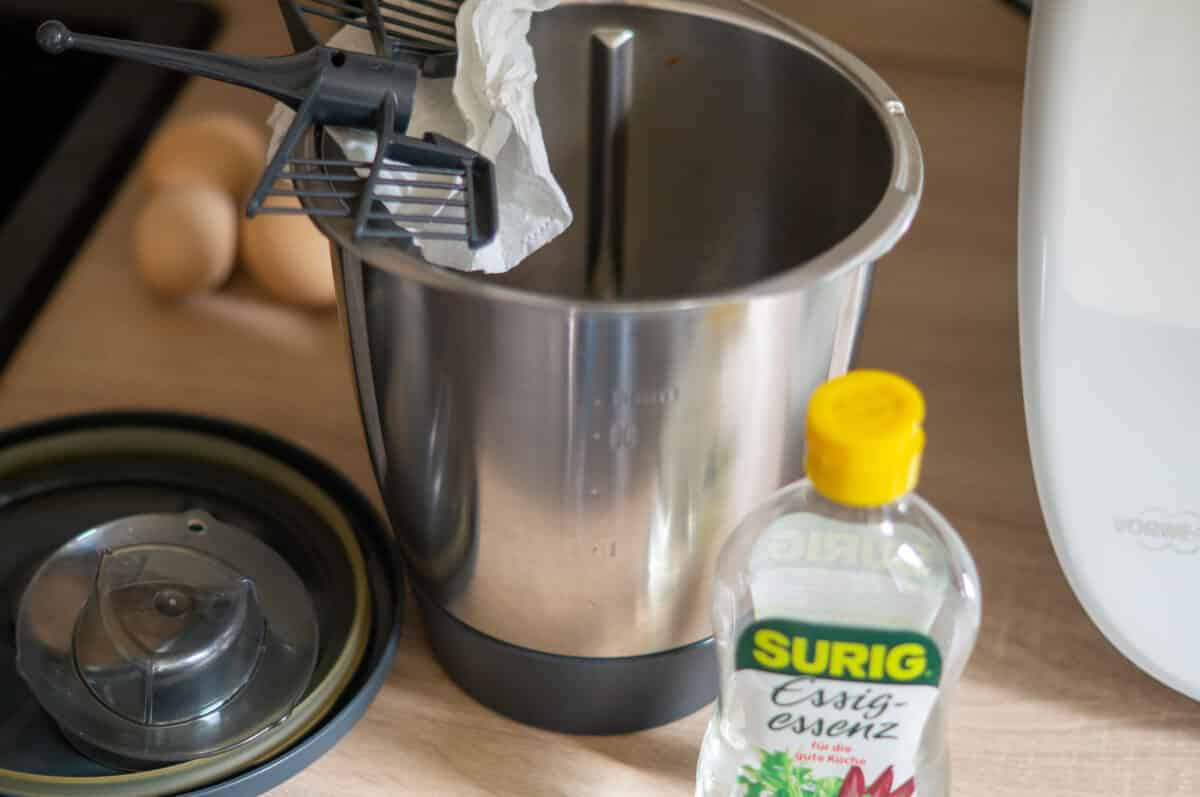
Tips: You can get the mixing bowl and butterfly whisk grease-free by wiping them down with a kitchen towel or paper towel and vinegar essence.
[caption id="attachment_59487" align="alignnone" width="300"]
You can whisk between 2 and 8 egg whites in the mixing bowl. Keep a close eye on the egg whites while whisking and adjust the mixing time if necessary!
Nutrition per serving
Why fat ruins egg whites and how to get the mixing bowl fat free
When you whip egg whites, the proteins form a foam structure through surface tension. Fat destroys that tension because fat molecules slot in between the proteins and stop them linking up. Just 0.5% fat residue in the mixing bowl is enough to keep the foam from going stiff.
We get the mixing bowl fat free with this routine: add 1 tbsp vinegar essence to 500 ml warm water, run for 1 minute at speed 4, then rinse out with hot water and rub dry with kitchen paper. Wipe the butterfly whisk separately with vinegar essence, then rinse it under hot water. The test: a drop of water on the dry base of the mixing bowl must stay round and not spread out. If it spreads, there is still fat present.
Washing-up liquid residue is just as much of a problem as fat. After the vinegar essence run, rinse thoroughly with clean water until no more suds appear. Then use the bowl straight away or leave it covered so no dust falls in.
The 0.1% egg yolk threshold: one drop stops it stiffening
Egg yolk contains lipoproteins that coat the egg white proteins and block foam formation completely. Just 0.1% egg yolk to 3 egg whites (Harold McGee, „On Food and Cooking“, 2004) is enough to keep the egg whites from going stiff. A tiny yellow drop while separating makes the whole batch of egg white unusable.
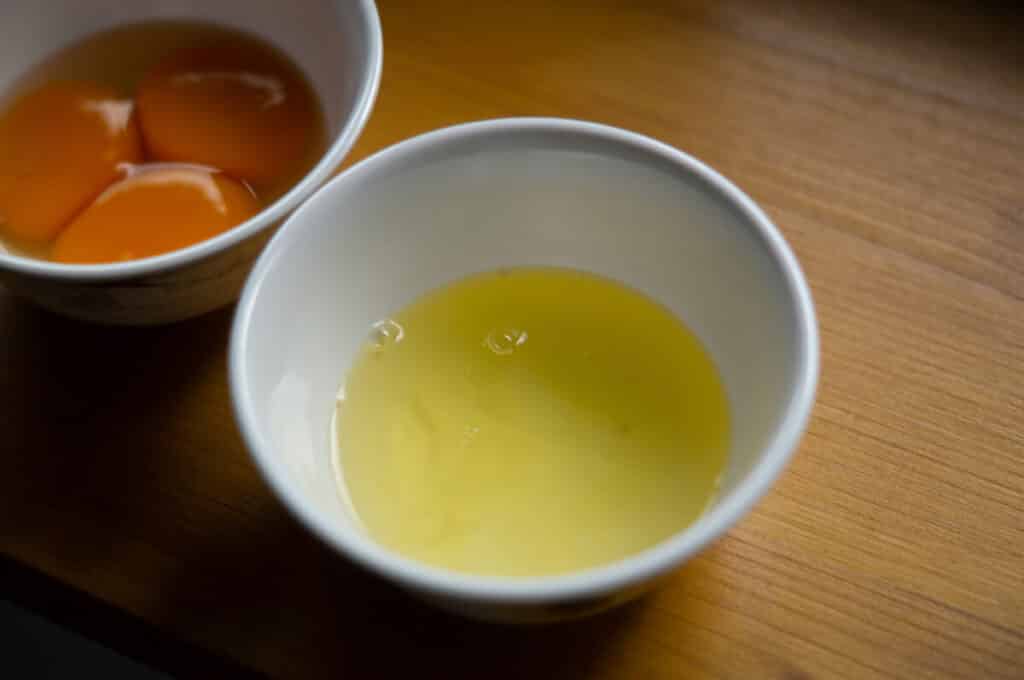
We separate eggs over a separate bowl, not directly over the mixing bowl. If egg yolk gets in, it only ruins one egg, not the whole batch. Eggs at room temperature separate more cleanly, because the yolk is firmer and does not break as easily. Eggs that are 7 to 14 days old work better than very fresh ones, because the egg white turns thinner and releases from the yolk more readily.
A stainless steel egg separator reduces the risk, but it is no guarantee. When separating by hand with the shell, never drag the sharp shell edges through the yolk. Better: crack the egg in your hand over the bowl, then gently tip the yolk back and forth between the two shell halves until all the egg white has run off.
Speed 3.5 for 3 minutes: the mechanics behind the setting
At speed 3.5, 3 egg whites take in exactly the right amount of air over 3 minutes to form fine, stable bubbles. Speed 5 or 6 would be too fast: the bubbles turn coarse, the foam becomes unstable and collapses after a few minutes. Speed 2 is too slow: the egg white goes watery instead of airy, takes twice as long and the volume stays low.
The 3 minutes are the guide value for 3 egg whites. After 2 minutes you reach soft peaks, after 3 minutes stiff peaks. If the egg whites are not stiff enough after 3 minutes, whip for 1 more minute at speed 3.5, then check again. More than 5 minutes of total time leads to over-whipping: the foam turns dry, crumbly and dull, and there is no saving it.
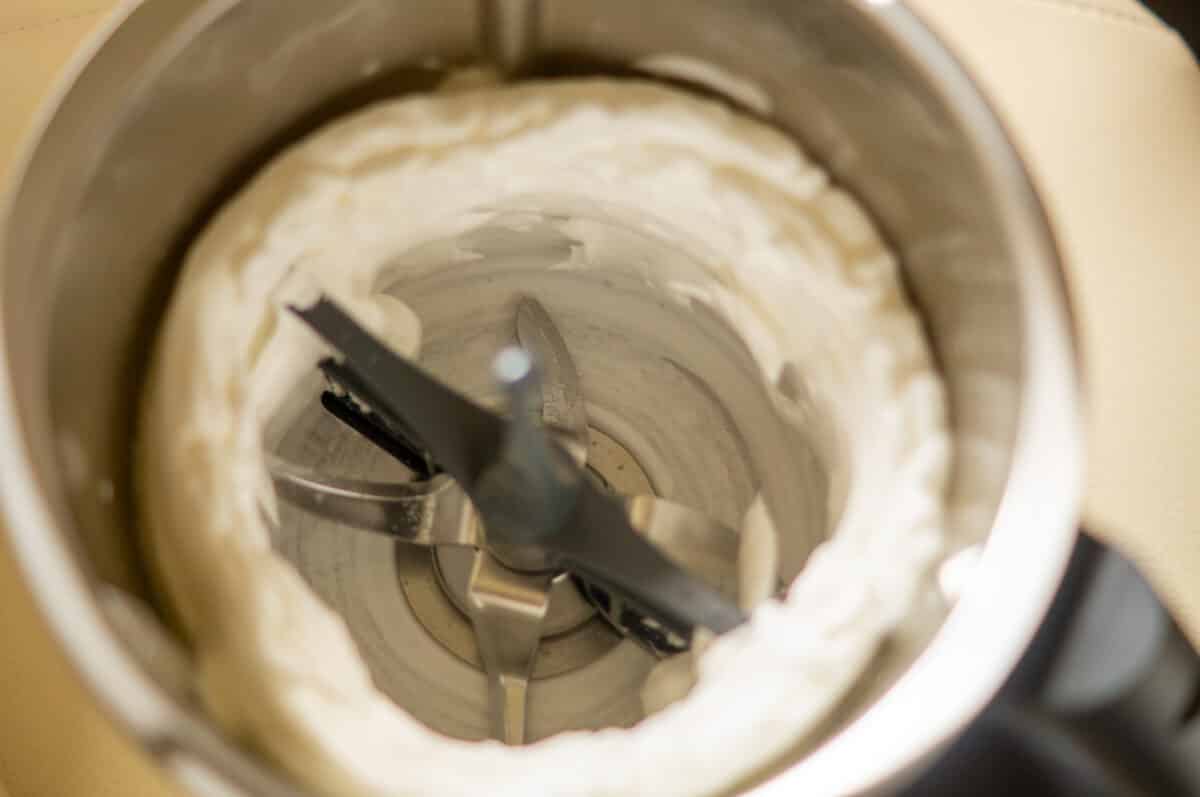
The test for stiffness: tip the mixing bowl. The beaten egg whites must not slide. Or lift out the butterfly whisk: stiff peaks hold their shape and do not flop over. The ideal is a slightly glossy foam with firm peaks. Over-whipped egg whites look matt and fall apart when you fold them in.
Salt stabilises the protein structure: why the pinch is essential
1 pinch of salt (about 0.5 g) lightly denatures the egg white proteins and makes the foam more stable. Vilém Lánský et al. showed in 2018 in the Journal of Food Science that NaCl at 0.5 to 1% concentration shortens the whipping time by 15 to 20%. Without salt it takes 1 minute longer to reach stiff peaks, and the foam is less firm.
Add the salt straight into the mixing bowl with the egg white, not afterwards. It dissolves while you whip and spreads evenly. Too much salt (more than 1 tsp to 3 egg whites) makes the foam runnier rather than firmer. The 1 pinch is the optimal amount.
As an alternative to salt, 1 tsp lemon juice or vinegar works just as well. The acid also stabilises the protein structure. Sugar (if you are making meringue) does NOT go in at the start, only after 2 minutes once the foam is already stiff. Sugar added too early does not dissolve and stays grainy, while sugar added too late reduces the volume.
The stirring attachment is standard, the butterfly whisk is the fallback
The recipe card uses the stirring attachment (the 4-blade attachment), because it whips in 20% more volume than the butterfly whisk (Thermomix manual TM6, 2019). The stirring attachment works with four broad surfaces that fold in more air. The butterfly whisk has only two narrow metal bars and folds in less air.
If you only have the butterfly whisk, that works too. The egg whites still go stiff, but have less volume and need 1 minute longer. For meringue or mousse, where maximum volume matters, the stirring attachment is the first choice. For simpler uses (folding into batter, for example) the butterfly whisk is plenty.
Always fit the attachment before the first egg white goes in, not afterwards. Fitting it later pushes air out of the foam and makes it flatter.
Maximum egg white quantity: 4 with the TM31, 6 with the TM5/TM6/TM7
The TM31 has a 2.0 litre mixing bowl (Thermomix TM31 Manual, 2004) and holds a maximum of 4 egg whites. The TM5, TM6 and TM7 have a 2.2 litre mixing bowl (TM5 Manual, 2014) and hold a maximum of 6 egg whites. Beyond that the foam spills over the rim, because the volume increases three to four fold while whipping.
For larger quantities, work in batches: whip the first batch, transfer it to a bowl, rinse and dry the mixing bowl, then whip the second batch. Gently combine both batches by hand. Do not force all the egg whites into a mixing bowl that is too small at once, that gives you a mushy foam.
The recipe card is based on 3 egg whites, because that is the most common quantity for cakes or desserts. Reckon on about 1 minute of whipping time per egg white as a guide: 4 egg whites need 4 minutes, 6 egg whites need 6 minutes at speed 3.5.
Frozen egg white: defrost completely and wait for room temperature
Frozen egg white can be whipped into beaten egg whites, but it must be fully defrosted and brought to room temperature (20 to 22°C). Cold egg white straight from the fridge takes twice as long and the foam is less stable, because the proteins are more sluggish at low temperatures.
We defrost frozen egg white overnight in the fridge, then leave it at room temperature for 30 minutes. Do not defrost it in the microwave, that denatures the proteins unevenly and makes the foam flat. Defrosted egg white behaves like fresh, as long as it has not been in the fridge for more than 2 days.
Egg white freezes easily for 3 months. Freeze it in small portions (3 egg whites per freezer bag), so you have exactly the amount you need. Label with the date and the count.
Sugar timing for meringue: trickle it in after 2 minutes
If you are making meringue or meringue mixture, add the sugar only after 2 minutes, once the foam already shows soft peaks. Sugar added too early (right at the start) does not dissolve completely and stays grainy. Sugar added too late (after 3.5 minutes) reduces the volume, because the foam is already too stiff and no longer works in the sugar crystals.
Trickle the sugar slowly through the lid opening while the Thermomix® runs at speed 3.5. 1 tbsp sugar every 30 seconds is the right pace. After the last of the sugar, keep whipping for 1 more minute until the sugar has fully dissolved. The foam turns glossy and firmer than it would without sugar.
For 3 egg whites we reckon on 150 g sugar (a 1:2 ratio). More sugar makes the foam too sweet and too heavy, less sugar will not hold together during baking.
Meringue temperature 65°C: food safety and stability
For meringue mixture that is not baked (mousse, frostings, cold desserts), heat the egg whites to 65°C. This kills off salmonella (FDA Food Code 2017: egg white must reach 60°C for 3.5 minutes) and makes the foam more heat resistant through the extra protein denaturation.
In the Thermomix®: put the egg white and salt into the mixing bowl, whip for 4 minutes at 65°C on speed 4 with the butterfly whisk fitted. The foam goes stiff and slightly warm as it whips. Once cooled, it is more stable than cold beaten egg whites and keeps for up to 4 hours in the fridge without collapsing.
Only the TM6 and TM7 offer the exact 65°C setting. With the TM31 and TM5, use the Varoma setting (about 120°C mixing bowl temperature), then whip for only 3 minutes so the foam does not turn too dry. The temperature matters more for meringue egg whites than for ordinary beaten egg whites, because raw egg white in cold desserts carries a salmonella risk.
Shelf life: a maximum of 30 minutes at room temperature
Freshly beaten egg whites last a maximum of 30 minutes at room temperature before drainage sets in (Shirley O. Corriher, „CookWise“, 1997). Drainage means: liquid separates out, the foam turns watery and collapses. Covered in the fridge, beaten egg whites keep for 2 hours, after which they are no longer usable.
Always whip egg whites fresh, right before you use them. Once beaten egg whites have collapsed, you cannot whip them up again. The protein structure is destroyed and cannot be restored.
If you have to store beaten egg whites for 10 to 15 minutes, put them in the fridge covered and gently fold them by hand before use, to spread the air bubbles evenly again. Do not re-whip them in the Thermomix®, that destroys the structure.
What we do differently with speed and attachment
Most guides (Zaubertopf, kochenkinderleicht) work with the butterfly whisk at speed 4 for 2 to 4 minutes. That works, but leaves volume on the table. We use the butterfly whisk at speed 3.5 for 3 minutes and get around 20% more volume out of the 3 egg whites (Vorwerk TM6 manual 2019). Speed 3.5 instead of 4 sounds like a detail, but it is the difference between fine, stable bubbles and a coarser foam that collapses after 10 minutes. If you only own the butterfly whisk, stick with speed 4 (speed 5 or higher destroys the attachment), but allow 1 minute more and accept the lower volume.
What we use beaten egg whites for
We use beaten egg whites in meringue, soft serve ice cream, coconut macaroons and redcurrant cake with a meringue topping. The recipes for these:
- Meringue with the Thermomix®
- Thermomix® Raspberry Soft Serve
- Solero-Style Soft Serve
- Thermomix® Coconut Macaroons
- Redcurrant Cake with Meringue Topping