Whipping cream in the Thermomix® usually goes wrong not because of the wrong speed or too little time, but because we trust the clock instead of our ears. We explain why the sound is the most reliable indicator and how the two methods work depending on the quantity.
After hundreds of batches we have learned that timings like „45 seconds at speed 3“ are misleading, because the temperature and fat content of the cream vary so much. What turns stiff in 40 seconds at 5°C might take 80 seconds at 12°C. The sound, on the other hand, never lies.
How to Whip Cream in a Thermomix®

Ingredients 0 / 1 ✓
- 200 g Cream well cooled
Instructions 0 / 1
-
1
Place the cream in the mixing bowl, insert the whisk attachment and whip on speed 3 to 4, under observation, until the desired consistency is reached.


Tip: With this recipe, you can use 200 to 600 grams of cream in one go.
Nutrition per serving
The sound method: listen instead of timing
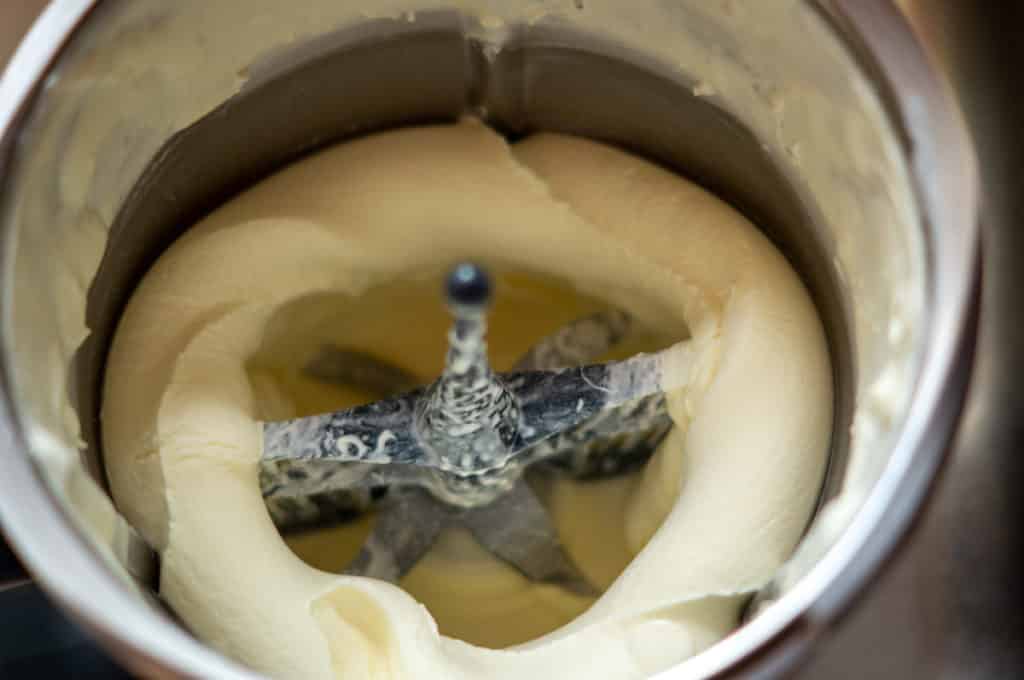
Liquid cream makes a deep sloshing noise as you whip, as though water were splashing against the wall of the mixing bowl. The moment it turns stiff, the sound changes abruptly to a high whirring or an idling noise, because the blade is suddenly cutting through air rather than liquid. This tipping point is unmistakable, and it always comes a few seconds before the cream turns to butter.
We stop the Thermomix® exactly when the whirring sets in. Better 5 seconds too early than 5 seconds too late, because the transition from stiff cream to butter takes only 10 to 20 seconds. The sound gives you a window of time, not a fixed mark.
With very cold cream (below 5°C) you hear the change earlier, with warmer cream (10 to 12°C) later. That is why blanket timings do not work. The acoustics adjust automatically to the conditions.
Two methods: stirring attachment yes or no
The quantity decides the method, not the taste. Below 400 g of cream we use the stirring attachment, above that we leave it out. The reason lies in the mechanics of the mixing bowl.
Small quantities (200 to 400 g): stirring attachment + speed 3 to 4
With small quantities the blade spins in empty space, because the cream does not sit high enough. The stirring attachment pushes the cream down and keeps it in constant contact. Speed 3 to 4 is enough, because the attachment works the cream through mechanically. Higher speeds bring no advantage, only more splashing on the lid.
This is the method from our recipe card below: 200 g of cream, fit the stirring attachment, speed 3 to 4, watch the sound. As soon as the sloshing tips over into whirring, stop.
Alternative for large quantities (from 400 g): without stirring attachment + speed 10
From 400 g the cream sits high enough that the blade stays in permanent contact even without the stirring attachment. At speed 10 the centrifugal force creates a vortex that presses the cream against the wall of the mixing bowl. The blade does not run empty, it cuts continuously through the rotating mass.
This method works up to about 700 g in a single batch. Above that the cream rises too high and splashes out of the lid opening. With 800 g or more, better to do two batches (400 g each).
TM31 special case: always the stirring attachment
The TM31 has a narrower mixing bowl (14 cm diameter instead of 15 cm like the TM5, TM6 and TM7). Even with larger quantities the blade partly runs empty, because the cream is not spread widely enough. That is why on the TM31 you should always use the stirring attachment, whether 200 g or 500 g.

Temperature is half the battle: chill 30 minutes beforehand
Milk fat crystallises below 10°C and then forms a stable foam structure. Above 15°C it stays liquid and the air bubbles collapse immediately. That is why the cream has to be cold, but not just the cream, the mixing bowl too.
We put the mixing bowl together with the cream into the fridge 30 minutes before whipping. Not 5 minutes, not 10 minutes. 30 minutes are needed so that the plastic material of the mixing bowl chills through and does not immediately give off warmth to the cream.
The stirring attachment does not need to be chilled. Metal conducts heat too slowly for the attachment to transfer any noticeable temperature during its few seconds of contact with the cream. That is pure placebo effort.
If the cream or the mixing bowl is too warm, you notice it straight away: the cream does thicken, but it never turns properly stiff. It stalls at a kind of soft-serve consistency, because the fat globules do not crystallise firmly enough. Then the only thing that helps is to put everything in the fridge for 20 minutes and whip again.
Why reduced-fat cream fails
In Germany, whipping cream must contain at least 30 percent fat by law. That is not an arbitrary limit, but a physical threshold. Below 30 percent there are too few fat globules to form a stable foam structure.
As you whip, the fat globules enclose the trapped air and stabilise the bubbles. The less fat, the fewer stabilisers. Spray cream from a can (often 15 percent fat) only works because propellant gas keeps the bubbles stable. Whipped mechanically, it collapses at once.
Reduced-fat cream (20 to 25 percent) can be whipped in the Thermomix®, but it takes longer and never gets as firm as normal cream. The consistency stays softer, almost mousse-like. For cakes or decorations that is too unstable.
Optimal is 35 to 40 percent fat. The cream turns stiff faster, holds longer and tastes fuller. In southern Germany and Austria there is often „Konditorsahne“ (pastry cream) with 40 percent, which is perfect for whipping in the Thermomix®.
When cream turns to butter: rescue or acceptance
Over-churning happens fast. The window between stiff cream and butter is only 10 to 20 seconds long. If you miss the moment, the fat globules clump together instead of trapping air. Then yellow flecks of butter float in watery buttermilk.
Immediate rescue attempt: add 2 to 3 ice cubes to the mixing bowl and mix for 30 seconds at speed 3. The ice cubes cool the mass suddenly and can re-stabilise the emulsion, if the mistake has only just happened. But this only works in the first 30 seconds after over-churning. After that the separation is too far advanced.
If the rescue fails, we accept the mistake and use the result. Skim off the flecks of butter, knead them with cold water (washing out the last traces of buttermilk) and use them as homemade butter. The buttermilk can be drunk or used for baking. No loss, just a different result.
Plant-based cream: only certain brands work
Not every plant-based cream can be whipped stiff in the Thermomix®. Ordinary oat or soya cream from the supermarket (10 to 15 percent fat) fails, because plant fat does not form a crystal structure like milk fat. It needs stabilisers such as methylcellulose or carrageenan for the foam to hold.
These products work reliably: Oatly Whippable Creamy Oat, Schlagfix (soya-based), Dr. Oetker soya whipping cream. All three contain at least 20 percent fat plus stabilisers and can be handled like normal cream.
The method is identical: fit the stirring attachment, speed 3 to 4, listen to the sound. Plant-based cream often needs 10 to 20 seconds longer than dairy cream, because the stabilisers have to kick in first. But the sloshing-to-whirring principle applies just the same.
Important: plant-based cream also has to be cold (below 10°C). The stabilisers only work at low temperature. Warm plant-based cream will not turn stiff at all.
TM31 vs TM5/TM6/TM7: the mixing bowl difference
The TM31 has a narrower mixing bowl (14 cm diameter) than the newer models TM5, TM6 and TM7 (all 15 cm diameter). That sounds like just one centimetre, but it makes a decisive difference when whipping cream.
In the TM31 the cream sits higher and narrower. Even with larger quantities (400 to 500 g) the blade partly runs empty, because the centrifugal force does not press the cream widely enough against the wall. That is why on the TM31 you should always use the stirring attachment, no matter how much cream you are whipping.
On the TM5, TM6 and TM7 the mixing bowl is wider. From 400 g of cream the mass sits high enough and wide enough that the blade stays in permanent contact at speed 10 without the stirring attachment. These three models behave identically when whipping cream, because the mixing bowl size and blade geometry are the same.
The TM7 (since 2024) has a better display and faster processor than the TM6 (since 2019), but the mixing bowl mechanics are unchanged. All recipes and methods that work for the TM6 work exactly the same for the TM7.
Sugar timing: added before it stabilises, after it loosens
Sugar before whipping (1 to 2 tbsp per 200 g of cream) binds water and stabilises the foam. The cream turns firmer and holds longer. This is the standard method for cake cream that has to sit in the fridge for several hours.
Sugar after whipping (stirred in at speed 2 for 5 seconds) gives a looser consistency and less sweetness, because the sugar is not bound into the fat structure. We use this for cream that is served straight away, for example on hot cocoa or fresh strawberries.
Vanilla sugar works just like normal sugar, but adds aroma. Icing sugar dissolves faster than granulated sugar, but it does not make the cream firmer. That is purely a question of texture when stirring it in, not of stability.
Cream stiffener: only needed for long standing time
Cream stiffener stabilises the cream over several hours, prevents it collapsing and binds any liquid that seeps out. We only use it when a cake stands in the fridge for longer than 4 hours, or in warm weather (above 20°C room temperature).
The standard dose is 1 sachet (8 g) per 500 g of cream. More does not make the cream firmer, only more artificial in taste. The cream stiffener goes into the still liquid cream, before whipping. It acts like a binding agent and changes the texture slightly (firmer, less creamy).
If the cream is eaten straight away, cream stiffener is unnecessary. Freshly whipped cream without additives tastes fuller and has a more natural consistency. We only use cream stiffener when we really need it, not as standard.
Flavouring: only after whipping
Cocoa, instant coffee, liqueur or fruit puree always go into the cream only after it is whipped stiff. Added beforehand they dilute the fat mass, and the cream will not turn stiff. This applies especially to liquid flavourings like liqueur or fruit juice.
After whipping, stir in at speed 2 for 5 seconds. No longer, or the cream collapses again. For cocoa or instant coffee, pass the powder through a sieve first so no lumps form.
Fruit puree (strawberries blended, for example) makes the cream a little softer, because it brings in water. A maximum of 50 g of puree per 200 g of cream, otherwise the consistency turns too loose. With more fruit, better to make a fruit mousse instead of flavoured cream.
Maximum 24 hours
Whipped cream keeps in the fridge for a maximum of 24 hours before it noticeably collapses. The air bubbles slowly escape, the cream turns more watery and loses volume. After 48 hours it is distinctly flatter and no longer decorative.
Freezing does not work. The emulsion breaks on thawing, the cream turns grainy and watery. Even cream stiffener does not prevent this, because ice crystals mechanically destroy the fat structure.
Freshly whipped, cream always tastes better than prepared in advance. Where possible, we whip the cream right before serving. With the sound method that takes only 40 to 60 seconds and gives the best consistency.
What Vorwerk officially recommends (and where we differ)
Vorwerk recommends speed 3 for the TM5 with 400 to 600 g of cream at 5 to 6°C, and speed 3.5 for the new TM7 with 600 to 1,400 g. In both cases the stirring attachment, not the butterfly whisk. That matches our recipe card exactly: 200 g, stirring attachment, speed 3.5. Anyone reading tips online about the butterfly whisk is confusing the Thermomix® with classic hand mixers. The butterfly whisk is meant for beaten egg whites and creamy mixtures, when whipping cream it does not press the mass cleanly against the wall and foams it more slowly.
Where we deliberately differ from Vorwerk: the minimum quantity. Vorwerk only starts at 400 g, while we whip 200 g daily for coffee or dessert. With the stirring attachment and speed 3.5 this works reliably, as long as the mixing bowl and cream are genuinely cold. This is exactly where the half-the-battle rule decides things: 30 minutes for the mixing bowl in the fridge, not just the cream. Then the ear hears the tipping point cleanly too.
Goes well with: Strawberry cake, red berry compote and hot cherries.
Our tip: chocolate custard powder, Thermomix®.
You will find more basic Thermomix® recipes in our collection: make your own vanilla sugar, butter with the Thermomix® and grinding nuts in the Thermomix®.