Bavarian coleslaw in the Thermomix® stands or falls on 8 seconds at speed 4. Any longer and the cabbage turns to mush, any shorter and it stays too coarse. The carrots bring the sweetness, the pointed cabbage the tenderness, and the white wine vinegar holds everything together without dulling the colour.
We have been making this salad for years at every barbecue. By now we know exactly: 3 seconds for the onion at speed 5, then 10 seconds for the carrots at speed 4, and finally 8 seconds for the cabbage, parsley and dressing together. Those are not approximate values. They are the exact thresholds. Go over and the result turns mushy. Go under and you get coarse chunks that absorb the dressing unevenly.
Bavarian Thermomix® Cabbage Salad

Ingredients 0 / 11 ✓
- 1 onion
- 100 grams carrots
- 400 grams cabbage
- 1/2 bunch parsley
- 30 grams white wine vinegar
- 40 grams sunflower oil
- 1 tsp medium hot mustard
- 3/4 tsp salt
- 1/2 tsp sugar
- 1/2 tsp cumin
- 1/2 tsp black pepper
Instructions 0 / 5
-
1
Peel the onion, cut in half, add to the mixing bowl and chop for 3 sec./speed 5.
-
2
Peel the carrots, cut into pieces, add to the mixing bowl and shred for 10 sec./speed 4.
-
3
Wash cabbage, remove stalk, cut into pieces and add to mixing bowl.
-
4
Wash parsley, shake dry and pluck leaves into mixing bowl.
-
5
Add remaining ingredients and chop for 8 sec./speed 4 using the spatula, transfer to a bowl and serve.
Video
Nutrition per serving
Pointed cabbage vs. white cabbage: why pointed cabbage is ready faster
Our recipe uses 400 g of pointed cabbage, and that is no coincidence. Pointed cabbage has 30 to 40 per cent less dietary fibre than white cabbage (Federal Centre for Nutrition BZfE, vegetable variety comparison 2023), which makes the leaves more tender and means they absorb the dressing noticeably faster. After one hour in the fridge the salad has marinated, and after three hours it is perfect.
White cabbage works too, but you need to allow at least twelve hours of resting time. The firmer fibres need longer before the vinegar penetrates. On the other hand, white-cabbage coleslaw keeps for five days in the fridge, whereas pointed cabbage only lasts three. Preparing the day before: use white cabbage. Serving tonight: use pointed cabbage.
8 seconds at speed 4: the line between crunchy and mushy
The final blending step, pointed cabbage, parsley and dressing together, always runs for exactly 8 seconds at speed 4 in our kitchen. The spatula pushes everything down during this step. We have done this hundreds of times, and every time we let it run for ten or twelve seconds the cabbage comes out too fine. The carrots too. The result looks more like baby food than salad.
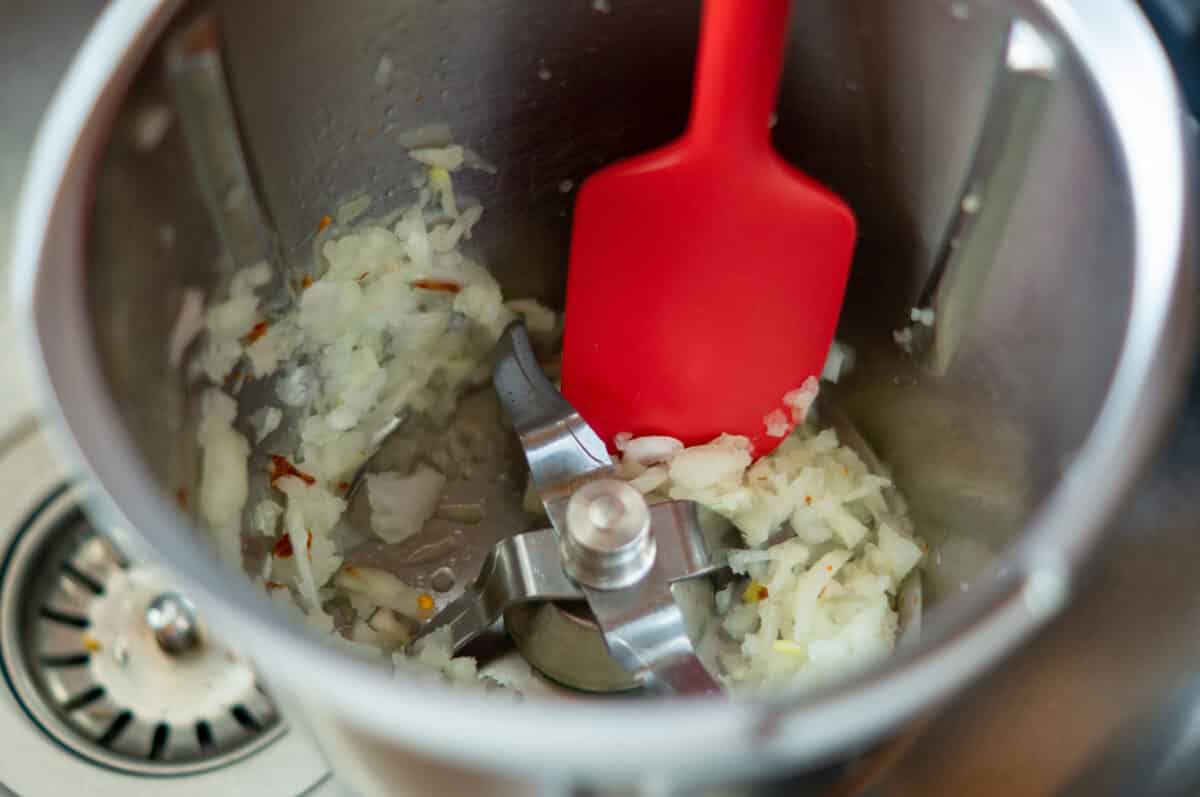
At five seconds you are left with coarse pieces. They look more rustic, but the dressing distributes unevenly. You end up with individual strips of cabbage that are still dry while others are already soaked. Eight seconds is the point where the texture is still present but every piece gets coated by the dressing.
Speed 5 instead of speed 4 only works if you deliberately want coarser pieces. That gives you more of a rustic farmhouse-salad style. For classic Bavarian coleslaw, stay at speed 4.
Serve straight away or leave to rest: what actually happens
The salad is perfectly fine to serve immediately after the final blending step. But one hour in the fridge changes the texture noticeably. The cabbage softens, not to mush, but less crunchy. The vinegar works deeper into the fibres. The result tastes more rounded, less sharp.
Served fresh you get a crunchy bite and a sharp vinegar accent. After three hours the flavour becomes rounder, the onion milder, the carrots sweeter. Both versions are perfectly valid. We prefer three hours of resting time because by then the salad is no longer a collection of separate components but a cohesive whole. That said, if your guests have already arrived and you cannot wait: serving straight away works fine too.
White wine vinegar, not balsamic: the vinegar decision
Our recipe calls for 30 g of white wine vinegar. That is the mild option. White wine vinegar has 5 to 6 per cent acidity (Max Rubner Institute, food preservation 2022), which lifts the sweetness of the cabbage without overpowering it. The salad stays pale and the carrots keep their colour.
Apple cider vinegar works too, but the result turns fruitier and sweeter. If you use apple cider vinegar, reduce the sugar to a pinch, otherwise the salad tips into dessert territory. Dark balsamic is too dominant. It colours the cabbage brown and masks everything else. White balsamic works as a compromise but is less traditional. For Bavarian coleslaw, stick with white wine vinegar.
Cumin is not Bavarian: the caraway truth
The recipe card calls for half a teaspoon of ground cumin. That works and tastes earthy and warm, but it is not traditionally Bavarian. Authentic Bavarian coleslaw uses whole caraway seeds, Carum carvi, not Cuminum cyminum (Society of German Chemists, spice glossary 2021). Both belong to the Apiaceae family, but the flavour is not interchangeable.

If you want authenticity: take half a teaspoon of whole caraway seeds, toast them briefly in a dry frying pan until they are fragrant, and then add them to the dressing. That is the version your Bavarian grandmother would recognise. Cumin is the modern shortcut. It tastes good, but it takes the salad in a different direction.
With bacon, served warm: the version for cold days
Once you have the base recipe ready, you can turn it into a bacon version. Cut 100 g of streaky bacon into cubes, put 10 g of butter into the empty mixing bowl, add the bacon, and cook for 3 minutes at Varoma temperature, speed 1. The bacon fries and the fat melts. Pour the warm bacon fat over the cold coleslaw and serve immediately.

Alternatively, fry the bacon separately in a pan if you want it crispier. The Thermomix® produces softer bacon, almost confit-style. Both versions work. Served warm, this becomes a completely different category of coleslaw, especially good in winter.
Avoiding a watery salad: add salt in the dressing, not beforehand
Salt draws water out of cabbage. One teaspoon of salt on 500 g of cabbage pulls out roughly 50 to 80 ml of water through osmosis within 30 minutes (Harold McGee, On Food and Cooking 2004, p. 283). If you salt the cabbage in advance and let it sit, it shrinks and the water collects at the bottom of the bowl. That is useful for sauerkraut but bad for coleslaw.
Our recipe adds salt directly in the dressing, three-quarters of a teaspoon together with vinegar and oil. That is the right approach. Vinegar and oil bind the water and the cabbage stays crunchy. If you still want to salt in advance, for example to soften the cabbage a little, you must squeeze it after 30 minutes and pour off the water. Otherwise the salad will be swimming in liquid.
One pot, no fuss: everything in the mixing bowl
Onion in, 3 seconds at speed 5. Carrots in, 10 seconds at speed 4. Pointed cabbage and parsley in, add the dressing ingredients, 8 seconds at speed 4 with the spatula. Done. No separate bowl until the very end. Everything happens in the mixing bowl. That is why this salad comes together so quickly. Most recipes made without the Thermomix® require a grater, a knife and a large mixing bowl. We only need the mixing bowl.
This works on all models: TM7, TM6, TM5, TM31. No temperature, no automatic programmes, just mechanical chopping. Even the TM31 from 2004 handles it without any trouble.
Storage and fridge time windows
The acidity of 3 to 4 per cent at pH 3.5 to 4.0 preserves coleslaw for up to five days at 4 degrees Celsius in the fridge (DLG quality guide for delicatessen salads 2020). After three days the texture is at its best: the cabbage is soft enough but not mushy. After five days it becomes very soft and the vinegar tastes sharper. Freezing is not possible as the cabbage turns to mush on thawing.
If you are making a larger batch: on the day you prepare it the salad is at its crunchiest, days two and three are the prime window, and from day four onwards it softens. Plan accordingly. If you do meal prep on Sunday you can eat it through to Thursday, after that it gets borderline.
Adjusting the carrot ratio
The recipe card says 100 g of carrots. That is the base sweetness level. If you want more colour, use 150 g of carrots, but then reduce the sugar to a pinch or leave it out entirely. Carrots bring their own sweetness, and at 150 g the salad will otherwise turn too sweet. Conversely, if you leave the carrots out altogether, the salad becomes more tart. In that case, add half a teaspoon more sugar to the dressing to compensate.
Warm marinade at 37 °C: the sugar dissolves completely
One detail most coleslaw recipes skip: sugar does not dissolve completely in cold vinegar. With 30 g of white wine vinegar and a teaspoon of sugar you would otherwise find small crystals in the dressing and at the bottom of the bowl later. Our trick in the Thermomix®: warm the vinegar, oil, salt and sugar for 2 minutes at 37 °C on speed 2 before adding the vegetables. The dressing turns clear, the sugar dissolves completely, and when you blend everything together later it distributes evenly over every strip of cabbage.
If you prefer it a little sweeter in the traditional way, you can add half a grated apple to the final blending step. The apple brings fruity sweetness, replaces some of the sugar and pairs perfectly with a Brotzeit spread of pretzels, Obatzda or Leberkäse. For 400 g of pointed cabbage, half a Boskoop apple is enough, otherwise the salad tips too sweet.
How does our recipe compare to Cookidoo and Zaubertopf?
The official Cookidoo recipe uses 300 g of white cabbage with white balsamic vinegar and no caraway. Zaubertopf goes with 400 g of white cabbage, apple cider vinegar and a teaspoon of caraway. Both versions work, but they require a long resting time for the firm white cabbage to soften. We take a different approach with 400 g of pointed cabbage and white wine vinegar: more tender leaves, ready after one hour, carrots for sweetness instead of extra sugar, and either cumin or whole caraway depending on your preference. The result stays pale, fresh and suits a last-minute Brotzeit, not just something you have to prepare the day before.
Goes well with: Pretzels.
More salad recipes: Coleslaw with honey bacon, Pointed cabbage and celery salad, Carrot spread.